


Overview
The Stuart House is a form of post-war non-traditional housing developed between 1946 and 1950 by Stuart & Sons (Housing) Ltd. Around 2,500 properties were constructed, primarily in suburban locations across the UK, as part of the wider effort to address housing shortages following the Second World War.
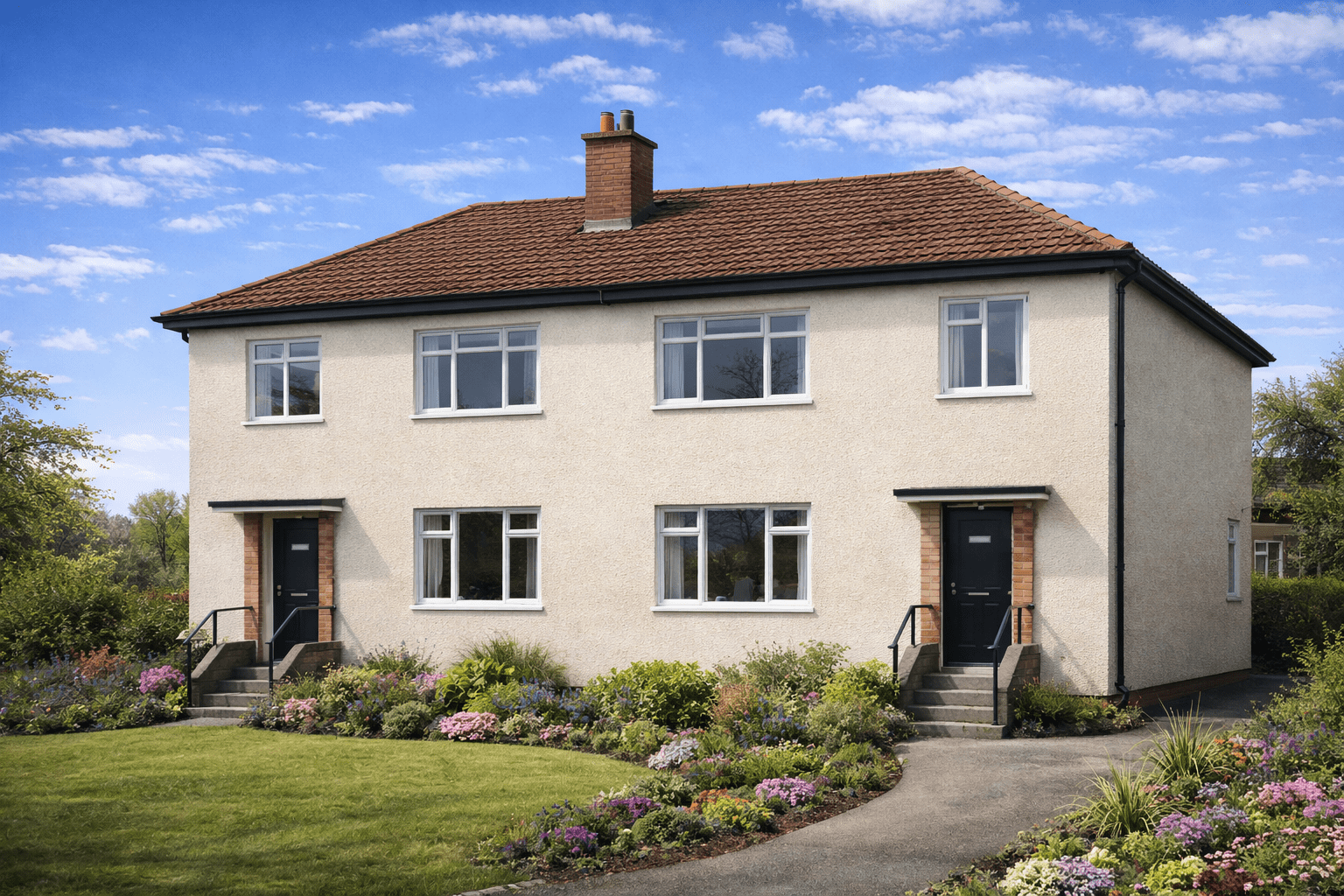
Stuart Houses are generally two-storey semi-detached or terraced properties, recognised for their harled external walls and steel-framed structural system.
Typical characteristics & construction
Stuart Houses are usually two-storey dwellings of semi-detached or terraced form. Roofs are medium pitch and hipped, finished with concrete tiles, with a flat canopy commonly formed above the main entrance.
External walls are constructed using a combination of brickwork and timber framing, finished externally with harling or roughcast. Internally, walls are lined with plasterboard over insulating paper.
Separating walls are generally rendered block cavity construction, while internal partitions are timber stud with plasterboard linings.
| Element | Typical construction | Inspection focus |
|---|---|---|
| Substructure | Concrete strip footings with brick piers | Settlement, cracking, bearing to stanchions |
| Frame | Double RSA steel corner stanchions | Corrosion, especially at bases |
| External walls | Harled brick and timber framing | Cracking, damp penetration, finish condition |
| Floors | Tongue-and-groove boarding on lattice joists | Deflection, corrosion to steel components |
| Roof | Timber rafters, sarking, felt and concrete tiles | Tile security, water ingress, timber condition |
Potential hazards & inspection priorities
The most significant risk in Stuart Houses relates to corrosion of the RSA steel stanchions, particularly at their bases and around ground floor lattice beams. This was evident during inspection in many examples of this construction type and can affect structural performance if left unmanaged.
Cracking is also commonly observed, particularly to flank walls and between ground floor window heads and first floor window sills. In practice, this often reflects movement within the structural frame and requires careful assessment.
Is this house right for you?
Stuart Houses can perform satisfactorily where maintenance has been consistent and earlier repairs have been properly detailed. However, purchasers should be prepared for ongoing monitoring and targeted remedial works where corrosion or movement is identified.
- Commission a full building survey
- Assess prior repair history carefully
- Budget for future steel protection or repair works
Mortgage & resale considerations
Lender acceptance for Stuart Houses can vary depending on condition and the clarity of professional reporting. Documented evidence of inspection, repair, and corrosion management is often influential in mortgage and resale decisions.
What a survey can — and cannot — tell you
A building survey provides an informed assessment of the visible condition and construction of a Stuart House. Inspections are non-intrusive and limited to areas that are accessible at the time of inspection.
- Identify visible corrosion to RSA stanchions and steel beams
- Assess cracking patterns to external walls and internal finishes
- Comment on roof coverings, drainage, and envelope condition
- Review accessible floors, ceilings, and structural elements
- Highlight defects requiring repair, monitoring, or further investigation
However, there are limitations to what a survey can determine without intrusive investigation.
- Confirm the condition of concealed steelwork within walls
- Assess hidden junctions between steel and masonry
- Determine the full extent of corrosion behind finishes
- Inspect inaccessible or covered areas
Where higher-risk indicators are identified, further specialist or intrusive investigation may be recommended.
For a thorough building survey in Greater London, an instant quotation can be obtained through the online survey calculator.
Considering a Stuart House?
A detailed building survey can help clarify construction-specific risks before committing to a purchase.
Get your instant survey quoteDisclaimer: This article is provided for general educational purposes only and is based on industry research, professional knowledge, and experience. It does not relate to any specific property and should not be relied upon when making a purchasing decision. Prospective purchasers should always commission an independent RICS-qualified surveyor to conduct a full inspection and provide a report on the actual condition of any property of interest.
