


Overview
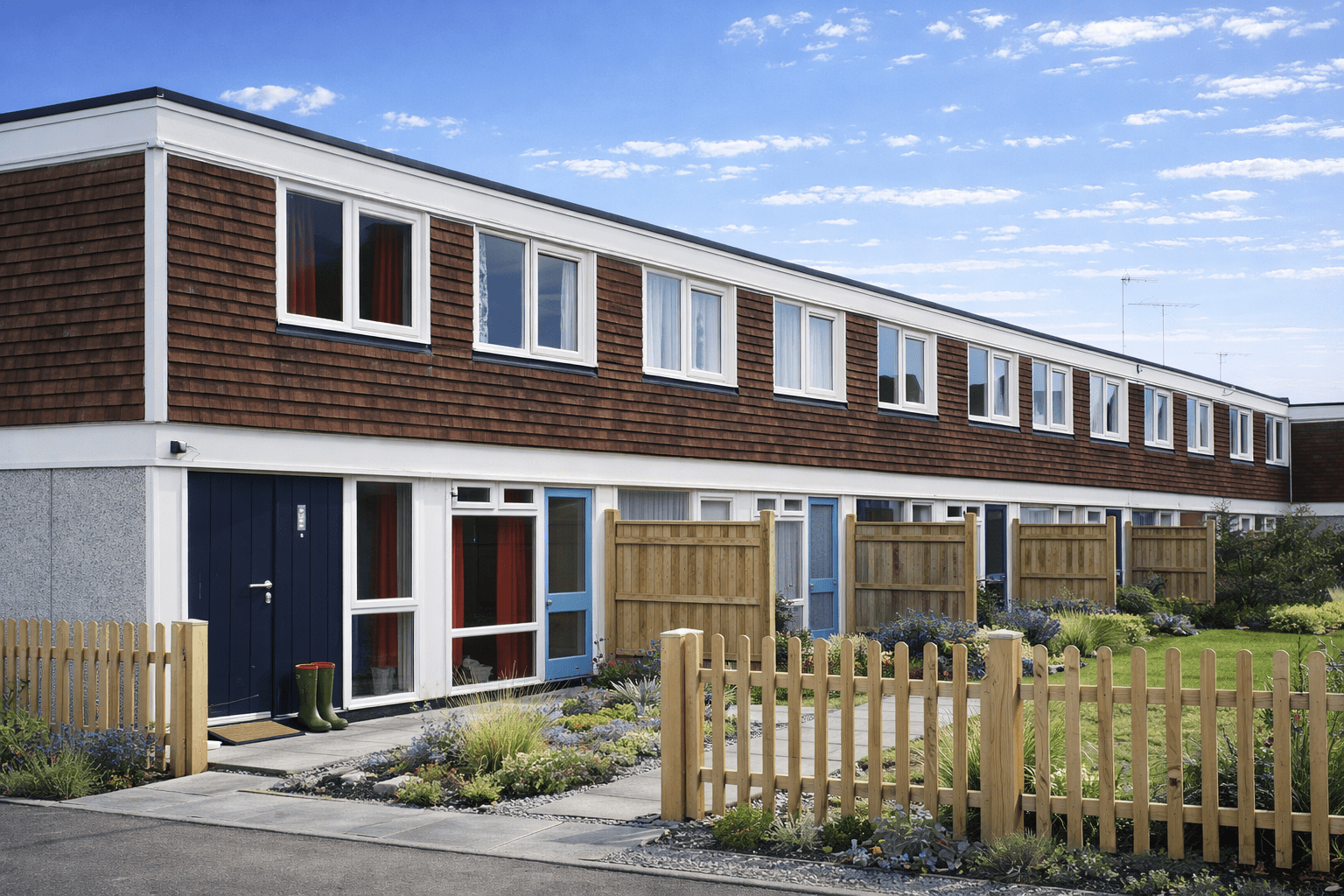
The MOHLG 5M house, also known as the CLASP 5M, is a system-built property type developed during the 1960s by the Ministry of Housing & Local Government Development Group. Construction took place between 1963 and 1970, with approximately 3,500 dwellings built in a range of bungalow, two-storey, and three-storey configurations.
These properties were designed to address post-war housing shortages through rapid construction methods. While innovative at the time, the construction approach results in a number of recurring inspection considerations today.
MOHLG 5M houses are non-traditional system-built dwellings dating from the 1960s, incorporating steel stanchions, timber framing, precast concrete elements, and flat asphalt roofs.
Typical characteristics & construction
MOHLG 5M houses are system-built using a structural frame of RS hollow box steel stanchions supporting composite floor and roof beams. External walls combine timber framing, precast reinforced concrete panels, and asbestos cement sheathing depending on elevation and storey level.
Roofs are flat in form and finished with asphalt over plywood decking, with mineral fibre insulation beneath. Internally, walls and ceilings are generally plasterboard-lined, with mineral fibre insulation used within wall cavities.
| Element | Typical construction | Inspection focus |
|---|---|---|
| Substructure | Concrete slab with raised perimeter kerb | Cracking, movement, carbonation |
| Structural frame | RS hollow box steel stanchions and composite beams | Corrosion at bases, shim packing |
| External walls | Timber frame, PRC panels, asbestos cement sheathing | Decay, cracking, spalling, insulation performance |
| Roof | Flat roof with plywood deck and asphalt covering | Cracking, drainage, water ingress |
Potential hazards & inspection priorities
Primary inspection concerns relate to corrosion of steel stanchions, carbonation of concrete kerbs, and deterioration of precast concrete panels. Timber decay is frequently encountered to perimeter beams and lower cladding zones.
Asbestos-containing materials are commonly present within external sheathing, fascia panels, ceilings to passageways, and fire protection strips, requiring careful management.
Is this house right for you?
Purchasers should be aware that MOHLG 5M houses require a construction-aware assessment. Condition can vary widely depending on maintenance history, exposure, and any previous remedial works.
- Commission a full building survey
- Assess evidence of past repairs or alterations
- Consider long-term maintenance obligations
Mortgage & resale considerations
Lender acceptance for system-built housing depends on construction type, condition, and clarity of professional reporting. Documented repairs and clear inspection findings are influential factors.
What a survey can — and cannot — tell you
A building survey provides an informed assessment of the visible condition and construction of a MOHLG 5M house. Inspections are non-intrusive and limited to areas that are accessible at the time of inspection.
- Identify visible cracking to precast concrete panels and associated finishes
- Assess signs of dampness, moisture ingress, and condensation risk
- Comment on roof coverings, drainage details, and external envelope condition
- Review the general condition of accessible floors, ceilings, and structural elements
- Highlight defects that may require repair, monitoring, or further investigation
However, there are limitations to what a survey can determine without intrusive investigation.
- Confirm the condition of concealed steel reinforcement or stanchion bases
- Assess hidden structural elements behind finishes or linings
- Determine the full extent of carbonation or internal concrete deterioration
- Inspect areas that are inaccessible or covered at the time of inspection
Where higher-risk indicators are identified, further specialist or intrusive investigation may be recommended.
For a thorough building survey in Greater London, an instant quotation can be obtained through the online survey calculator.
Considering a MOHLG 5M house?
A detailed building survey can help clarify construction-specific risks before committing to a purchase.
Get your instant survey quoteDisclaimer: This article is provided for general educational purposes only and is based on industry research, professional knowledge, and experience. It does not relate to any specific property and should not be relied upon when making a purchasing decision. Prospective purchasers should always commission an independent RICS-qualified surveyor to conduct a full inspection and provide a report on the actual condition of any property of interest.
