


Overview
The Wimpey No-Fines house is a form of post-war non-traditional housing developed in response to acute housing shortages following the Second World War. Constructed by George Wimpey & Co. Ltd between the 1940s and the 1970s, approximately 300,000 units were built across the UK, forming a significant part of the national housing stock.
These properties are also known by several alternative names, including Butterfly, Butterfly No-Fines, Formwall, Gateshead Butterfly, Gateshead No-Fines, Wimpey, and Wimpey W6M.
Wimpey No-Fines houses were designed to allow rapid and economical construction using no-fines concrete, a material that omits fine aggregates such as sand. This approach reduced material demands while enabling large-scale housing delivery.
Wimpey No-Fines houses were developed as a widely adopted post-war housing solution and remain a common non-traditional construction type across many parts of the UK.
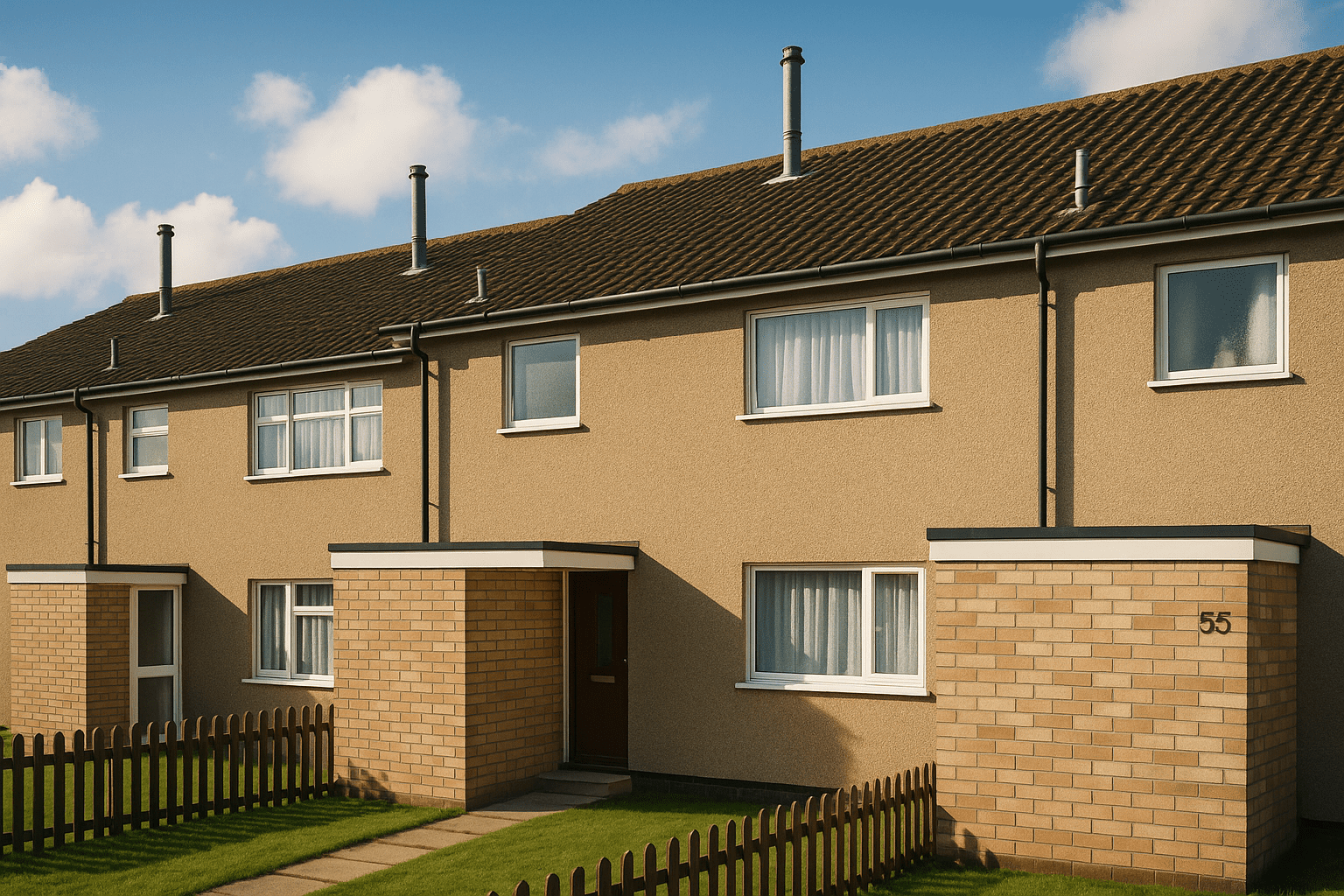
Typical characteristics & construction
Wimpey No-Fines houses were constructed in a range of forms, including bungalows, two-storey semi-detached houses, and terraced dwellings. Roofs are typically medium-pitched hipped or gable designs covered with tiles, although some examples incorporate flat or shallow valley roofs finished with bituminous felt or asphalt.
External walls are generally rendered throughout, or rendered to the front and rear elevations with brickwork to the flank wall. Some properties incorporate front bay windows. The internal layout typically includes timber stud partitions lined with plasterboard.
| Element | Typical construction | Inspection focus |
|---|---|---|
| Substructure | Concrete strip footings, brick under-building, concrete slab and DPC | Settlement, cracking, damp-proof course continuity |
| External walls | 10-inch no-fines reinforced concrete with horizontal tie reinforcement | Vertical and horizontal cracking, render condition, carbonation |
| Separating walls | 10-inch no-fines reinforced concrete | Cracking, movement, soundness |
| Floors | Concrete ground floor; timber first floor on joists and metal corbels | Deflection, dampness, timber condition |
| Roof | Timber rafters, purlins, tiled or felt-covered roof | Covering condition, water ingress, structural integrity |
Potential hazards & inspection priorities
Vertical cracking to no-fines concrete external walls is a common defect, often accompanied by horizontal cracking to render above window drips. Corrosion and scarcity of wall ties to brick cladding, where present, can also be an issue.
Dense reinforced concrete ring beams may exhibit varying levels of carbonation, while the porous nature of no-fines concrete can increase susceptibility to damp and moisture ingress. Flat or shallow valley roofs are at risk of water pooling and membrane failure, potentially leading to internal water damage.
Is this house right for you?
Wimpey No-Fines houses may suit purchasers who understand non-traditional construction and are prepared to assess the property based on its individual condition, age, and maintenance history.
- Commission a detailed building survey
- Review evidence of repairs and ongoing maintenance
- Consider the implications of concrete construction and moisture risk
Mortgage & resale considerations
Wimpey No-Fines houses are not generally classified as defective under the Defective Premises Act. However, lender acceptance can depend on condition, repair history, and the clarity of professional reporting.
Clear documentation, evidence of maintenance, and identification of any unresolved defects are commonly influential factors in mortgage and resale considerations.
What a survey can — and cannot — tell you
A building survey provides an informed assessment of the visible condition and construction of a Wimpey No-Fines house. Inspections are non-intrusive and limited to areas that are accessible at the time of inspection.
- Identify visible cracking to no-fines concrete walls and associated render
- Assess signs of dampness, moisture ingress, and condensation risk
- Comment on roof coverings, drainage details, and external envelope condition
- Review the general condition of accessible floors, ceilings, and structural elements
- Highlight defects that may require repair, monitoring, or further investigation
However, there are limitations to what a survey can determine without intrusive investigation.
- Confirm the condition of concealed reinforcement within no-fines concrete
- Assess hidden structural elements behind finishes or linings
- Determine the full extent of carbonation or internal concrete deterioration
- Inspect areas that are inaccessible or covered at the time of inspection
Where higher-risk indicators are identified, further specialist or intrusive investigation may be recommended.
For a thorough building survey in Greater London, an instant quotation can be obtained through the online survey calculator.
Considering a Wimpey No-Fines house?
A detailed building survey can help clarify construction-specific risks before committing to a purchase.
Get your instant survey quoteDisclaimer: This article is provided for general educational purposes only and is based on industry research, professional knowledge, and experience. It does not relate to any specific property and should not be relied upon when making a purchasing decision. Prospective purchasers should always commission an independent RICS-qualified surveyor to conduct a full inspection and provide a report on the actual condition of any property of interest.
