


Overview
When considering a property purchase in the UK, understanding the history, construction, and inherent risks of the building type is essential. The Whatling house is a non-traditional form of post–First World War housing that is still encountered in parts of the country today. A clear understanding of how these houses were built, and where defects commonly arise, is central to making an informed assessment.
Whatling houses were manufactured by J H Whatling Ltd and constructed primarily between 1919 and the 1930s. Around 500 units were built, largely within suburban developments formed to address post-war housing shortages.
Typical characteristics & construction
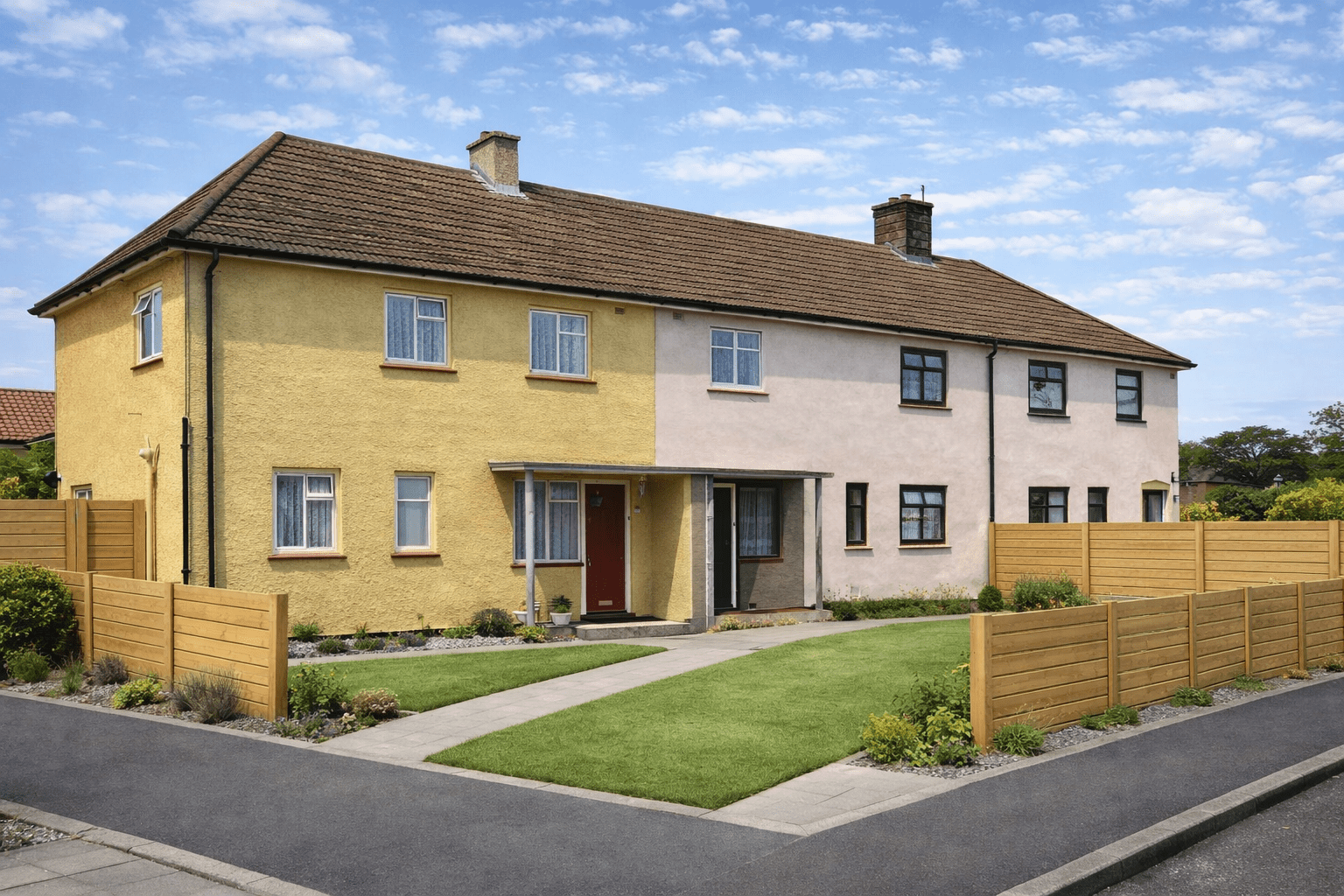
The Whatling house is generally a two-storey semi-detached dwelling. Roofs are medium-pitched and hipped in form, with some examples incorporating a mansard design. Clay or concrete tiles are commonly used as the roof covering. Bay windows are frequently present on the front ground floor elevation, with a flat canopy over the entrance door.
Externally, walls are finished with a rendered pebbledash coating. This finish forms part of the original construction and contributes to the distinctive appearance of the house type.
| Element | Typical construction | Inspection focus |
|---|---|---|
| Substructure | Concrete strip foundations with concrete underbuilding | General stability, drainage provision, signs of settlement |
| External walls | Dense aggregate reinforced concrete cavity walls with pebbledash render | Cracking, condition of render, damp-proof course performance |
| Internal walls | Dense aggregate concrete walls and partitions | Cracking, movement, damp transfer from external walls |
| Floors | Timber boarding on timber joists at ground and first floor | Decay, dampness, adequacy of ventilation |
| Roof | Timber rafters with concrete or clay tiles | Tile condition, timber decay, water ingress |
Potential hazards & inspection priorities
The most common defects encountered in Whatling houses relate to the behaviour of the reinforced concrete walls and the performance of damp-proofing measures. Vertical cracking to external walls is frequently observed and is often associated with settlement or thermal movement.
Horizontal cracking can also occur, particularly above ground floor window openings, where the absence of vertical movement joints places additional stress on the wall panels.
Dampness within the dense aggregate reinforced concrete walls is another recurring issue. This may be linked to compromised damp-proof courses, poor drainage, or deterioration of the external render finish.
Whatling houses are not classed as defective under the Defective Premises Act, but the presence of the defects described above should always be assessed carefully during inspection.
Is this house right for you?
Purchasing a Whatling house requires an understanding of non-traditional construction and an acceptance that defects may not always be immediately apparent. Condition can vary significantly between properties depending on maintenance history and exposure.
- Careful inspection of external wall cracking is essential
- Damp-related issues should be thoroughly assessed
- Timber floors and roof structures require close attention
Mortgage & resale considerations
Mortgage acceptance for Whatling houses is influenced by construction type, condition, and the clarity of professional reporting. Lender criteria can vary, and clear identification of defects, together with evidence of repair or stability, is often critical.
Resale prospects are similarly linked to condition and the quality of supporting survey documentation.
What a survey can — and cannot — tell you
A building survey provides an informed assessment of the visible condition and construction of a Whatling house. Inspections are non-intrusive and limited to areas that are accessible at the time of inspection.
- Identify visible cracking to reinforced concrete walls and render
- Assess signs of dampness, moisture ingress, and condensation risk
- Comment on roof coverings, drainage details, and external envelope condition
- Review the general condition of accessible floors, ceilings, and structural elements
- Highlight defects that may require repair, monitoring, or further investigation
However, there are limitations to what a survey can determine without intrusive investigation.
- Confirm the condition of concealed reinforcement within concrete walls
- Assess hidden structural elements behind finishes or linings
- Determine the full extent of internal concrete deterioration
- Inspect areas that are inaccessible or covered at the time of inspection
Where higher-risk indicators are identified, further specialist or intrusive investigation may be recommended.
For a thorough building survey in Greater London, an instant quotation can be obtained through the online survey calculator.
Considering a Whatling house?
A detailed building survey can help clarify construction-specific risks before committing to a purchase.
Get your instant survey quoteDisclaimer: This article is provided for general educational purposes only and is based on industry research, professional knowledge, and experience. It does not relate to any specific property and should not be relied upon when making a purchasing decision. Prospective purchasers should always commission an independent RICS-qualified surveyor to conduct a full inspection and provide a report on the actual condition of any property of interest.
