


Overview
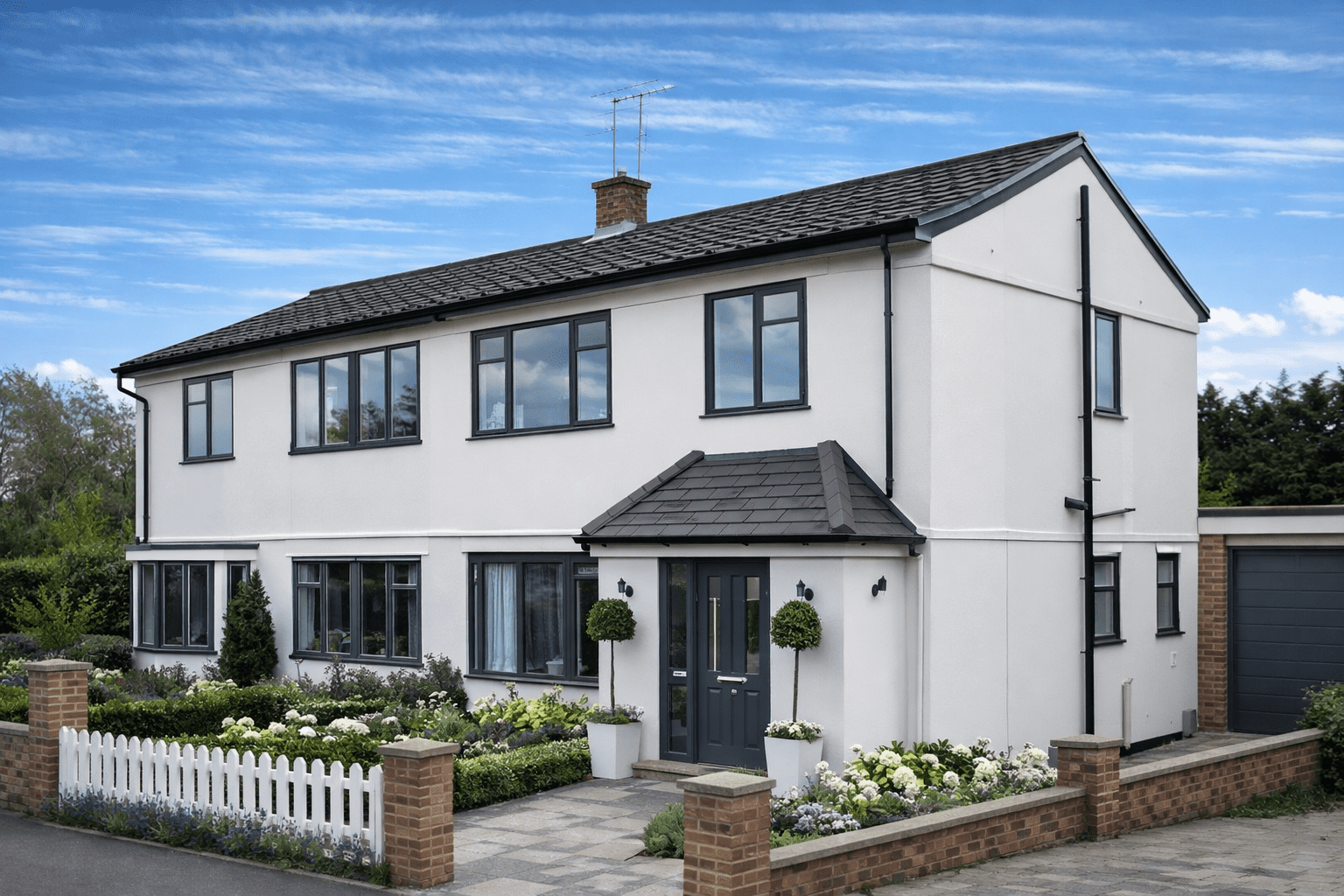
The Universal Type I House is a rare form of post-war prefabricated housing developed in 1945 in response to acute housing shortages following the Second World War. Manufactured by Universal Housing, this design represents an ambitious attempt to deliver durable, rapidly assembled family housing at a time of national urgency.
Only two Universal Type I Houses were ever constructed. As a result, surviving examples are exceptionally uncommon and form a distinctive, if obscure, part of Britain’s non-traditional housing stock.
Universal Type I Houses were designed as two-storey semi-detached dwellings using prefabricated structural components, including a steel frame and asbestos cement cladding. Their limited production makes them one of the rarest post-war housing types.
Typical characteristics & construction
Universal Type I Houses are two-storey semi-detached properties constructed around a steel frame. The substructure comprises concrete pads beneath stanchions, with a concrete slab thickened around the perimeter.
External walls are formed from storey-height timber frame panels clad externally with flat asbestos cement sheets and internally lined with fibreboard backed with aluminium foil paper. A clinker concrete block cavity wall is used as the separating wall between dwellings.
The roof is of medium pitch gable form and covered with profiled asbestos cement sheets. Junctions at the first-floor level and eaves are weathered with metal flashing, with moulded cover strips used to conceal corner joints.
| Element | Typical construction | Inspection focus |
|---|---|---|
| Substructure | Concrete pads and perimeter-thickened slab | Cracking, movement, localised settlement |
| Frame | Steel stanchions, beams and trusses with red oxide coating | Corrosion, coating breakdown, structural integrity |
| External walls | Timber panels with asbestos cement cladding | Panel condition, fixings, asbestos deterioration |
| Roof | Pitched roof with asbestos cement sheets | Sheet condition, fixings, flashing integrity |
| Floors | Concrete ground floor; T&G boarding on timber joists at first floor | Deflection, moisture effects, wear |
Potential hazards & inspection priorities
The most significant hazard associated with Universal Type I Houses is the extensive use of asbestos cement in both roof coverings and external wall panels. While asbestos cement is generally lower risk when intact, deterioration or disturbance can present health concerns.
Structural longevity is also a key consideration. Steel framing relies on the continued effectiveness of protective coatings, while timber and fibreboard elements remain vulnerable to prolonged moisture exposure if detailing fails.
Is this house right for you?
Purchasers considering a Universal Type I House should be prepared for a highly individual assessment driven by condition rather than assumptions. The rarity of the type means limited comparative evidence and a strong reliance on professional inspection.
- Commission a full building survey by a surveyor familiar with non-traditional housing
- Review the condition of asbestos-containing materials carefully
- Plan for ongoing maintenance and monitoring
Mortgage & resale considerations
Mortgage availability for non-traditional construction depends on lender criteria, professional reporting, and the absence of unresolved defects. The extremely limited number of Universal Type I Houses means lender familiarity may be limited.
Clear survey findings, documented maintenance, and evidence of appropriate management of asbestos-containing materials are likely to be influential factors.
What a survey can — and cannot — tell you
A building survey provides an informed assessment of the visible condition and construction of a Universal Type I House. Inspections are non-intrusive and limited to areas that are accessible at the time of inspection.
- Identify visible defects to asbestos cement cladding and roof sheets
- Assess signs of corrosion to accessible steel framing
- Comment on dampness, moisture ingress, and condensation risk
- Review the general condition of accessible floors, walls, and ceilings
- Highlight defects requiring repair, monitoring, or further investigation
However, there are limitations to what a survey can determine without intrusive investigation.
- Confirm the condition of concealed steel connections or fixings
- Assess hidden elements behind linings or cladding
- Determine the internal condition of asbestos cement panels
- Inspect areas that are inaccessible at the time of inspection
Where higher-risk indicators are identified, further specialist or intrusive investigation may be recommended.
For a thorough building survey in Greater London, an instant quotation can be obtained through the online survey calculator.
Considering a Universal Type I House?
A detailed building survey can help clarify construction-specific risks before committing to a purchase.
Get your instant survey quoteDisclaimer: This article is provided for general educational purposes only and is based on industry research, professional knowledge, and experience. It does not relate to any specific property and should not be relied upon when making a purchasing decision. Prospective purchasers should always commission an independent RICS-qualified surveyor to conduct a full inspection and provide a report on the actual condition of any property of interest.
