


Overview
When considering a property purchase in the UK, understanding the construction and risks associated with non-traditional house types is essential. The Universal house is one such property, developed during the interwar period and still encountered in a number of established suburban estates.
These houses are defined by their use of reinforced concrete, steel components, and asbestos cement materials. While outwardly conventional in appearance, their underlying construction requires careful and informed inspection.
Universal houses were manufactured by Universal Construction Co. Ltd. Approximately 1,060 units were built from the 1920s onwards, primarily as two-storey semi-detached houses in suburban locations.
Typical characteristics & construction
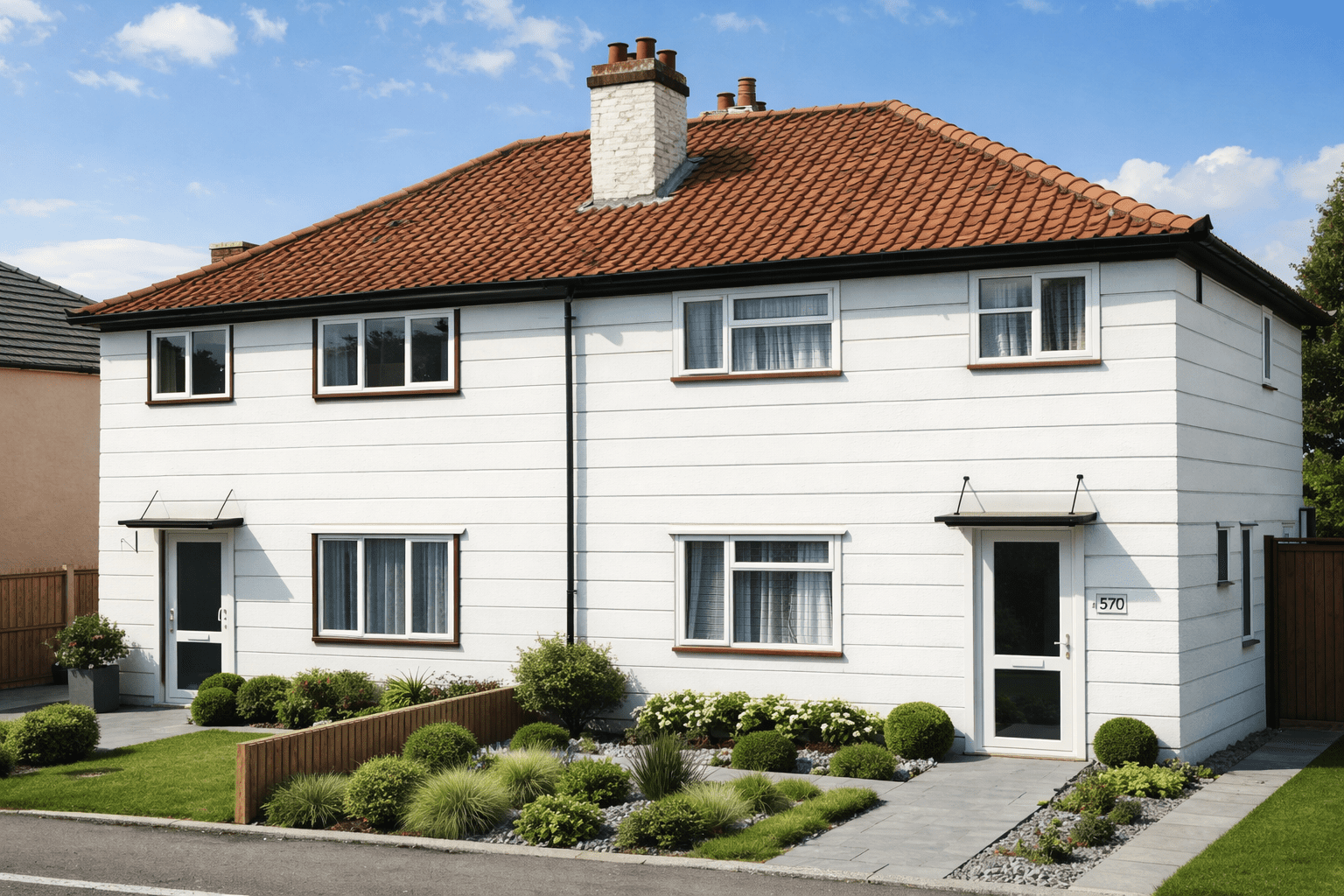
Universal houses are generally two-storey semi-detached properties with a medium-pitched hipped roof finished in clay or concrete tiles. Chimney stacks are usually of brick construction and are commonly present.
External wall construction varies between examples. Many incorporate horizontal asbestos cement channel section boards fixed to timber battens, combined with clinker and dense aggregate reinforced concrete panels. Rolled steel channel (RSC) stanchions provide vertical support within the wall structure.
Some variants are rendered externally, either fully or at first floor level, while others have been overclad in brick or constructed with brick external walls bonded directly to reinforced concrete.
| Element | Typical construction | Inspection focus |
|---|---|---|
| Substructure | Concrete strip footings and concrete slab | Movement, cracking, confirmation of damp-proof course |
| External walls | Asbestos cement boards, reinforced concrete, RSC stanchions | Cracking, corrosion, rain penetration, carbonation |
| Floors | Concrete ground floor, timber first floor | Dampness, deflection, timber condition |
| Roof | Timber rafters with clay or concrete tiles | Tile condition, roof spread, chimney stability |
Potential hazards & inspection priorities
The primary concern with Universal houses is corrosion of the RSC stanchions and reinforcement within the clinker and dense aggregate concrete. This was evident during inspection of many examples and can lead to cracking, displacement, and loss of structural capacity.
Asbestos cement sheeting is widely used to external walls and partitions. While generally stable if undisturbed, deterioration or inappropriate alteration increases health risk and complicates repair work.
Carbonation of the concrete and the presence of chlorides accelerate corrosion processes. Rain penetration through asbestos cement boarding and cracked concrete panels is also common, often resulting in dampness and mould internally.
Chimney stacks frequently show cracking above roof level, increasing the risk of water ingress and localised structural failure if not addressed.
Is this house right for you?
A Universal house may be suitable where the construction type is understood and the condition has been clearly established through detailed inspection.
- Accept that non-traditional materials require ongoing monitoring
- Factor in the presence of asbestos cement components
- Rely on condition rather than appearance alone
Mortgage & resale considerations
Mortgage acceptance for Universal houses depends on construction detail, condition, and the clarity of professional reporting. Variations in wall construction and evidence of corrosion can influence lending decisions.
Clear survey findings and documented remedial works are commonly influential when assessing both lending and future resale prospects.
What a survey can — and cannot — tell you
A building survey provides an informed assessment of the visible condition and construction of a Universal house. Inspections are non-intrusive and limited to areas that are accessible at the time of inspection.
- Identify visible cracking to concrete panels and external finishes
- Assess signs of corrosion to exposed steel elements
- Comment on dampness, rain penetration, and condensation risk
- Review the condition of accessible floors, walls, and roof structure
- Highlight defects requiring repair, monitoring, or further investigation
However, there are limitations to what a survey can determine without intrusive investigation.
- Confirm the condition of concealed reinforcement or steel stanchions
- Assess hidden elements behind linings or cladding
- Determine the full extent of carbonation or chloride contamination
- Inspect inaccessible or covered areas
Where higher-risk indicators are identified, further specialist or intrusive investigation may be recommended.
For a thorough building survey in Greater London, an instant quotation can be obtained through the online survey calculator.
Considering a Universal house?
A detailed building survey can help clarify construction-specific risks before committing to a purchase.
Get your instant survey quoteDisclaimer: This article is provided for general educational purposes only and is based on industry research, professional knowledge, and experience. It does not relate to any specific property and should not be relied upon when making a purchasing decision. Prospective purchasers should always commission an independent RICS-qualified surveyor to conduct a full inspection and provide a report on the actual condition of any property of interest.
