


Overview
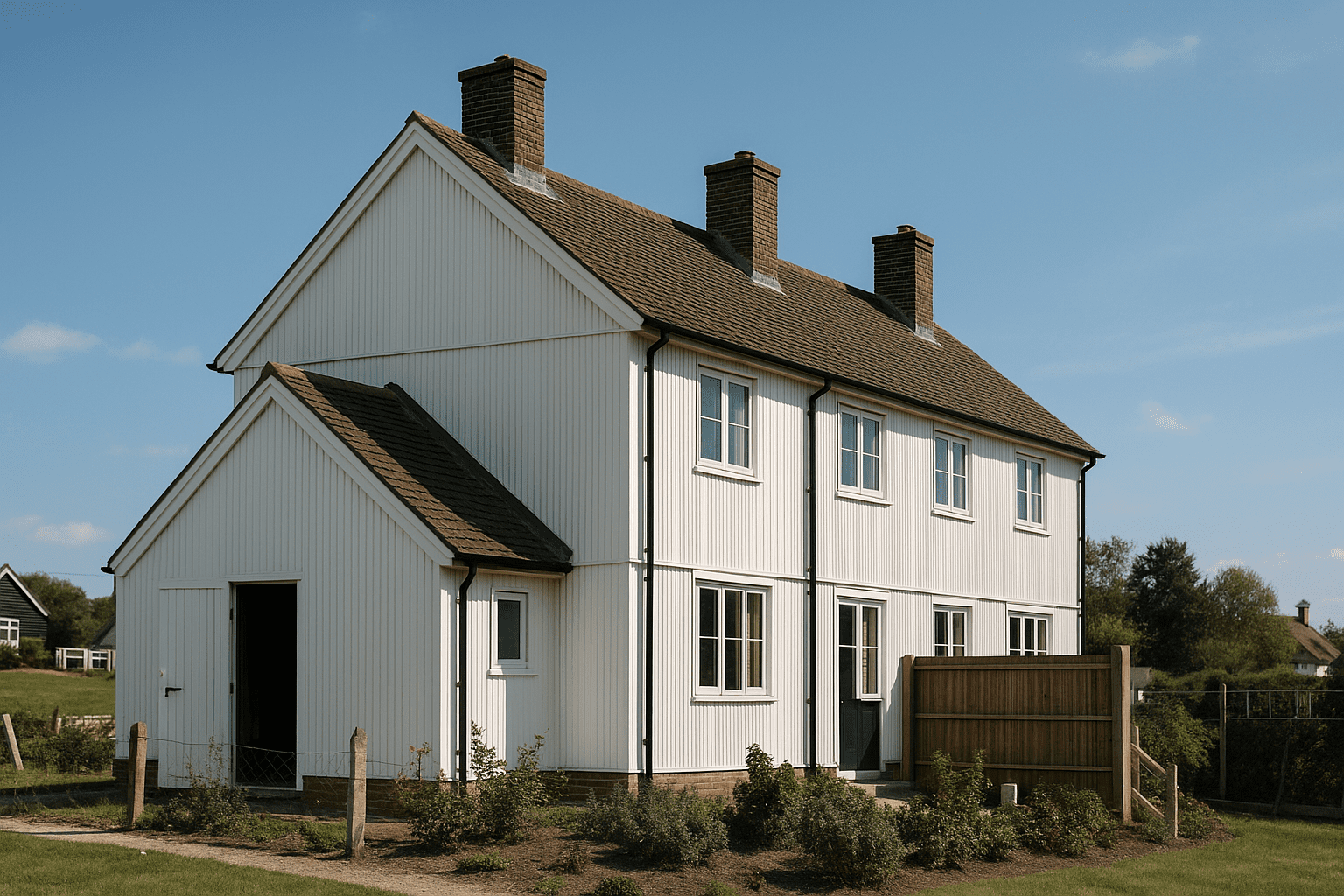
The Swedish Sectional Timber (SST) house, also known as the Swedish Timber house, is a non-traditional property type constructed in the UK between 1937 and 1947. These homes were produced during a period of acute housing shortage associated with the Second World War and its aftermath.
Designed by C.L. Sjostrom Mardall, the system aimed to deliver efficient, durable housing using prefabricated timber components. Approximately 300 properties were built, typically as semi-detached bungalows or two-storey semi-detached and terraced houses, with concentrations in London and other major urban areas.
Swedish Sectional Timber houses were manufactured using prefabricated timber frame panels. Limited numbers were constructed, and surviving examples remain relatively uncommon.
Typical characteristics & construction
Swedish Sectional Timber houses were constructed using storey-height timber frame panels. Externally, walls are typically finished with painted or stained horizontal or vertical timber boarding, with some examples rendered over fibreboard lathing.
Roofs are generally shallow pitch monopitch or shallow pitch gable forms, commonly covered with profiled asbestos cement sheets. Internally, walls and ceilings are often lined with fibreboard fixed over tongue and groove timber boarding.
| Element | Typical construction | Inspection focus |
|---|---|---|
| Substructure | Concrete strip footings carried above ground level | Cracking, settlement, adequacy of support |
| External walls | Timber frame panels with timber boarding or render on fibreboard | Decay, moisture ingress, condition of cladding |
| Separating walls | Timber frame with T&G boarding and asbestos cement sheeting | Asbestos condition, soundness, fire separation |
| Floors | T&G timber boarding on timber joists | Deflection, rot, insect attack |
| Roof | Asbestos cement profiled sheeting on timber rafters and purlins | Sheet condition, fixings, timber decay |
Potential hazards & inspection priorities
Asbestos is a key consideration, with asbestos cement commonly present in roof coverings and separating walls. Disturbance of these materials can present a health risk and should be assessed by a competent professional.
Timber decay and insect infestation are also common risks, particularly where moisture ingress has occurred. Original insulation materials, including sawdust and lime, are unlikely to meet modern thermal performance expectations.
Is this house right for you?
A Swedish Sectional Timber house may be suitable where the purchaser understands non-traditional construction and is prepared to assess the property on its individual condition.
Particular attention should be paid to evidence of moisture ingress, timber condition, and the presence and state of asbestos-containing materials.
Mortgage & resale considerations
The Swedish Sectional Timber house is not classified as defective under the Defective Premises Act. However, lending and resale considerations can be influenced by construction type, condition, and the quality of professional reporting.
Clear survey findings and documented maintenance are commonly important factors in decision-making.
What a survey can — and cannot — tell you
A building survey provides an assessment of the visible condition and construction of the property based on non-intrusive inspection of accessible areas.
- Identify visible timber decay, dampness, and material deterioration
- Assess roof coverings, external walls, and internal linings
- Comment on insulation, ventilation, and general upkeep
- Recommend further investigation where appropriate
Concealed elements cannot be fully assessed without opening up the structure. Where higher-risk indicators are present, targeted intrusive investigations may be advised.
For a thorough building survey in Greater London, an instant quotation can be obtained through the online survey calculator.
Considering a Swedish Sectional Timber house?
A detailed building survey can help clarify construction-specific risks before committing to a purchase.
Get your instant survey quoteDisclaimer: This article is provided for general educational purposes only and is based on industry research, professional knowledge, and experience. It does not relate to any specific property and should not be relied upon when making a purchasing decision. Prospective purchasers should always commission an independent RICS-qualified surveyor to conduct a full inspection and provide a report on the actual condition of any property of interest.
