


Overview
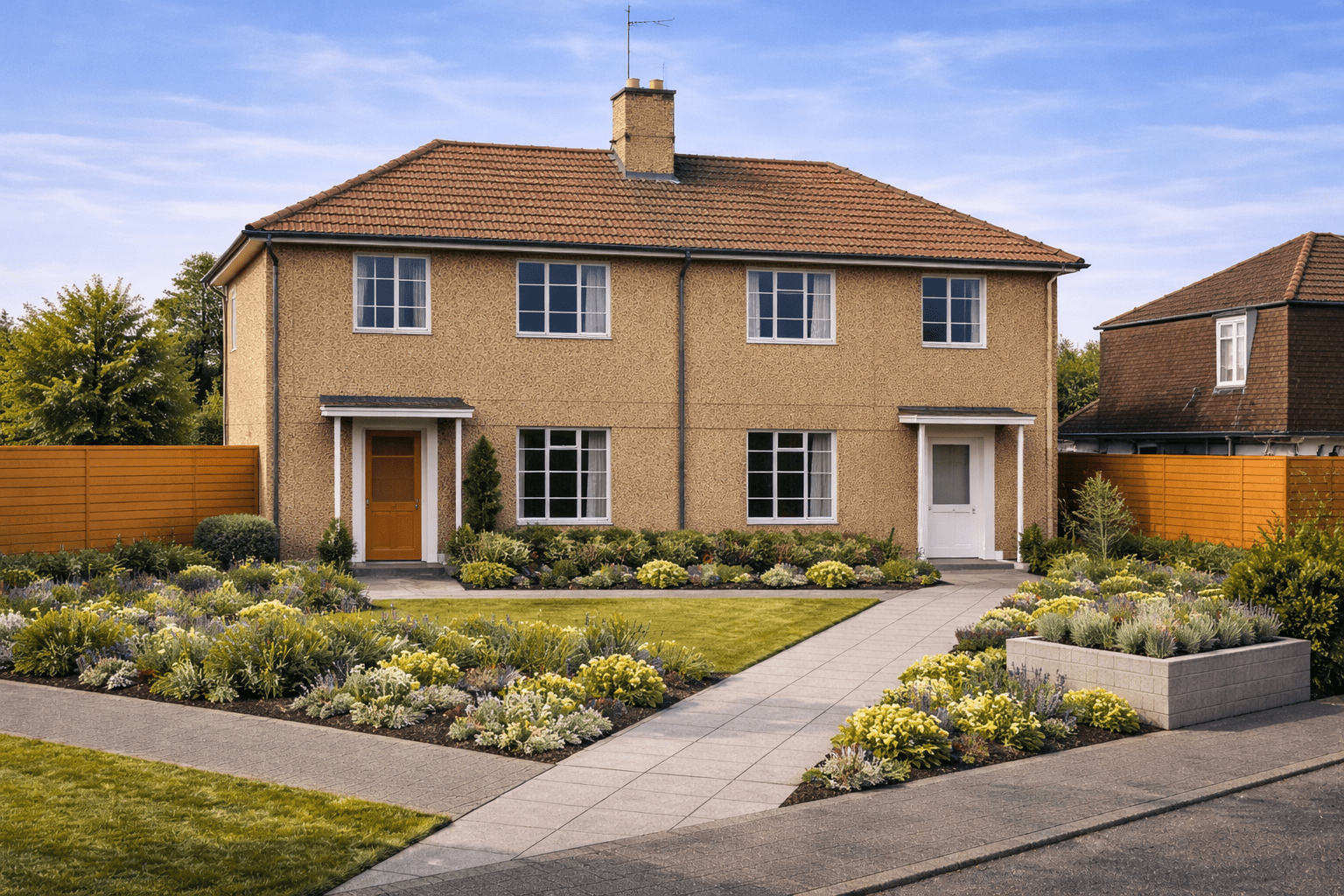
The Reema Hollow Panel house is a form of post-war non-traditional housing developed in response to acute housing shortages following the Second World War. Manufactured by Reema Ltd, these properties were constructed between 1945 and 1966 and form part of a wider programme of system-built housing intended to provide rapid, affordable accommodation.
Reema Hollow Panel houses were built in significant numbers, with approximately 17,600 units constructed. They are commonly found in suburban locations and may also be known as Engineered Homes, Bourne, Nadder, Stour, or Wylye types.
Typical characteristics & construction
Reema Hollow Panel houses are generally constructed as bungalows or two-storey semi-detached houses. Roofs are medium or shallow pitch, either hipped or gabled, and are typically covered with concrete tiles or asbestos cement sheets.
External walls are formed from storey-height exposed aggregate precast concrete panels, sometimes finished with tile hanging. Internally, a mix of precast concrete partitions and timber stud walls lined with plasterboard may be present.
| Element | Typical construction | Inspection focus |
|---|---|---|
| Substructure | Pad foundations supporting concrete slab | Settlement, cracking, general stability |
| External walls | Hollow precast concrete panels with RC columns | Carbonation, cracking, spalling, panel joints |
| Floors | Concrete ground floor; timber first floor on PC beams | Cracking, deflection, moisture-related damage |
| Roof | Timber rafters and purlins with tiled or asbestos cement covering | Covering condition, timber decay, fixings |
| Internal walls | Precast concrete panels and timber stud partitions | Cracking, movement, lining condition |
Potential hazards & inspection priorities
The primary concerns associated with Reema Hollow Panel houses relate to the durability of the reinforced concrete panels. Carbonation and elevated chloride levels can lead to corrosion of embedded steel reinforcement, which in turn may cause cracking and spalling of the concrete.
Cracking is commonly observed around window and door openings, sills, and floor beam bearings. Deterioration of pointing between panels can also allow moisture ingress, accelerating further decay.
Is this house right for you?
Purchasers considering a Reema Hollow Panel house should be aware of its non-traditional construction and the implications of its defective designation.
- Commission a full building survey by an experienced surveyor
- Understand the condition of the concrete panels and reinforcement
- Factor in the likelihood of ongoing maintenance and repair
Properties showing advanced concrete deterioration or poor historic maintenance warrant particular caution.
Mortgage & resale considerations
Mortgage availability and resale prospects for Reema Hollow Panel houses are influenced by lender policies, overall condition, and the quality of professional reporting. Some lenders may apply restrictions due to the defective classification.
Clear survey findings and evidence of appropriate repairs or monitoring can be influential when addressing lender and purchaser concerns.
What a survey can — and cannot — tell you
A building survey provides an informed assessment of the visible condition and construction of a Reema Hollow Panel house. Inspections are non-intrusive and limited to areas that are accessible at the time of inspection.
- Identify visible cracking and spalling to concrete panels
- Assess signs of dampness, moisture ingress, and condensation risk
- Comment on roof coverings, drainage details, and external envelope condition
- Review the general condition of accessible floors, ceilings, and structural elements
- Highlight defects that may require repair, monitoring, or further investigation
However, there are limitations to what a survey can determine without intrusive investigation.
- Confirm the condition of concealed reinforcement within concrete panels
- Assess hidden structural elements behind finishes or linings
- Determine the full extent of carbonation or internal concrete deterioration
- Inspect areas that are inaccessible or covered at the time of inspection
Where higher-risk indicators are identified, further specialist or intrusive investigation may be recommended.
For a thorough building survey in Greater London, an instant quotation can be obtained through the online survey calculator.
Considering a Reema Hollow Panel house?
A detailed building survey can help clarify construction-specific risks before committing to a purchase.
Get your instant survey quoteDisclaimer: This article is provided for general educational purposes only and is based on industry research, professional knowledge, and experience. It does not relate to any specific property and should not be relied upon when making a purchasing decision. Prospective purchasers should always commission an independent RICS-qualified surveyor to conduct a full inspection and provide a report on the actual condition of any property of interest.
