


Overview
The O’Sullivan house, also known as the Miller O’Sullivan or simply O’Sullivans, is a distinctive type of system-built property developed in the UK during the 1940s and 1950s. Designed and manufactured by E O’Sullivan, these homes formed part of the post-war drive to address acute housing shortages.
With only around 100 units constructed, they are relatively rare and occupy a specific position within the wider group of non-traditional housing produced in the immediate post-war period.
O’Sullivan houses were constructed between the late 1940s and early 1950s, primarily in the Midlands and the North of England where housing demand was particularly high. Both design and manufacture were overseen by E O’Sullivan.
Typical characteristics & construction
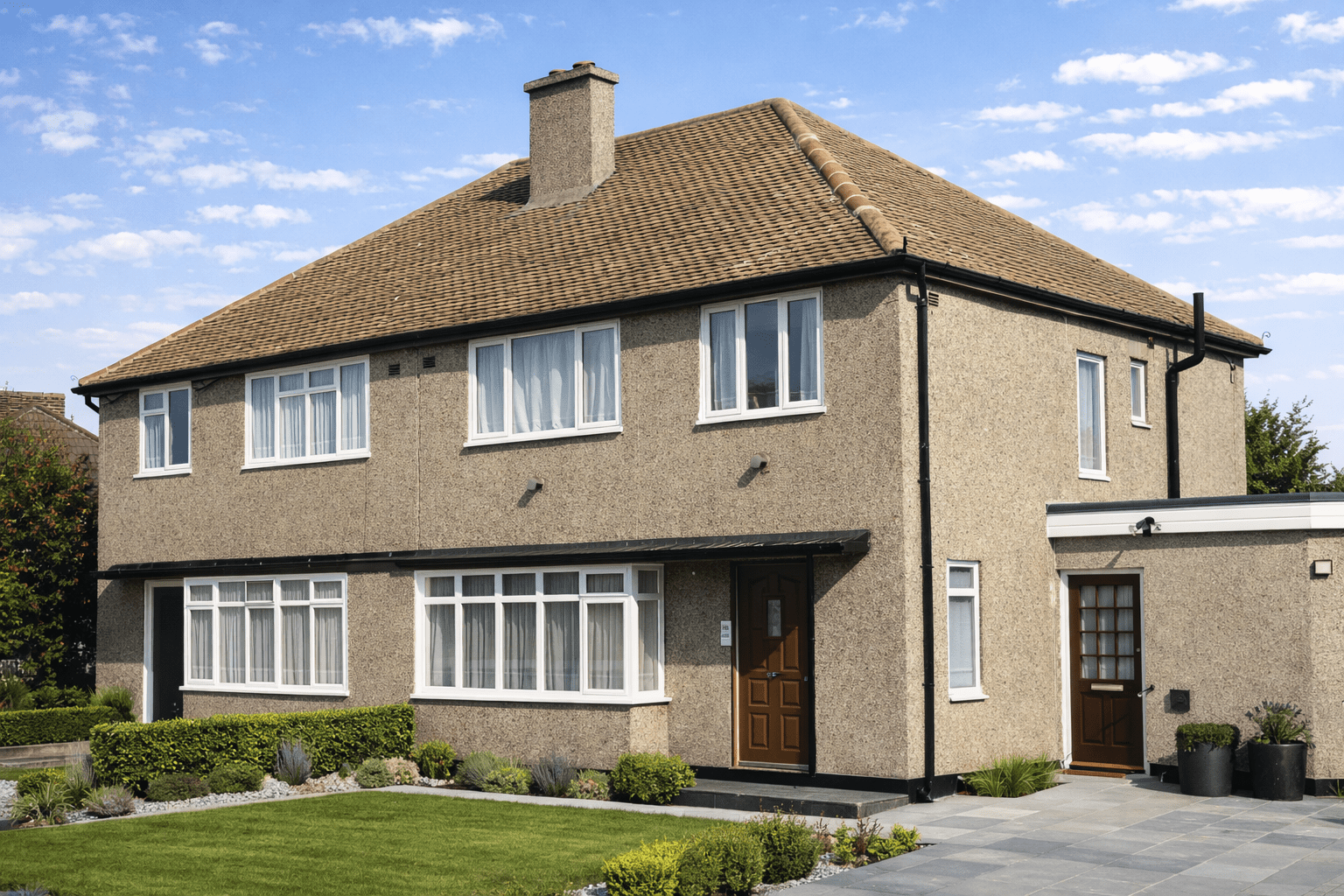
O’Sullivan houses are generally two-storey semi-detached properties with medium-pitch hipped or gable roofs finished in concrete tiles. The external walls are fully rendered, giving a uniform external appearance.
A distinguishing feature is the square-fronted, single-storey flat-roofed bay to the front elevation. In some examples, the bay roof projects to form a canopy over the entrance.
The substructure comprises concrete strip footings, concrete under-building and a concrete slab incorporating honeycomb sleeper walls and a damp-proof course. External walls are formed in 11-inch concrete cavity construction with a 2-inch cavity, secured with mild steel wall ties. Precast slip blocks close cavities at openings and reinforced concrete lintels are provided above.
Separating walls are 11-inch concrete cavity construction to eaves level, with 9-inch brickwork within the roof space. Behind fireplaces, 9-inch concrete walls are used. Internal partitions are constructed from 4.5-inch concrete blocks bonded to the external walls and tied with mild steel hoops.
Ground and first floors are typically timber boarding on timber joists supported by timber wall plates and concrete sleeper walls. Ceilings are generally plasterboard. Roofs comprise timber rafters and purlins beneath concrete tiles. Chimneys are formed from 4.5-inch concrete blocks at lower level and 4.5-inch brickwork above.
Variants may include precast reinforced concrete lintels, continuous reinforced concrete courses at eaves level, staggered air vents in both leafs, asbestos cement liners to door and window reveals, and in some cases pressed steel joists with concrete floors.
| Element | Typical construction | Inspection focus |
|---|---|---|
| Substructure | Concrete strip footings, concrete under-building and slab with sleeper walls | Movement, cracking, signs of settlement |
| External walls | 11-inch concrete cavity walls with mild steel ties and rendered finish | Vertical cracking, render condition, damp penetration |
| Floors | Timber boarding on timber joists; some pressed steel and concrete variants | Deflection, rot, insect attack, ventilation |
| Roof | Timber rafters and purlins with concrete tiles | Tile condition, timber decay, chimney stability |
Potential hazards & inspection priorities
Vertical cracking between ground and first-floor openings is one of the more frequently reported issues and can indicate structural movement. This should be assessed in the context of overall alignment and foundation performance.
Dampness is a recurring concern in properties of this age. Although lead damp-proof membranes and cavity construction were progressive for their time, deterioration over decades can allow moisture ingress.
Where asbestos cement liners are present to door or window reveals, appropriate management is essential. Asbestos-containing materials require specialist handling if disturbed.
Thermal efficiency is limited by modern standards. Original wall construction and floor build-ups provide modest insulation levels compared with current expectations.
Is this house right for you?
O’Sullivan houses are non-traditional in form but conventional in layout. Purchasers should be comfortable with concrete cavity wall construction and the potential for age-related movement and damp-related defects.
- Review evidence of past structural repairs or crack stitching
- Confirm the condition of wall ties and reinforced concrete elements
- Assess damp-proofing performance and ventilation provision
- Establish whether any asbestos-containing materials remain in situ
A detailed survey is advisable to clarify condition and identify areas requiring repair or monitoring.
Mortgage & resale considerations
As a relatively rare system-built type with concrete cavity wall construction, lender attitudes can vary. The limited number originally constructed may influence comparable evidence and underwriting decisions.
Clear reporting on structural condition, confirmation that there is no significant ongoing movement, and appropriate management of any asbestos-containing materials are likely to be relevant factors in lending and resale discussions.
What a survey can — and cannot — tell you
A building survey provides an informed assessment of the visible condition and construction of an O’Sullivan house. Inspections are non-intrusive and limited to areas that are accessible at the time of inspection.
- Identify visible vertical cracking between structural openings
- Assess the condition of rendered concrete cavity walls and lintels
- Comment on roof coverings, chimney stability, and external envelope performance
- Review the general condition of accessible floors, ceilings, and partitions
- Highlight defects requiring repair, monitoring, or further investigation
However, there are limitations to what a survey can determine without intrusive investigation.
- Confirm the condition of concealed mild steel wall ties
- Assess hidden reinforcement within concrete elements
- Determine the full extent of concealed damp within cavities or floor voids
- Inspect areas that are inaccessible or covered at the time of inspection
Where higher-risk indicators are identified, further specialist or intrusive investigation may be recommended.
For a thorough building survey in Greater London, an instant quotation can be obtained through the online survey calculator.
Considering a O’Sullivan house?
A detailed building survey can help clarify construction-specific risks before committing to a purchase.
Get your instant survey quoteDisclaimer: This article is provided for general educational purposes only and is based on industry research, professional knowledge, and experience. It does not relate to any specific property and should not be relied upon when making a purchasing decision. Prospective purchasers should always commission an independent RICS-qualified surveyor to conduct a full inspection and provide a report on the actual condition of any property of interest.
