


Overview
The Nissen-Petren house is a rare form of interwar non-traditional housing developed in the mid-1920s. Designed by Petter & Warren and manufactured by Nissen-Petren Houses Ltd, these properties were constructed in 1925 as a limited experimental housing solution.
Only 20 Nissen-Petren houses were built. They are typically found in suburban locations associated with interwar development, and surviving examples remain uncommon.
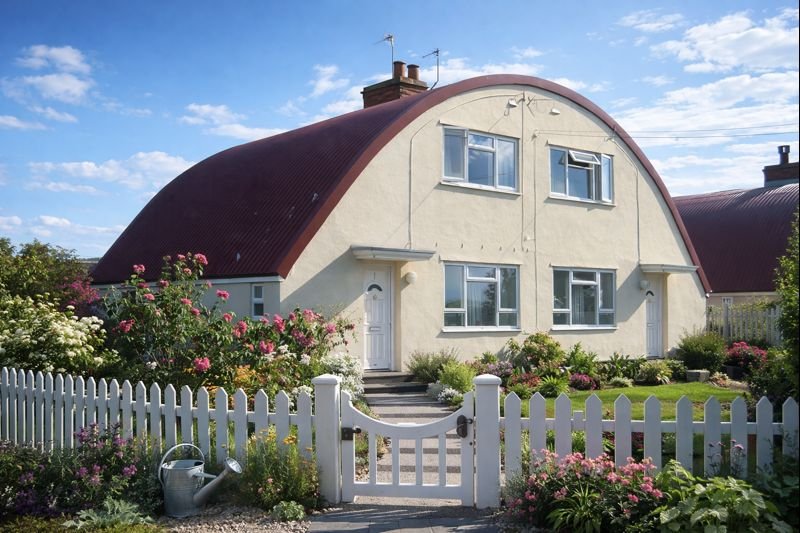
Nissen-Petren houses are two-storey semi-detached properties with distinctive curved steel roofs and steel-framed construction. Their limited numbers and unusual form make accurate identification and informed inspection particularly important.
Typical characteristics & construction
Nissen-Petren houses are two-storey semi-detached dwellings defined by a semi-circular roof profile. The structure is based around rolled steel joist ribs, with masonry and concrete elements forming the remainder of the envelope.
The curved roof form, combined with steel framing and rendered external walls, sets these houses apart from more conventional interwar housing.
| Element | Typical construction | Inspection focus |
|---|---|---|
| Substructure | Concrete slab thickened at perimeter with DPC | Settlement, damp proof course continuity |
| Frame | Five semi-circular rolled steel joist ribs with bolted connections | Corrosion, condition of protective coatings |
| External walls | Rendered concrete block cavity walls | Cracking, render failure, moisture penetration |
| Roof | Bituminous-coated corrugated steel sheets on timber purlins | Corrosion, coating failure, leaks |
| Floors | Concrete ground floor; timber joists with T&G boarding at first floor | Movement, decay, wear |
| Ceilings | Lath and plaster | Cracking, sagging, historic repairs |
Potential hazards & inspection priorities
Corrosion of steel components is the primary concern with Nissen-Petren houses. Superficial corrosion is commonly found to steel ribs, particularly at bases and within the roof structure. More advanced corrosion can affect the corrugated steel roof sheets where the bituminous coating has deteriorated.
Wet rot is a recognised issue where timber purlins have been exposed to prolonged moisture, usually associated with roof covering failure. This can compromise roof stability if not addressed.
A further risk is the absence of a separating wall within the roof space. Where present, this increases fire spread risk between semi-detached units.
Is this house right for you?
Purchasing a Nissen-Petren house requires an understanding of non-traditional steel-framed construction and acceptance that maintenance demands differ from conventional masonry housing.
- Commission a full building survey with experience of non-traditional houses
- Expect focused assessment of steel corrosion and roof condition
- Factor in ongoing inspection and maintenance obligations
Mortgage & resale considerations
Lender attitudes to Nissen-Petren houses can vary due to their rarity and non-traditional construction. Mortgage acceptance is often influenced by the clarity of professional reporting and evidence of controlled corrosion and effective maintenance.
Documented repairs, protective treatments, and clear survey findings can be influential where lending decisions are cautious.
What a survey can — and cannot — tell you
A building survey provides an informed assessment of the visible condition and construction of a Nissen-Petren house. Inspections are non-intrusive and limited to areas that are accessible at the time of inspection.
- Identify visible corrosion to steel ribs and roof sheets
- Assess signs of dampness, moisture ingress, and condensation risk
- Comment on roof coverings, drainage details, and external wall condition
- Review the general condition of accessible floors, ceilings, and partitions
- Highlight defects that may require repair, monitoring, or further investigation
However, there are limitations to what a survey can determine without intrusive investigation.
- Confirm the condition of concealed steel sections or fixings
- Assess hidden elements behind linings or finishes
- Determine the full extent of corrosion beneath protective coatings
- Inspect areas that are inaccessible or covered at the time of inspection
Where higher-risk indicators are identified, further specialist or intrusive investigation may be recommended.
For a thorough building survey in Greater London, an instant quotation can be obtained through the online survey calculator.
Considering a Nissen-Petren house?
A detailed building survey can help clarify construction-specific risks before committing to a purchase.
Get your instant survey quoteDisclaimer: This article is provided for general educational purposes only and is based on industry research, professional knowledge, and experience. It does not relate to any specific property and should not be relied upon when making a purchasing decision. Prospective purchasers should always commission an independent RICS-qualified surveyor to conduct a full inspection and provide a report on the actual condition of any property of interest.
