


Overview
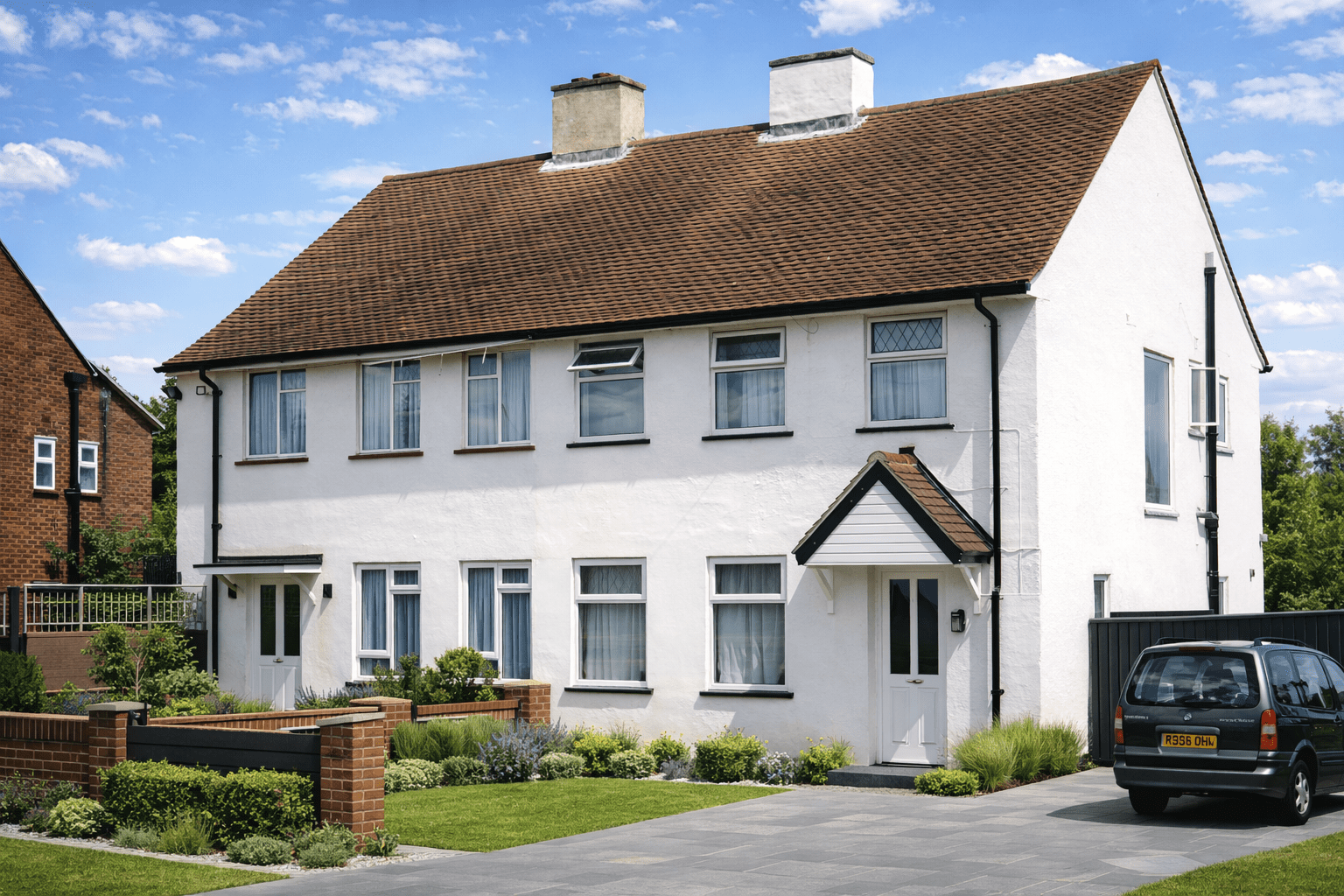
The MOW Demonstration Foamed Slag house stands as a unique relic of post-war British architecture. Designed by the Ministry of Works in the 1940s, this property type is exceptionally rare, with only two known examples ever built. Understanding the intricacies of this construction is essential when assessing its condition and associated risks.
Developed during a period of acute housing shortage, the design formed part of the Ministry of Works’ exploration into alternative construction methods using innovative materials.
MOW Demonstration Foamed Slag houses were designed by the Ministry of Works in the 1940s using foamed slag aggregate concrete. Only two known examples were constructed as part of experimental housing initiatives.
Typical characteristics & construction
These properties are two-storey semi-detached houses with steep pitch gable roofs finished in tiles. External walls are fully rendered, presenting a uniform appearance.
The principal construction material is foamed slag aggregate concrete, developed as a lightweight alternative during post-war material shortages. Continuous bar reinforcement was incorporated at specific structural locations.
| Element | Typical construction | Inspection focus |
|---|---|---|
| Substructure | Concrete strip footings with dense concrete underbuilding and concrete slab; Damp Proof Course provided | Settlement, cracking, DPC integrity, moisture bridging |
| External walls | 8″ foamed slag aggregate concrete with rendered finish and 3/8″ continuous bar reinforcement in cement mortar positioned above openings | Cracking, spalling, render condition, corrosion staining |
| Separating wall | Foamed slag aggregate concrete | Cracking, signs of movement |
| Internal partitions | 4″ foamed slag aggregate concrete | Cracking, moisture ingress |
| Ground floor | Wood blocks laid on concrete | Dampness, condition of blocks and slab |
| First floor | Timber boarding on timber joists | Deflection, decay, structural integrity |
| Roof | Timber rafters and purlins with tiled covering | Tile condition, timber decay, water ingress |
Potential hazards & inspection priorities
Long-term durability of foamed slag aggregate concrete is a primary consideration. Exposure to sustained moisture can lead to material degradation and loss of structural performance.
Continuous bar reinforcement embedded within the wall construction is vulnerable to corrosion where protective concrete cover has been compromised. Resulting expansion can cause cracking and spalling.
Although a Damp Proof Course was incorporated, moisture ingress remains a risk where detailing has failed or where external levels bridge the DPC.
Thermal insulation performance is not well documented. As a result, energy efficiency may fall short of modern standards.
The Defective Premises Act 1972 places a duty on builders and landlords to ensure properties are fit for habitation. Given the potential structural and durability concerns associated with this experimental construction, remedial action may be required where defects compromise safety or habitability.
Is this house right for you?
Purchasers should recognise that this is an experimental and extremely rare non-traditional construction type.
- Commission a full building survey with specific attention to concrete condition
- Assess evidence of past repairs or structural movement
- Consider long-term maintenance obligations linked to reinforced concrete elements
Condition and evidence of ongoing maintenance will significantly influence suitability.
Mortgage & resale considerations
Lending decisions on rare non-traditional construction types are influenced by condition, durability, and clarity of professional reporting.
Documented repair history and clear assessment of structural performance are likely to be material considerations.
What a survey can — and cannot — tell you
A building survey provides an informed assessment of the visible condition and construction of a MOW Demonstration Foamed Slag house. Inspections are non-intrusive and limited to areas that are accessible at the time of inspection.
- Identify visible cracking and spalling to foamed slag aggregate concrete walls
- Assess signs of dampness, moisture ingress, and condensation risk
- Comment on roof coverings, drainage details, and external envelope condition
- Review the general condition of accessible floors, ceilings, and structural elements
- Highlight defects that may require repair, monitoring, or further investigation
However, there are limitations to what a survey can determine without intrusive investigation.
- Confirm the condition of concealed reinforcement within foamed slag aggregate concrete
- Assess hidden structural elements behind finishes or linings
- Determine the full extent of internal concrete deterioration
- Inspect areas that are inaccessible or covered at the time of inspection
Where higher-risk indicators are identified, further specialist or intrusive investigation may be recommended.
For a thorough building survey in Greater London, an instant quotation can be obtained through the online survey calculator.
Considering a MOW Demonstration Foamed Slag house?
A detailed building survey can help clarify construction-specific risks before committing to a purchase.
Get your instant survey quoteDisclaimer: This article is provided for general educational purposes only and is based on industry research, professional knowledge, and experience. It does not relate to any specific property and should not be relied upon when making a purchasing decision. Prospective purchasers should always commission an independent RICS-qualified surveyor to conduct a full inspection and provide a report on the actual condition of any property of interest.
