


Overview
The Miller No-Fines house is a post-war form of non-traditional housing developed in the 1950s in response to the acute housing shortage following the Second World War. Designed by J Miller & Partners Ltd, these properties formed part of a wider national building initiative aimed at delivering durable, quickly constructed homes at scale.
The term “No-Fines” refers to the concrete mix used in construction, which excludes fine aggregates such as sand. This produces a porous but robust structural material. Thousands were built across the UK, particularly in suburban areas and locations affected by wartime bomb damage, and they now form a recognised part of Britain’s mid-20th century housing stock.
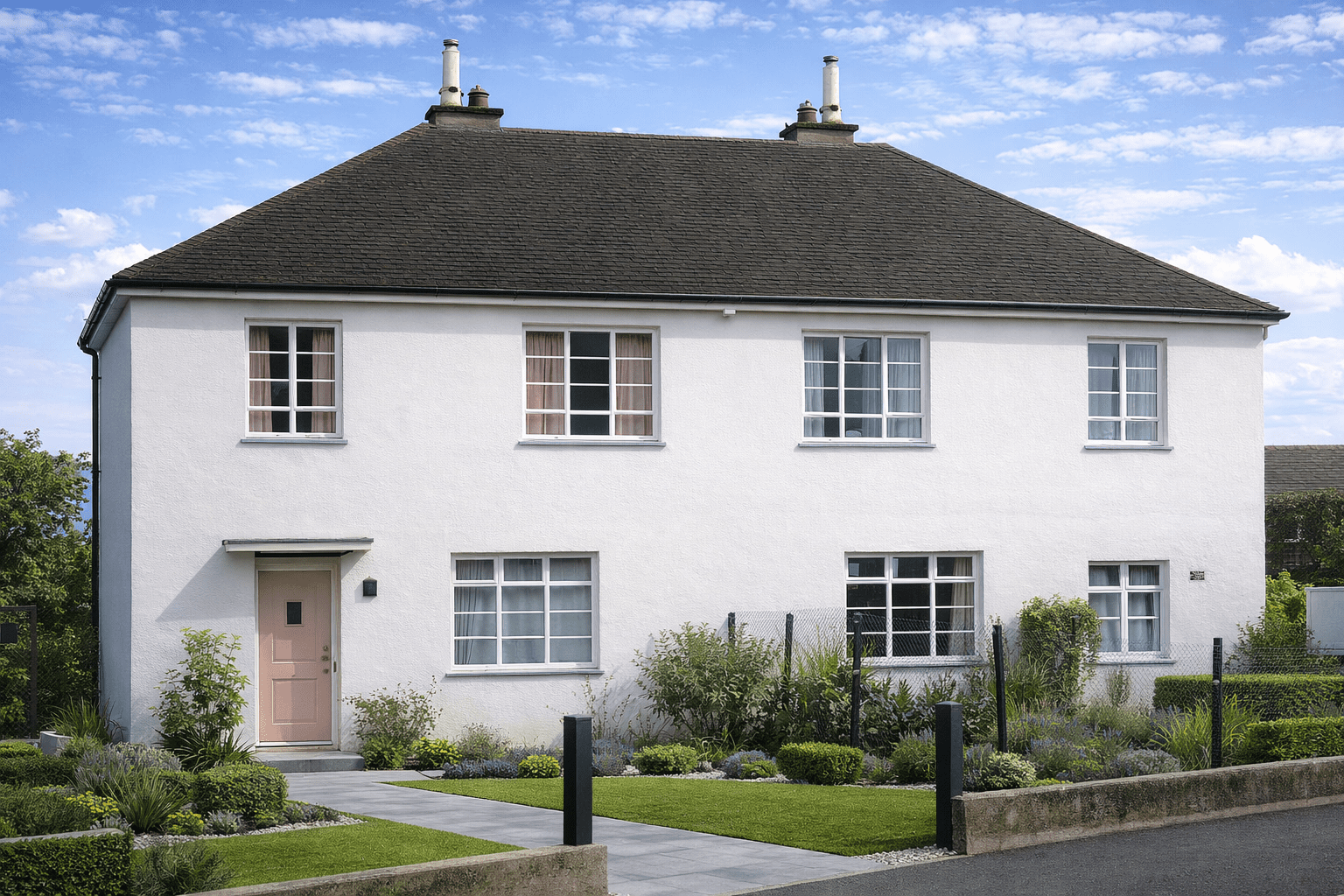
Miller No-Fines houses are typically two-storey semi-detached or terraced dwellings constructed using in-situ no-fines concrete for both external and separating walls, finished externally with render.
Typical characteristics & construction
Miller No-Fines houses are generally two-storey semi-detached or terraced properties. Roofs are medium-pitch hipped or gable forms, commonly covered with interlocking concrete tiles. A flat canopy over the front entrance is a frequent identifying feature.
External walls are formed from no-fines concrete and finished in render, creating a consistent external appearance. The porous nature of the concrete contributes to thermal performance relative to other post-war systems of the period.
Internally, the ground floor is typically a concrete slab. First floors are formed using tongue-and-groove boarding supported on composite timber and metal lattice beams. Internal partitions are timber stud lined with plasterboard, and ceilings are generally plasterboard. Separating walls between adjoining properties are also constructed in no-fines concrete.
| Element | Typical construction | Inspection focus |
|---|---|---|
| Substructure | Concrete strip footings with concrete under-building and slab; damp-proof course included | Settlement, cracking, DPC integrity |
| External walls | Rendered no-fines concrete lined internally with plasterboard on timber battens | Cracking, spalling, moisture ingress, render condition |
| Separating walls | No-fines concrete | Cracking, sound transmission, structural movement |
| Floors | Concrete ground floor; timber and metal lattice beam first floor with tongue-and-groove boarding | Deflection, movement, dampness |
| Roof | Timber trusses with interlocking concrete tiles | Tile condition, roof covering integrity, flashing |
Potential hazards & inspection priorities
Moisture management is a primary consideration. The porous nature of no-fines concrete means prolonged exposure to water can result in damp penetration. Cracking or spalling of the render finish increases this risk and should be addressed promptly.
Where moisture penetrates deeply, there is potential for corrosion of embedded steel reinforcement. Progressive corrosion can affect structural performance and may require specialist assessment.
Thermal performance, while comparatively good for its era, may not meet modern expectations. Upgrades such as improved insulation or replacement glazing are common considerations.
Asbestos-containing materials may also be present in components typical of mid-20th century construction. Identification and management in accordance with current regulations is essential.
Is this house right for you?
Purchasers considering a Miller No-Fines house should understand the implications of non-traditional concrete construction and the importance of ongoing external maintenance.
- Ensure render and external detailing are in sound condition
- Review any history of structural repair or concrete treatment
- Consider energy efficiency improvements where required
Properties in good condition can perform satisfactorily, but visible defects should be investigated before commitment.
Mortgage & resale considerations
Lender acceptance of non-traditional construction varies. Mortgage decisions commonly depend on the condition of the concrete structure, the absence of significant cracking, and the quality of professional reporting.
Clear documentation of maintenance and any past remedial works can assist in supporting lending and future resale.
What a survey can — and cannot — tell you
A building survey provides an informed assessment of the visible condition and construction of a Wimpey No-Fines house. Inspections are non-intrusive and limited to areas that are accessible at the time of inspection.
- Identify visible cracking to no-fines concrete walls and associated render
- Assess signs of dampness, moisture ingress, and condensation risk
- Comment on roof coverings, drainage details, and external envelope condition
- Review the general condition of accessible floors, ceilings, and structural elements
- Highlight defects that may require repair, monitoring, or further investigation
However, there are limitations to what a survey can determine without intrusive investigation.
- Confirm the condition of concealed reinforcement within no-fines concrete
- Assess hidden structural elements behind finishes or linings
- Determine the full extent of carbonation or internal concrete deterioration
- Inspect areas that are inaccessible or covered at the time of inspection
Where higher-risk indicators are identified, further specialist or intrusive investigation may be recommended.
For a thorough building survey in Greater London, an instant quotation can be obtained through the online survey calculator.
Considering a Miller No-Fines house?
A detailed building survey can help clarify construction-specific risks before committing to a purchase.
Get your instant survey quoteDisclaimer: This article is provided for general educational purposes only and is based on industry research, professional knowledge, and experience. It does not relate to any specific property and should not be relied upon when making a purchasing decision. Prospective purchasers should always commission an independent RICS-qualified surveyor to conduct a full inspection and provide a report on the actual condition of any property of interest.
