


Overview
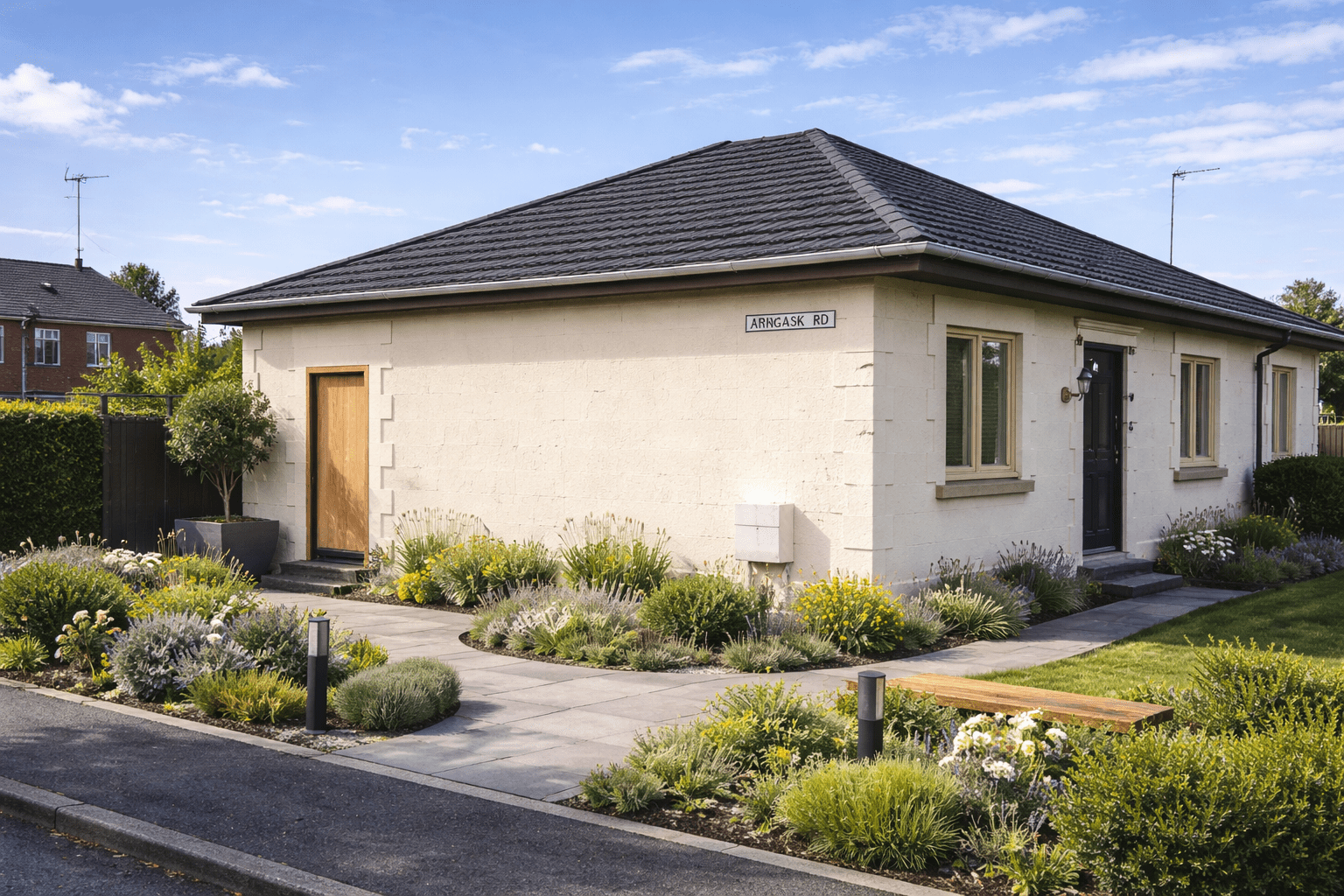
The Langlands house is an exceptionally rare non-traditional property type dating from 1926. Only two semi-detached bungalows of this design were ever constructed, giving the type a distinct place within early twentieth-century British housing experimentation.
These properties reflect a period of architectural innovation, where concrete block construction and steel framing were being explored as alternatives to traditional masonry.
Langlands houses were constructed in 1926, with only two known examples built. The designers and manufacturers are no longer recorded, but the structural approach demonstrates early adoption of steel framing combined with concrete block walls.
Typical characteristics & construction
Langlands houses are semi-detached single-storey bungalows with shallow-pitched hipped roofs finished in asbestos cement slates. External walls are formed entirely of concrete blocks, with projecting quoins that are a notable identifying feature.
The properties are founded on concrete strip foundations with underbuilding. A substantial internal steel frame provides the primary structural support.
| Element | Construction | Inspection focus |
|---|---|---|
| Foundations | Concrete strip foundation with underbuilding | Settlement, cracking, general stability |
| Frame | Steel frame using RSA, RST and RSJ sections | Corrosion, condition of protective coatings |
| External walls | 2-inch concrete blocks with horizontal rods, cavity and timber framing | Cracking, spalling, moisture exposure |
| Separating wall | Breeze concrete cavity wall | Cracking, soundness, moisture transfer |
| Ground floor | Timber boarding on timber and RSA joists | Rot, deflection, insect activity |
| Roof | Timber purlins and sarking with bituminous felt and asbestos cement slates | Slate condition, weatherproofing, asbestos management |
Potential hazards & inspection priorities
The most significant risks relate to the age of materials and long-term durability rather than inherent design weakness. Asbestos cement roof slates are a key consideration and require appropriate management to avoid disturbance.
Steel framing should be checked for corrosion, particularly where protective coatings may have deteriorated. Concrete blockwork also requires close inspection for cracking or surface breakdown associated with prolonged moisture exposure.
Is this house right for you?
A Langlands house will suit purchasers who understand non-traditional construction and are prepared to assess condition on its individual merits rather than relying on assumptions associated with more conventional housing.
- Commission a detailed building survey
- Review evidence of maintenance and repair
- Allow for ongoing inspection of structural materials
Mortgage & resale considerations
Mortgage acceptance for non-traditional properties is influenced by construction type, condition, and the quality of professional reporting. Decisions vary between lenders and can change over time.
Clear survey findings and evidence that key risks are understood and managed are commonly influential factors.
What a survey can — and cannot — tell you
A building survey provides an informed assessment of the visible condition and construction of a Langlands house. Inspections are non-intrusive and limited to areas that are accessible at the time of inspection.
- Identify visible defects to concrete block walls and external finishes
- Assess signs of dampness, moisture ingress, and condensation risk
- Comment on roof coverings, drainage details, and external envelope condition
- Review the condition of accessible floors, ceilings, and structural elements
- Highlight defects that may require repair, monitoring, or further investigation
However, there are limitations to what a survey can determine without intrusive investigation.
- Confirm the concealed condition of steel reinforcement and fixings
- Assess hidden structural elements behind finishes or linings
- Determine the full extent of internal concrete deterioration
- Inspect areas that are inaccessible or covered at the time of inspection
Where higher-risk indicators are identified, further specialist or intrusive investigation may be recommended.
For a thorough building survey in Greater London, an instant quotation can be obtained through the online survey calculator.
Considering a Langlands house?
A detailed building survey can help clarify construction-specific risks before committing to a purchase.
Get your instant survey quoteDisclaimer: This article is provided for general educational purposes only and is based on industry research, professional knowledge, and experience. It does not relate to any specific property and should not be relied upon when making a purchasing decision. Prospective purchasers should always commission an independent RICS-qualified surveyor to conduct a full inspection and provide a report on the actual condition of any property of interest.
