


Overview
The Lamella House, also known as the Lamella Roofed Cottage, was manufactured by F Hills & Sons Ltd between 1946 and 1948. Developed during the post-war housing shortage, it formed part of the rapid housing response designed to provide family accommodation in suburban locations.
A total of 183 units were constructed. Surviving examples are therefore relatively limited in number and represent a distinct post-war non-traditional construction type.
Lamella Houses were built using a combination of in-situ no-fines concrete and cavity brickwork, with a distinctive timber lamella grid roof structure. Construction took place between 1946 and 1948, with approximately 183 units completed.
Typical characteristics & construction
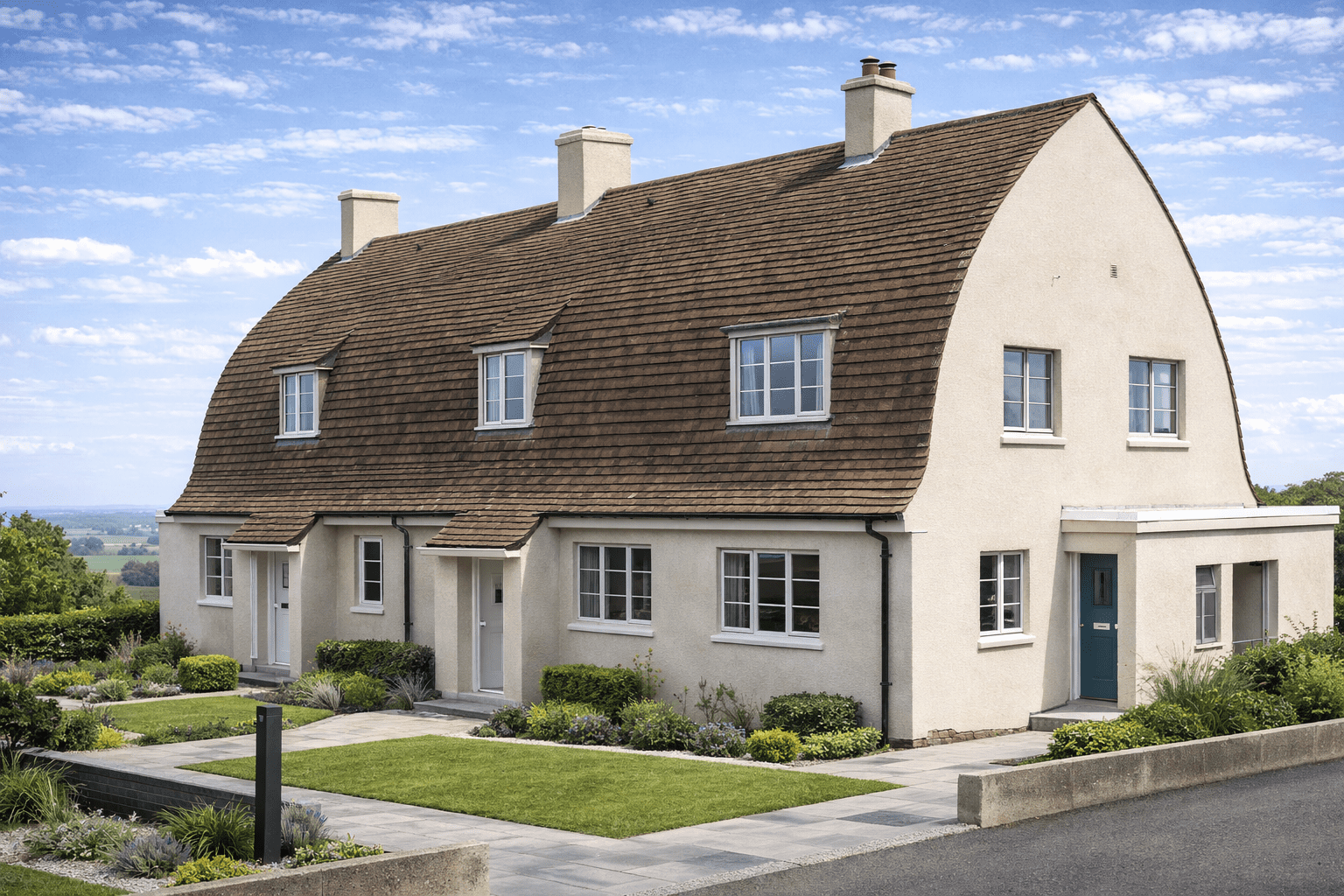
The external walls are constructed in rendered in-situ no-fines concrete up to ground floor sill level. Above this, cavity brickwork rises to the underside of the projecting eaves. The junction between materials requires careful inspection due to differential movement and exposure.
The gable roof is formed using a timber lamella grid structure supported by shaped sprockets. This is overlaid with sarking felt and finished with plain tiles or metal sheeting. Projecting flat-topped dormer windows are incorporated within the roof slope. The gable apex is either rendered or finished with shingles.
The ground floor is concrete. The first floor comprises tongue-and-groove timber boarding laid on stub joists, supported by rolled steel joists bearing onto brickwork. Ceilings are plasterboard lined. The substructure consists of concrete footings.
| Element | Typical construction | Inspection focus |
|---|---|---|
| Substructure | Concrete footings | Movement, cracking, signs of subsidence |
| External walls | Rendered no-fines concrete to sill level with cavity brickwork above | Cracking, spalling, moisture ingress, junction detailing |
| Roof | Timber lamella grid with sarking felt and plain tiles or metal sheeting | Timber decay, insect attack, covering condition, dormer detailing |
| Floors | Concrete ground floor; timber boarding on joists with RSJ support at first floor | Settlement, rot, structural integrity |
| Ceilings | Plasterboard | Cracking, water staining, distortion |
Potential hazards & inspection priorities
Corrosion of steel within concrete elements is a recognised risk. Where reinforcement is present, long-term exposure to moisture can lead to deterioration and localised cracking or spalling.
Carbonation of concrete is also a consideration. As alkalinity reduces over time, embedded steel becomes more vulnerable to corrosion. Monitoring of carbonation depth may be necessary where defects are evident.
The timber lamella roof structure requires ongoing maintenance. Decay, insect infestation, and moisture penetration can affect structural performance. Dormer junctions and roof coverings should be carefully checked for weather tightness.
Moisture ingress more generally can affect concrete, steel, timber, and internal finishes. Early identification of defects reduces the likelihood of wider structural implications.
Is this house right for you?
A Lamella House may appeal to purchasers seeking a distinctive post-war design. However, the construction type requires an understanding of non-traditional materials and the need for regular maintenance.
- Commission a detailed building survey
- Review any history of concrete repairs or roof works
- Assess ongoing maintenance requirements
Careful evaluation of condition is essential before commitment.
Mortgage & resale considerations
The Lamella House is not classified as defective under the Defective Premises Act. However, lender criteria can vary depending on construction type and condition.
Clear reporting on concrete condition, roof integrity, and evidence of maintenance will influence lending and future resale prospects.
What a survey can — and cannot — tell you
A building survey provides an informed assessment of the visible condition and construction of a Lamella House. Inspections are non-intrusive and limited to areas that are accessible at the time of inspection.
- Identify visible cracking and spalling to no-fines concrete and brickwork
- Assess signs of dampness, moisture ingress, and condensation risk
- Comment on roof coverings, dormer detailing, and external envelope condition
- Review the general condition of accessible floors, ceilings, and structural elements
- Highlight defects requiring repair, monitoring, or further investigation
However, there are limitations to what a survey can determine without intrusive investigation.
- Confirm the condition of concealed reinforcement within concrete elements
- Assess hidden structural elements behind finishes or linings
- Determine the full extent of carbonation or internal concrete deterioration
- Inspect areas that are inaccessible or covered at the time of inspection
Where higher-risk indicators are identified, further specialist or intrusive investigation may be recommended.
For a thorough building survey in Greater London, an instant quotation can be obtained through the online survey calculator.
Considering a Lamella House?
A detailed building survey can help clarify construction-specific risks before committing to a purchase.
Get your instant survey quoteDisclaimer: This article is provided for general educational purposes only and is based on industry research, professional knowledge, and experience. It does not relate to any specific property and should not be relied upon when making a purchasing decision. Prospective purchasers should always commission an independent RICS-qualified surveyor to conduct a full inspection and provide a report on the actual condition of any property of interest.
