


Overview
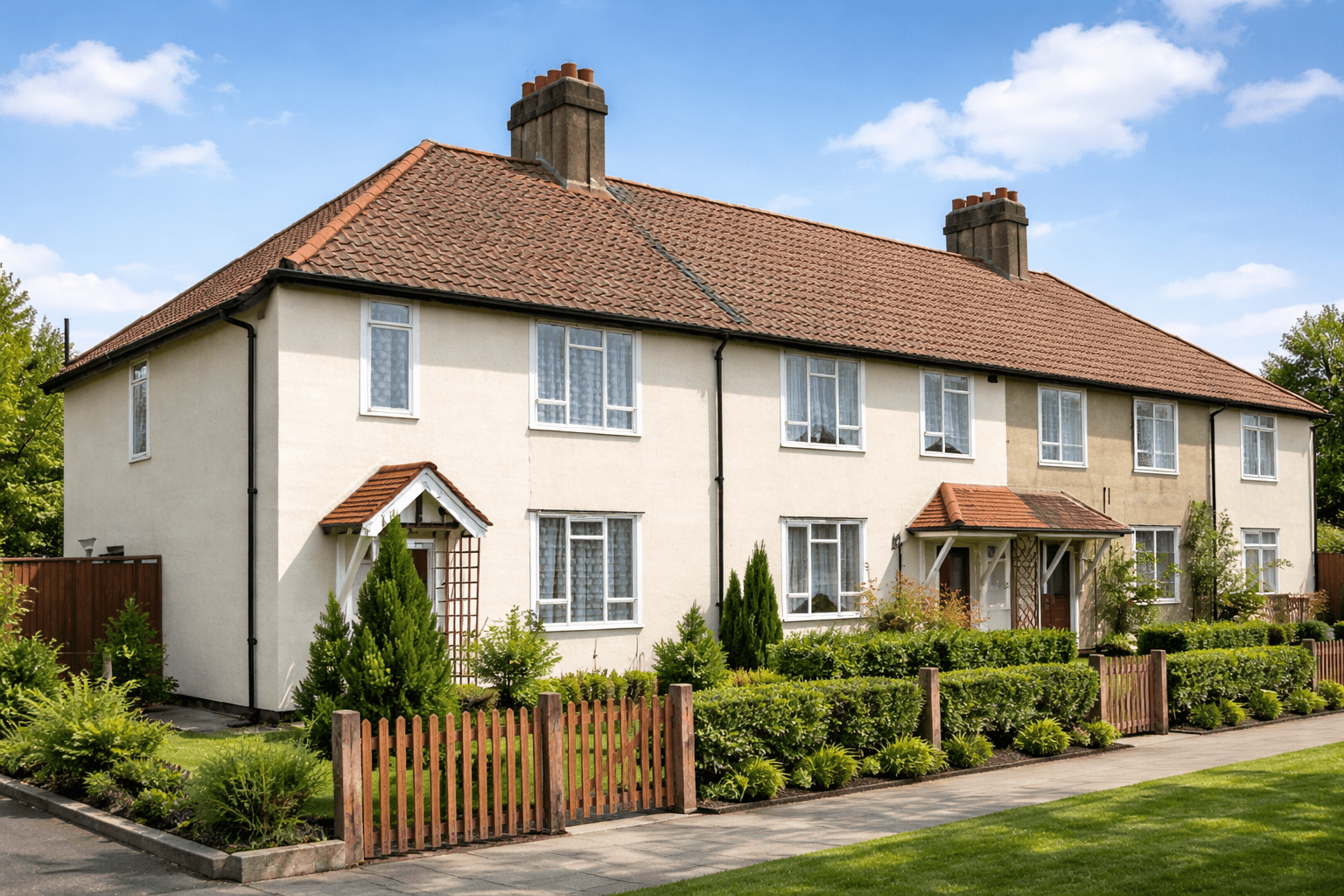
The Kirton house is a distinctive two-storey terraced property type that emerged in the 1920s as part of the UK’s post-World War I housing boom. These homes were developed to address acute housing shortages and were constructed using innovative reinforced concrete methods for the time.
Only eight Kirton houses were built, making them an exceptionally rare construction type within today’s property market.
Kirton houses were constructed using reinforced concrete with rendered external walls and a medium pitch hipped roof covered in concrete tiles. Their limited production makes surviving examples uncommon.
Typical characteristics & construction
Kirton houses are two-storey terraced dwellings constructed around a reinforced concrete main frame. The substructure comprises concrete strip footings with a damp-proof course intended to limit rising moisture.
External walls are formed in 9-inch thick concrete incorporating cast-in tapered vertical and horizontal ventilation cavities. These walls are rendered throughout, creating a uniform external appearance. Integral concrete corbels support the first-floor joists, and window sills are also formed in concrete. Rebated window reveals were incorporated to accommodate window frames neatly within the wall structure.
Internally, both ground and first floors comprise timber boarding on timber joists. Partitions are constructed in concrete, contributing to the overall solidity of the structure. Ceiling construction details are not well documented but are understood to be consistent with timber-based construction methods of the period.
| Element | Typical construction | Inspection focus |
|---|---|---|
| Substructure | Concrete strip footings with damp-proof course | Settlement, cracking, DPC effectiveness |
| Main frame | Reinforced concrete | Carbonation risk, reinforcement corrosion, cracking |
| External walls | 9-inch concrete with cast-in ventilation cavities, rendered finish | Render condition, moisture ingress, blocked cavities |
| Floors | Timber boarding on timber joists | Decay, insect attack, ventilation |
| Roof | Timber rafters and purlins with concrete tiles | Tile brittleness, water ingress, timber condition |
Potential hazards & inspection priorities
The principal structural concern in Kirton houses relates to the reinforced concrete frame. Over time, carbonation can reduce the alkalinity of the concrete, increasing the risk of steel reinforcement corrosion. Progressive corrosion can lead to cracking, spalling and localised structural weakness.
Moisture ingress presents a secondary but significant risk. The cast-in ventilation cavities and air inlet/outlet holes are designed to assist airflow and moisture control; however, if blocked or poorly maintained, dampness can develop within the wall structure. Failure of the damp-proof course can further compound this issue.
Thermal efficiency is also a recognised limitation. Solid concrete walls offer limited insulation by modern standards, which can contribute to higher heating demands and condensation risk. Retrofitting insulation requires careful detailing to avoid trapping moisture within the structure.
Is this house right for you?
A Kirton house will appeal primarily to purchasers comfortable with early reinforced concrete construction and the inspection implications that accompany it.
- Recognition of the rarity of the construction type
- Acceptance of potential specialist repair requirements
- Willingness to commission a detailed pre-purchase survey
Condition, maintenance history and evidence of previous concrete repairs will heavily influence suitability.
Mortgage & resale considerations
As a non-traditional reinforced concrete construction with very limited numbers built, lender acceptance may vary. Mortgage decisions are influenced by structural condition, evidence of concrete deterioration and the clarity of professional reporting.
Clear documentation of repairs, absence of significant cracking or corrosion, and a well-maintained external envelope are typically influential factors.
What a survey can — and cannot — tell you
A building survey provides an informed assessment of the visible condition and construction of a Kirton house. Inspections are non-intrusive and limited to areas that are accessible at the time of inspection.
- Identify visible cracking to reinforced concrete walls and render finishes
- Assess signs of dampness, moisture ingress, and condensation risk
- Comment on roof coverings, drainage details, and external envelope condition
- Review the general condition of accessible floors, ceilings, and structural elements
- Highlight defects that may require repair, monitoring, or further investigation
However, there are limitations to what a survey can determine without intrusive investigation.
- Confirm the condition of concealed steel reinforcement within concrete
- Assess hidden structural elements behind finishes or linings
- Determine the full extent of carbonation or internal concrete deterioration
- Inspect areas that are inaccessible or covered at the time of inspection
Where higher-risk indicators are identified, further specialist or intrusive investigation may be recommended.
For a thorough building survey in Greater London, an instant quotation can be obtained through the online survey calculator.
Considering a Kirton house?
A detailed building survey can help clarify construction-specific risks before committing to a purchase.
Get your instant survey quoteDisclaimer: This article is provided for general educational purposes only and is based on industry research, professional knowledge, and experience. It does not relate to any specific property and should not be relied upon when making a purchasing decision. Prospective purchasers should always commission an independent RICS-qualified surveyor to conduct a full inspection and provide a report on the actual condition of any property of interest.
