


Overview
The Incast house, also known as the No-Fines house, is a unique property type that emerged in the 1940s. Manufactured by the Metropolitan Concrete Co. Ltd, these houses were designed to address the post-war housing shortage in the UK. With only five units built, these properties are rare and hold a special place in the history of British architecture.
Incast houses were constructed in the 1940s by the Metropolitan Concrete Co. Ltd using no-fines reinforced concrete methods developed to deliver rapid, cost-efficient post-war housing.
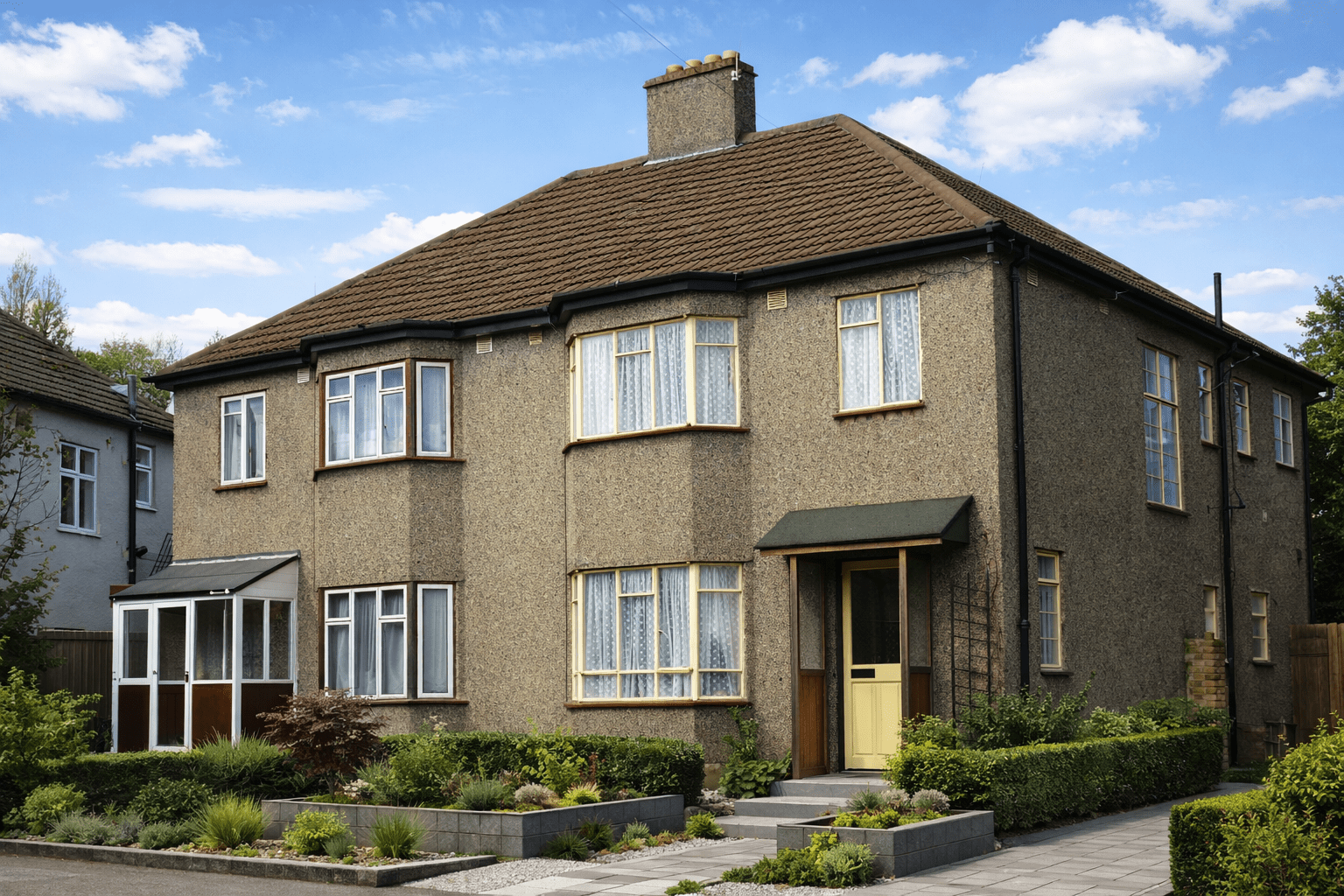
Typical characteristics & construction
Incast houses are typically two-storey detached or semi-detached properties built using no-fines reinforced concrete construction. They were developed during the 1940s in response to urgent housing demand and reflect a focus on speed of build and material efficiency.
They commonly feature a medium pitch hipped roof covered with interlocking concrete tiles. External walls are rendered throughout, creating a uniform external appearance. A distinctive two-storey flat-roofed bay window is often present on the front elevation.
| Element | Typical construction | Key considerations |
|---|---|---|
| Substructure | Concrete strip foundations with reinforced concrete under-building and concrete slab incorporating a damp-proof course | Condition of slab, integrity of DPC, signs of movement or moisture ingress |
| External walls | 4′ I-section no-fines precast concrete columns with 10″ thick no-fines reinforced concrete walls (4″ at bay), rendered finish, bar reinforcement and L-shaped no-fines eaves beam | Cracking, spalling, reinforcement corrosion risk, render condition |
| Separating walls | 8″ thick no-fines reinforced concrete | Structural integrity and signs of cracking |
| Internal partitions | Precast concrete block partitions | Cracking and localised damage |
| Floors | Concrete ground floor; timber boarding on timber joists at first floor with RSJ encased in concrete adjacent to bay window | Dampness, deflection, condition of structural steel support |
| Roof | Timber rafters and purlins with interlocking concrete tiles; timber flat roof over bay window | Tile condition, flat roof integrity, moisture ingress |
Potential hazards & inspection priorities
The principal risk in Incast houses relates to the performance of the no-fines reinforced concrete. Cracking and spalling can occur where moisture reaches embedded reinforcement, leading to corrosion and progressive deterioration if not addressed.
Moisture ingress is another significant concern. Failure of the damp-proof course, deterioration of render, or defects in the roof covering — particularly over the flat-roofed bay — can permit water penetration affecting both structure and internal finishes.
Thermal efficiency is limited by modern standards. These properties were built prior to contemporary insulation requirements, and upgrading thermal performance can be complex due to the nature of the concrete wall construction.
Is this house right for you?
Incast houses are rare and historically significant, but they require careful evaluation of condition. Prospective purchasers should understand the implications of no-fines reinforced concrete construction and the importance of ongoing maintenance.
- Review previous survey reports and maintenance documentation
- Assess evidence of concrete repair or render renewal
- Consider the condition of the flat roof and damp-proof detailing
- Recognise that thermal upgrades may require specialist design input
Mortgage & resale considerations
As a non-traditional construction type with very limited numbers built, lender attitudes can vary. The condition of the reinforced concrete, evidence of effective maintenance, and clarity of professional reporting are likely to influence decision-making.
Where structural defects or unresolved moisture issues are identified, these may affect lending or future marketability until remedial works are completed.
What a survey can — and cannot — tell you
A building survey provides an informed assessment of the visible condition and construction of an Incast house. Inspections are non-intrusive and limited to areas that are accessible at the time of inspection.
- Identify visible cracking or spalling to no-fines concrete walls and associated render
- Assess signs of dampness, moisture ingress, and condensation risk
- Comment on roof coverings, including the flat-roofed bay, and external envelope condition
- Review the general condition of accessible floors, ceilings, and structural elements
- Highlight defects that may require repair, monitoring, or further investigation
However, there are limitations to what a survey can determine without intrusive investigation.
- Confirm the condition of concealed reinforcement within no-fines concrete
- Assess hidden structural elements behind finishes or linings
- Determine the full extent of internal concrete deterioration
- Inspect areas that are inaccessible or covered at the time of inspection
Where higher-risk indicators are identified, further specialist or intrusive investigation may be recommended.
For a thorough building survey in Greater London, an instant quotation can be obtained through the online survey calculator.
Considering a Incast house?
A detailed building survey can help clarify construction-specific risks before committing to a purchase.
Get your instant survey quoteDisclaimer: This article is provided for general educational purposes only and is based on industry research, professional knowledge, and experience. It does not relate to any specific property and should not be relied upon when making a purchasing decision. Prospective purchasers should always commission an independent RICS-qualified surveyor to conduct a full inspection and provide a report on the actual condition of any property of interest.
