


Overview
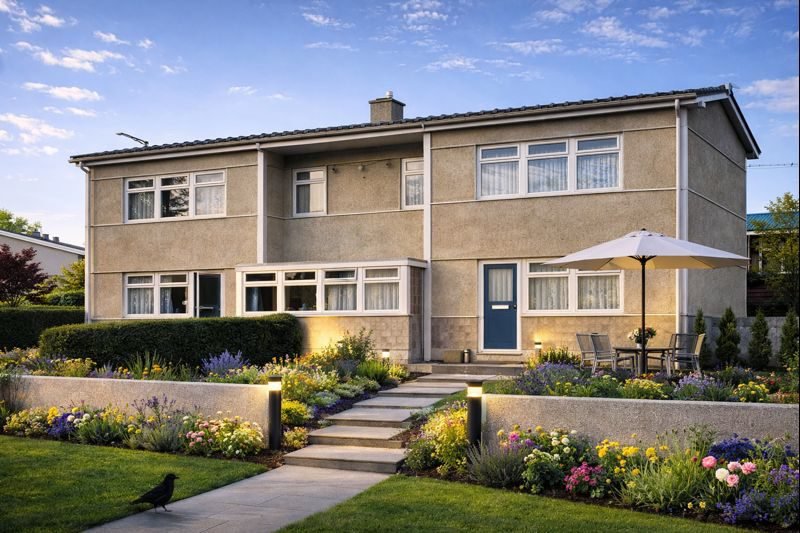
The Howard Type A house is a rare post-war non-traditional property manufactured by John Howard & Co. Ltd and designed by Phillip Powell and Eric Chick. Constructed in 1945, immediately following the Second World War, only two examples were ever built, making this one of the least common post-war housing types encountered in practice.
Howard Type A houses are two-storey semi-detached dwellings of steel-framed construction with extensive use of asbestos cement and woodwool panels. Their rarity means lender familiarity is limited and condition assessment is critical.
Typical characteristics & construction
Howard Type A houses are two-storey semi-detached properties, identifiable by shallow pitch gable roofs clad with profiled asbestos cement sheets and steel-framed windows. External walls incorporate clay tile-faced precast concrete panels at lower levels, with flat asbestos cement sheets above arranged in horizontal bands.
The substructure comprises a concrete slab stepped around the perimeter with an extended apron and incorporated damp-proof course. The superstructure is formed from a complex steel frame using rolled steel angles, rolled steel joists, rolled steel tees, and pre-stressed concrete and flitched timber floor members.
Wall cavities are timber-framed, lined with asbestos cement sheets, and infilled with woodwool slabs. Similar construction is used to internal partitions and the separating wall between dwellings.
| Element | Typical construction | Inspection focus |
|---|---|---|
| Substructure | Concrete slab with perimeter apron and DPC | Cracking, movement, damp transfer |
| Frame | Steel stanchions, beams, trusses and purlins | Corrosion, protection coating condition |
| External walls | PC panels, timber framing, asbestos cement sheets | Damp ingress, panel condition, fixings |
| Roof | Profiled asbestos cement sheets | Sheet degradation, fixings, weathering |
| Internal elements | Woodwool slabs with asbestos linings | Damp, distortion, surface deterioration |
Potential hazards & inspection priorities
The primary inspection risks relate to asbestos-containing materials, steel frame corrosion, and moisture performance. Asbestos cement sheets are present externally and internally and require careful condition assessment, particularly where fixings, edges, or previous alterations are evident.
Steel components rely on unknown protective coatings. Where moisture ingress has occurred, corrosion risk increases and can affect structural performance. Woodwool infill panels are also vulnerable to prolonged damp exposure, with associated mould growth and material breakdown.
Is this house right for you?
Howard Type A houses demand a clear understanding of non-traditional construction and long-term management responsibilities.
- Condition and corrosion protection of the steel frame
- Extent, condition, and management of asbestos-containing materials
- Evidence of damp control and historic maintenance
Mortgage & resale considerations
Lender acceptance is influenced by construction type, asbestos content, and clarity of professional reporting. Given the extreme rarity of this house type, mortgage decisions are often case-specific and dependent on detailed survey findings.
What a survey can — and cannot — tell you
A building survey provides an informed assessment of the visible condition and construction of a Howard Type A house. Inspections are non-intrusive and limited to areas that are accessible at the time of inspection.
- Identify visible deterioration to asbestos cement sheets and panels
- Assess signs of corrosion to accessible steel elements
- Comment on dampness, moisture ingress, and condensation risk
- Review the condition of floors, ceilings, and wall linings
- Highlight defects requiring repair, monitoring, or further investigation
However, there are limitations to what a survey can determine without intrusive investigation.
- Confirm the condition of concealed steelwork and coatings
- Assess hidden corrosion within wall or floor voids
- Determine the internal condition of asbestos-containing materials
- Inspect areas that are inaccessible or covered at the time of inspection
Where higher-risk indicators are identified, further specialist or intrusive investigation may be recommended.
For a thorough building survey in Greater London, an instant quotation can be obtained through the online survey calculator.
Considering a Howard Type A House?
A detailed building survey can help clarify construction-specific risks before committing to a purchase.
Get your instant survey quoteDisclaimer: This article is provided for general educational purposes only and is based on industry research, professional knowledge, and experience. It does not relate to any specific property and should not be relied upon when making a purchasing decision. Prospective purchasers should always commission an independent RICS-qualified surveyor to conduct a full inspection and provide a report on the actual condition of any property of interest.
