


Overview
The Hillcon house, also referred to as the Hills house, is a rare form of post-war system-built housing constructed in the early 1950s. Designed by Hills Patent Glazing Co. Ltd and manufactured by Hills (West Bromwich) Ltd, these two-storey semi-detached properties were built in 1952 in limited numbers, with only around 100 units completed.
They were developed to address post-war housing shortages and are generally found in specific suburban locations where rapid housing delivery was required.
Hillcon houses are two-storey semi-detached system-built properties dating from 1952. Their limited production makes them relatively uncommon within the UK housing stock.
Typical characteristics & construction
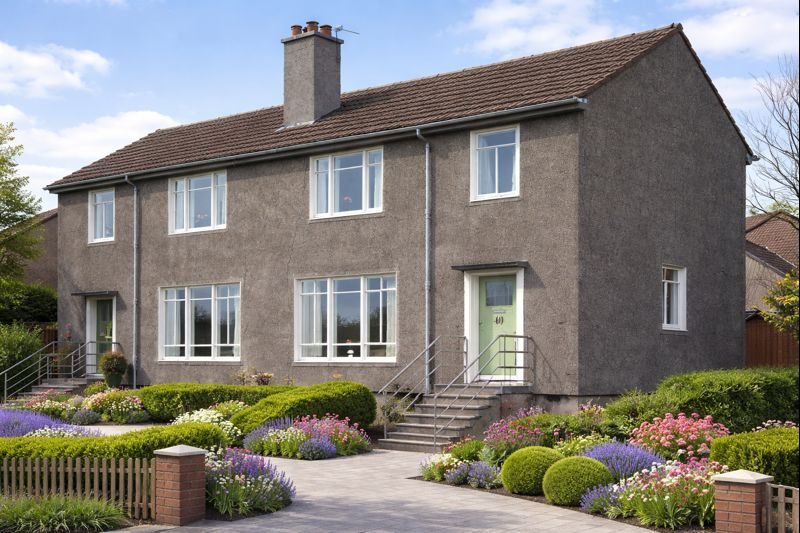
Hillcon houses are two-storey semi-detached dwellings with medium-pitch gable roofs finished in interlocking concrete tiles. External walls are harled throughout, with smoother render detailing around door and window openings.
Pre-stressed concrete door and window surrounds are a defining feature, along with a flat pre-cast concrete canopy over the principal entrance.
| Element | Typical construction | Inspection focus |
|---|---|---|
| Substructure | Concrete strip footings with brick under-building and DPC | Settlement, damp-proof course condition, moisture ingress |
| Frame | Steel lattice stanchions and beams with protective coatings | Corrosion, particularly at stanchion bases |
| External walls | Brick, cavity, and timber framing with plasterboard lining | Dampness, render condition, insulation performance |
| Floors | Concrete ground floor and T&G first floor on steel lattice joists | Deflection, dampness, general stability |
| Roof | Timber battens and sarking with interlocking concrete tiles | Tile condition, timber decay, weather tightness |
Potential hazards & inspection priorities
The most significant issue associated with Hillcon houses is corrosion of the steel lattice stanchions. This was evident during inspection guidance for this construction type and is particularly critical where corrosion occurs at the base of the stanchions.
Moisture ingress is also a recurring concern, often linked to deteriorated external render or failure of the damp-proof course. Internal dampness can accelerate corrosion and affect timber components.
Insulation levels, while present within cavity walls, fall below modern expectations and should be considered a longer-term performance issue rather than a defect.
Is this house right for you?
Hillcon houses may be suitable for purchasers who understand non-traditional construction and are prepared to rely on detailed professional inspection rather than assumptions based on appearance alone.
- Commission a full building survey
- Pay particular attention to steel frame condition
- Budget for maintenance of render and protective coatings
Mortgage & resale considerations
Mortgage acceptance for Hillcon houses can vary depending on lender criteria and the clarity of professional reporting. Construction type and confirmed condition of the steel frame are key considerations.
Clear survey findings and evidence of maintenance are often influential in both lending and resale decisions.
What a survey can — and cannot — tell you
A building survey provides an informed assessment of the visible condition and construction of a Hillcon house. Inspections are non-intrusive and limited to areas that are accessible at the time of inspection.
- Identify visible corrosion to steel lattice stanchions and beams
- Assess signs of dampness, moisture ingress, and condensation risk
- Comment on roof coverings, drainage, and external envelope condition
- Review the general condition of accessible floors, ceilings, and walls
- Highlight defects requiring repair, monitoring, or further investigation
However, there are limitations to what a survey can determine without intrusive investigation.
- Confirm the condition of concealed steelwork within walls
- Assess hidden structural elements behind finishes
- Determine the full extent of corrosion where access is restricted
- Inspect areas that are inaccessible at the time of inspection
Where higher-risk indicators are identified, further specialist or intrusive investigation may be recommended.
For a thorough building survey in Greater London, an instant quotation can be obtained through the online survey calculator.
Considering a Hillcon house?
A detailed building survey can help clarify construction-specific risks before committing to a purchase.
Get your instant survey quoteDisclaimer: This article is provided for general educational purposes only and is based on industry research, professional knowledge, and experience. It does not relate to any specific property and should not be relied upon when making a purchasing decision. Prospective purchasers should always commission an independent RICS-qualified surveyor to conduct a full inspection and provide a report on the actual condition of any property of interest.
