


Overview
When considering a property purchase in the UK, understanding the intricacies of different property types is crucial. One such property type is the Herald house, also known as the Page-Johnson house. These properties were predominantly built during the 1960s in response to significant demand for affordable housing and are commonly found in suburban estates developed during that period.
Herald houses were manufactured by Page-Johnson Construction Ltd and designed by Page-Johnson Design Ltd. They were produced primarily during the 1960s, although the exact number constructed remains unclear.
Typical characteristics & construction
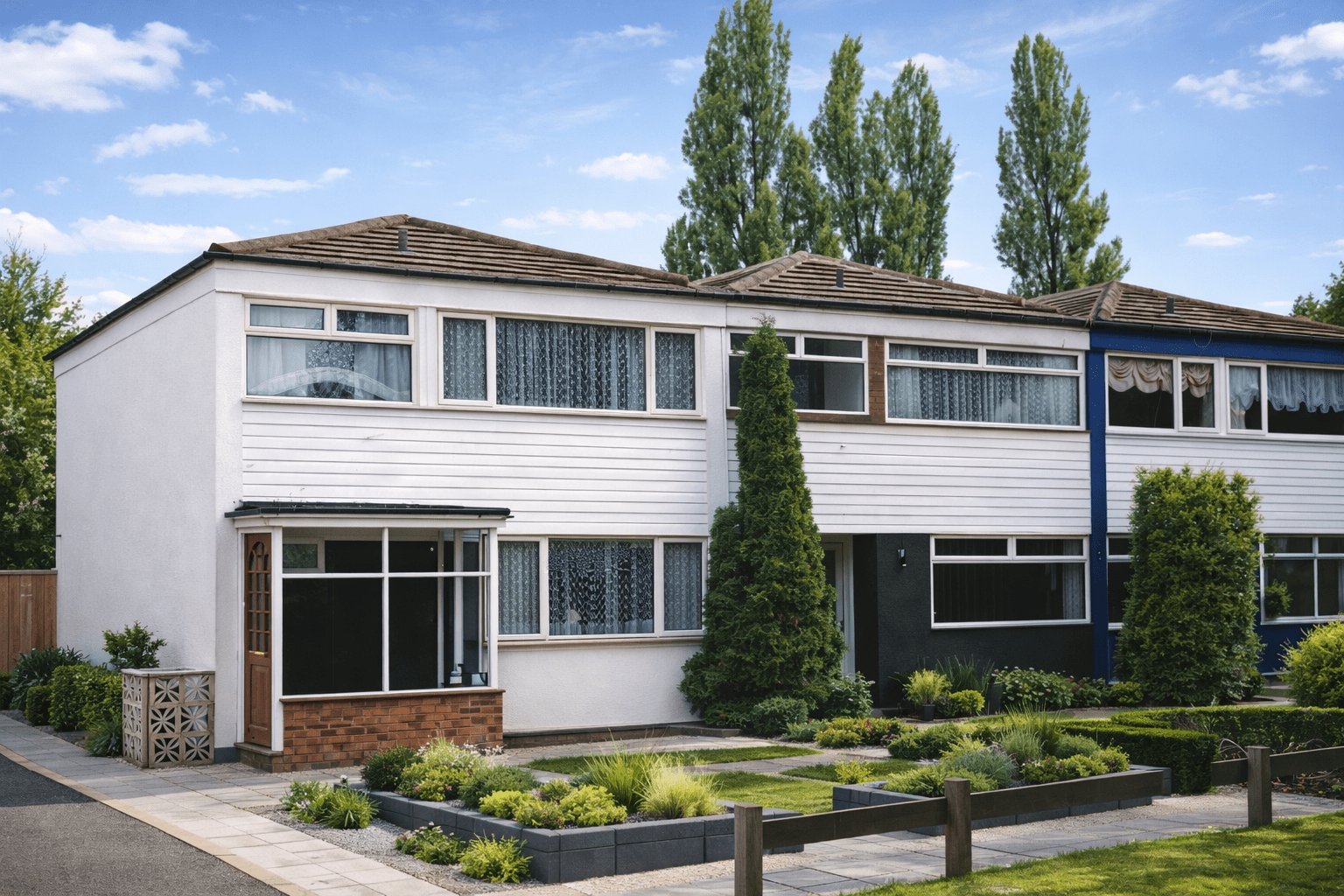
Herald houses were constructed in both bungalow form and as two-storey terraced houses. They share a number of distinctive architectural and structural elements.
Roofs are shallow pitch and hipped in form, finished with interlocking concrete tiles. Front and rear elevations are clad with vertical timber boarding up to first-floor level, backed with bituminous felt, with shiplap timber boarding or tile hanging above. Flank walls are generally formed in lightweight aggregate concrete and finished in textured concrete or faced with light-coloured stone bricks.
| Element | Typical construction | Inspection focus |
|---|---|---|
| Substructure | Concrete ring beam foundation with concrete ground floor slab and damp proof membrane | Cracking, movement, signs of damp proof membrane failure |
| Front & rear walls | Timber frame panels with vertical boarding and shiplap or tile hanging above; foil-backed plasterboard internally | Rot, insect attack, moisture ingress, condition of cladding and linings |
| Flank walls | 8-inch lightweight aggregate concrete | Cracking, spalling, signs of carbonation |
| Separating walls | 8-inch dense aggregate concrete | Structural integrity, cracking, fire separation performance |
| Floors | Concrete ground floor; chipboard on timber joists at first floor with mild steel straps and timber wall plate | Moisture, sagging, deflection, strap corrosion |
| Roof | Timber rafters and binders with interlocking concrete tiles | Tile condition, timber decay, roof stability |
Potential hazards & inspection priorities
Primary risks relate to the durability of timber frame components and the long-term performance of concrete elements. Timber cladding and framing can be vulnerable to rot and insect infestation, particularly where detailing allows moisture retention.
Concrete components, including ring beams and flank walls, may exhibit cracking, spalling, or carbonation over time. These issues can affect durability and, if reinforcement is present, potentially compromise structural performance.
Damp and condensation are recurring concerns, particularly where the damp proof membrane has deteriorated or where insulation levels fall short of modern standards. Moisture ingress can result in mould growth, decay, and deterioration of internal finishes.
Fire safety measures, including fire doors and smoke detection, should be assessed to ensure they remain effective and compliant with current expectations.
Is this house right for you?
Herald houses offer a blend of affordability and functional 1960s design. However, buyers should understand the implications of mixed timber and concrete construction and the maintenance demands associated with exposed timber cladding.
- Arrange a detailed building survey
- Review evidence of past maintenance and timber treatment
- Assess whether insulation upgrades have been undertaken
- Check for previous concrete repairs or structural movement
Where maintenance has been consistent and defects addressed promptly, these properties can perform satisfactorily. Neglect, particularly in relation to moisture control, can accelerate deterioration.
Mortgage & resale considerations
Lender acceptance will depend on construction type, condition, and clarity of reporting. While Herald houses are not universally classified as defective under the Defective Premises Act 1972, their age and non-traditional elements can prompt closer scrutiny.
Clear evidence of maintenance, absence of significant structural defects, and professional reporting are important factors influencing mortgage decisions and future resale prospects.
What a survey can — and cannot — tell you
A building survey provides an informed assessment of the visible condition and construction of a Herald house. Inspections are non-intrusive and limited to areas that are accessible at the time of inspection.
- Identify visible rot or deterioration to timber cladding and frame elements
- Assess cracking, spalling, or carbonation signs in concrete components
- Comment on roof coverings, drainage details, and external envelope condition
- Review the general condition of accessible floors, ceilings, and structural elements
- Highlight defects that may require repair, monitoring, or further investigation
However, there are limitations to what a survey can determine without intrusive investigation.
- Confirm the condition of concealed timber frame elements behind finishes
- Assess hidden reinforcement within concrete walls or ring beams
- Determine the full extent of carbonation or embedded steel corrosion
- Inspect areas that are inaccessible or covered at the time of inspection
Where higher-risk indicators are identified, further specialist or intrusive investigation may be recommended.
For a thorough building survey in Greater London, an instant quotation can be obtained through the online survey calculator.
Considering a Herald house?
A detailed building survey can help clarify construction-specific risks before committing to a purchase.
Get your instant survey quoteDisclaimer: This article is provided for general educational purposes only and is based on industry research, professional knowledge, and experience. It does not relate to any specific property and should not be relied upon when making a purchasing decision. Prospective purchasers should always commission an independent RICS-qualified surveyor to conduct a full inspection and provide a report on the actual condition of any property of interest.
