


Overview
The Hawthorn Leslie house, also known as HLB or Plasteel, is a system-built property type manufactured between 1964 and 1969. These homes were designed by P Keate and F Mould and produced by Hawthorn Leslie (Buildings). A total of 3,600 units were constructed, forming a recognisable part of mid-20th-century British housing.
These properties were built as bungalows and as two-storey detached, semi-detached, and terraced houses. They were developed as part of the wider post-war programme for faster delivery of housing, using prefabricated and system-build methods intended to speed construction and reduce cost.
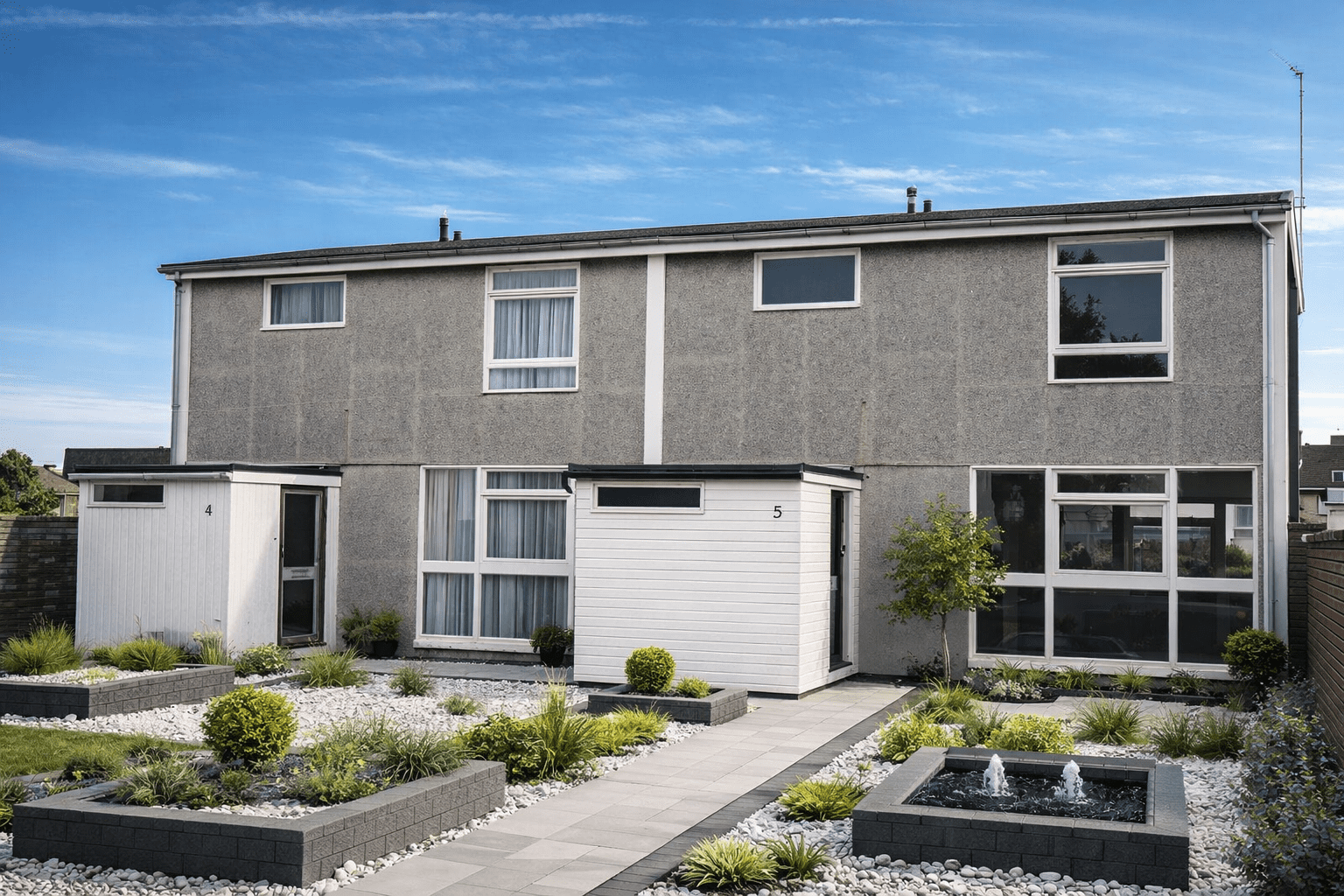
Hawthorn Leslie houses (HLB / Plasteel) were produced between 1964 and 1969. They are often found on 1960s suburban estates and are commonly identified by shallow pitch gable roofs (or flat felt roofs), storey-height cladding panels with coloured aggregate finishes, and prominent timber cover strips at key junctions.
Typical characteristics & construction
Hawthorn Leslie houses are generally found on 1960s estates and were constructed in a range of forms, including bungalows and two-storey detached, semi-detached, and terraced dwellings. Externally, these homes are commonly identified by shallow pitch gable roofs covered with interlocking concrete tiles, or flat roofs covered with bituminous felt.
External walls are formed with storey-height cladding panels coated with various coloured aggregate finishes. Large section timber cover strips are used to mask corner and separating wall junctions. Gable apex areas are often clad with timber shiplap boarding.
Construction is based around a steel frame using RS hollow box stanchions and an RSA floor support beam, with a Primocon protective paint finish. Wall panels are bolted through the stanchions and overlapped at first-floor level, with internal linings and insulation as part of the panel build-up.
| Element | Typical construction | Inspection focus |
|---|---|---|
| Substructure | Concrete pads below stanchions with perimeter kerb in oversite concrete; DPC included | Localised movement, cracking, condition around stanchion bases, DPC continuity |
| Frame | Nine RS hollow box stanchions (one single storey) and one RSA floor support beam; Primocon protective coating | Corrosion at stanchion bases and frame members; coating breakdown; stability and fixings |
| External walls | Storey-height galvanised MS channel panels with asbestos cement sheets and aggregate finish; plasterboard lining; polyurethane insulation; bolted and overlapped at first floor; timber cover strips at key junctions | Aggregate coating separation, panel distortion/warping, fixings, rain penetration at junctions, condition of cover strips |
| Separating wall | Block cavity wall; 9" blocks laid flat in roof space | Build quality in roof space, gaps or discontinuity, sound/thermal performance issues |
| Partitions | Honeycomb plasterboard | Stability, impact damage, signs of movement or alteration |
| Floors | Chipboard on timber joists (ground and first floor) | Sagging, deflection, moisture damage, localised softness |
| Ceilings | Plasterboard | Cracking, staining, evidence of leaks or condensation |
| Roof | Timber trusses; bituminous felt and interlocking concrete tiles (depending on roof form) | Felt deterioration (where present), tile condition, racking of trusses in detached dwellings, leaks and associated damage |
Potential hazards & inspection priorities
The primary concerns with Hawthorn Leslie houses relate to frame corrosion and moisture paths through the external envelope. Corrosion is often noted at the bases of RS hollow box stanchions and plain metal panel frames. Loose or missing holding down bolts are a direct stability issue and should be treated as a priority during inspection.
Cladding performance is another key area. Separation of the aggregate coating and warping of asbestos cement cladding sheets can affect both weather resistance and appearance. Rain penetration is commonly associated with panel-window frame joints where sealing is poor or has degraded, which can lead to internal dampness and mould.
Roofing defects are also material. Deterioration of bituminous felt can lead to leaks and water damage, while racking of roof trusses (particularly in detached dwellings) can compromise the roof structure. Poorly constructed roof space separating walls can reduce thermal performance and allow sound transmission between adjoining properties.
Asbestos cement sheet claddings and fire protection casings present a significant hazard if disturbed. Any proposed repair or alteration works should take account of this, with appropriate professional handling where asbestos-containing materials are suspected or identified.
Is this house right for you?
A Hawthorn Leslie house can be a practical option, but it needs to be assessed on its individual condition and any evidence of long-term water ingress or frame deterioration. In practice, the decision often turns on whether the external envelope is performing, and whether the frame and fixings are in sound condition.
- Commission a full building survey with close attention to frame condition, cladding build-up, and fixings
- Check for signs of rain penetration at panel joints and around windows and doors
- Approach any cladding or casing works cautiously where asbestos cement products may be present
- Review roof condition, including felt deterioration (where applicable) and any evidence of truss racking
Mortgage & resale considerations
Mortgage and resale decisions for system-built properties are influenced by construction type and the clarity of professional reporting. Acceptance criteria can vary between lenders, and the issues associated with Hawthorn Leslie houses can affect lending decisions where significant defects are identified.
The Defective Premises Act 1972 is intended to ensure properties are built to a reasonable standard and are safe for occupation. Where a Hawthorn Leslie house has significant structural issues such as corrosion, loose holding down bolts, or warping of asbestos cement sheets, it may be regarded as defective. The practical approach is to obtain a thorough inspection and clear advice on the extent of defects and the remedial actions required.
What a survey can — and cannot — tell you
A building survey provides an informed assessment of the visible condition and construction of a Hawthorn Leslie house (HLB / Plasteel). Inspections are non-intrusive and limited to areas that are accessible at the time of inspection.
- Identify visible corrosion to accessible steel stanchions, beams, and panel frames
- Assess signs of dampness, rain penetration, moisture ingress, and mould risk around panel junctions and openings
- Comment on roof coverings, felt or tile condition, and associated roof structure issues such as truss racking
- Review the general condition of accessible floors, ceilings, partitions, and separating wall details within the roof space
- Highlight defects that may require repair, monitoring, or further investigation
However, there are limitations to what a survey can determine without intrusive investigation.
- Confirm the condition of concealed steelwork within panel constructions or behind linings
- Assess hidden structural elements behind finishes, casings, or inaccessible junctions
- Determine the full extent of concealed moisture paths within the panel build-up
- Inspect areas that are inaccessible or covered at the time of inspection
Where higher-risk indicators are identified, further specialist or intrusive investigation may be recommended.
For a thorough building survey in Greater London, an instant quotation can be obtained through the online survey calculator.
Considering a
A detailed building survey can help clarify construction-specific risks before committing to a purchase.
Get your instant survey quoteDisclaimer: This article is provided for general educational purposes only and is based on industry research, professional knowledge, and experience. It does not relate to any specific property and should not be relied upon when making a purchasing decision. Prospective purchasers should always commission an independent RICS-qualified surveyor to conduct a full inspection and provide a report on the actual condition of any property of interest.
