


Overview
The Gadie house is a distinctive UK property type constructed during the 1920s. Developed in response to post-World War I housing demand, these system-built semi-detached homes were designed to provide durable and cost-effective accommodation during a period of national housing shortage.
Only 82 units were constructed, making surviving examples relatively rare. They are typically found in suburban settings where demand for semi-detached housing was strong.
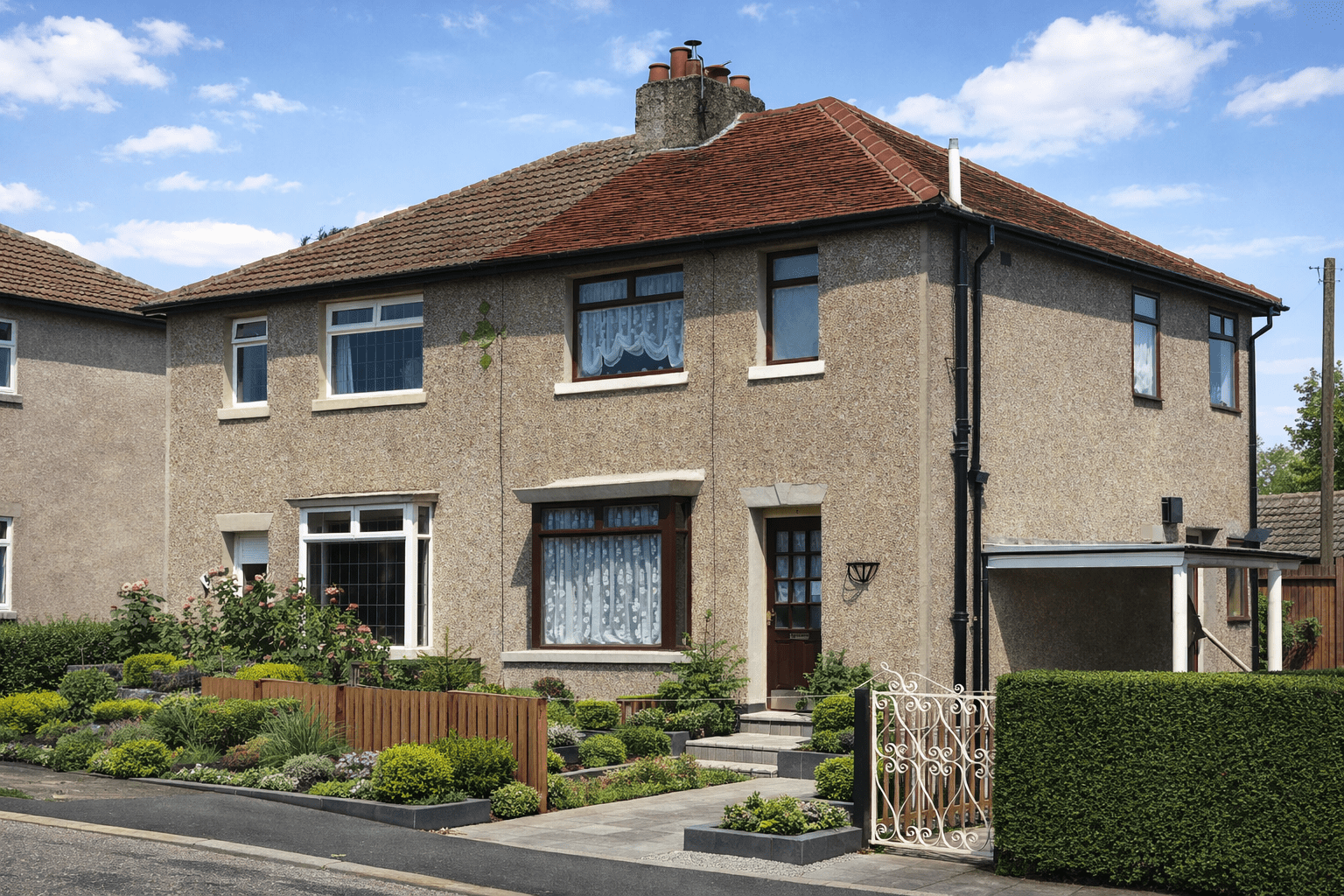
Gadie houses were designed and manufactured by Gadie using clinker concrete construction techniques. They are two-storey semi-detached dwellings characterised by rendered elevations, hipped roofs and reinforced concrete elements.
Typical characteristics & construction
Gadie houses are two-storey semi-detached dwellings with a medium pitch hipped roof, generally covered in concrete tiles or slates. Elevations are fully rendered, with smooth render at corners formed to resemble ashlar quoins. A square fronted single-storey flat-roofed bay is a common identifying feature.
The substructure comprises clinker concrete underbuilding incorporating a damp-proof course and air bricks. External walls are formed using 4′ 0″ x 12″ dry-laid clinker aggregate concrete blocks with a 4″ cavity. Clinker reinforced concrete columns incorporating 3/8″ bar reinforcement are created using chamfered panel ends and timber formers retained within the cavity.
Separating walls between semi-detached units are constructed in clinker aggregate concrete blockwork. Internal partition materials are not well documented. Ground floors are typically timber, with first floors formed in timber boarding on joists built into the external walls. Roof structures consist of timber rafters finished in tile or slate coverings.
| Element | Typical construction | Inspection focus |
|---|---|---|
| Substructure | Clinker concrete underbuilding with DPC and air bricks | Efflorescence, moisture ingress, condition of concrete and ventilation |
| External walls | Dry-laid clinker aggregate concrete blocks with 4″ cavity and RC columns | Bowing, cracking, corrosion of reinforcement, render condition |
| Floors | Timber ground and first floors | Movement, moisture ingress, condition of joist bearings |
| Roof | Timber rafters with concrete tiles or slates | Tile/slate condition, structural integrity, water ingress |
| Lintels & sills | Reinforced concrete | Cracking, corrosion, signs of distress |
Potential hazards & inspection priorities
Corrosion of reinforcement within clinker reinforced concrete columns is a primary concern. Prolonged moisture exposure can lead to expansion of embedded steel, cracking of surrounding concrete and progressive structural weakening.
Bowing of external walls has been observed in some examples. This may relate to foundation movement, thermal effects or moisture-related deterioration. Progressive distortion can lead to cracking and local instability.
Efflorescence to internal faces of substructure walls indicates moisture migration through clinker concrete. While often superficial, it signals ongoing damp conditions that require investigation.
Distress to reinforced concrete lintels and window sills can occur through corrosion or structural movement. Cracking at openings should be carefully assessed to determine whether reinforcement deterioration is present.
Is this house right for you?
A Gadie house requires an informed assessment of its clinker concrete construction and reinforced elements. The rarity of the type means condition varies depending on maintenance history and exposure.
- Commission a detailed building survey
- Review previous structural repairs or reinforcement treatment
- Assess evidence of ongoing moisture ingress
- Consider future maintenance of render and reinforced concrete elements
Understanding the performance of the reinforced components is central to evaluating suitability.
Mortgage & resale considerations
As a non-traditional construction type with reinforced concrete elements, lending decisions may depend on condition, evidence of deterioration and the clarity of professional reporting.
Clear documentation of maintenance and absence of significant structural distress are commonly influential in both mortgage assessment and future resale.
What a survey can — and cannot — tell you
A building survey provides an informed assessment of the visible condition and construction of a Gadie house. Inspections are non-intrusive and limited to areas that are accessible at the time of inspection.
- Identify visible cracking to clinker concrete walls and associated render
- Assess signs of dampness, moisture ingress, and condensation risk
- Comment on roof coverings, drainage details, and external envelope condition
- Review the general condition of accessible floors, ceilings, and structural elements
- Highlight defects that may require repair, monitoring, or further investigation
However, there are limitations to what a survey can determine without intrusive investigation.
- Confirm the condition of concealed reinforcement within clinker reinforced concrete columns
- Assess hidden structural elements behind finishes or linings
- Determine the full extent of internal concrete deterioration
- Inspect areas that are inaccessible or covered at the time of inspection
Where higher-risk indicators are identified, further specialist or intrusive investigation may be recommended.
For a thorough building survey in Greater London, an instant quotation can be obtained through the online survey calculator.
Considering a Gadie house?
A detailed building survey can help clarify construction-specific risks before committing to a purchase.
Get your instant survey quoteDisclaimer: This article is provided for general educational purposes only and is based on industry research, professional knowledge, and experience. It does not relate to any specific property and should not be relied upon when making a purchasing decision. Prospective purchasers should always commission an independent RICS-qualified surveyor to conduct a full inspection and provide a report on the actual condition of any property of interest.
