


Overview
The Forrester-Marsh house, also known as Edward’s Construction, is a non-traditional property type that emerged in the 1920s. Designed and manufactured by Edwards Construction Co. Ltd, these houses formed part of the wider response to housing shortages following the First World War.
Only 50 units were constructed, making surviving examples relatively rare within the UK housing stock.
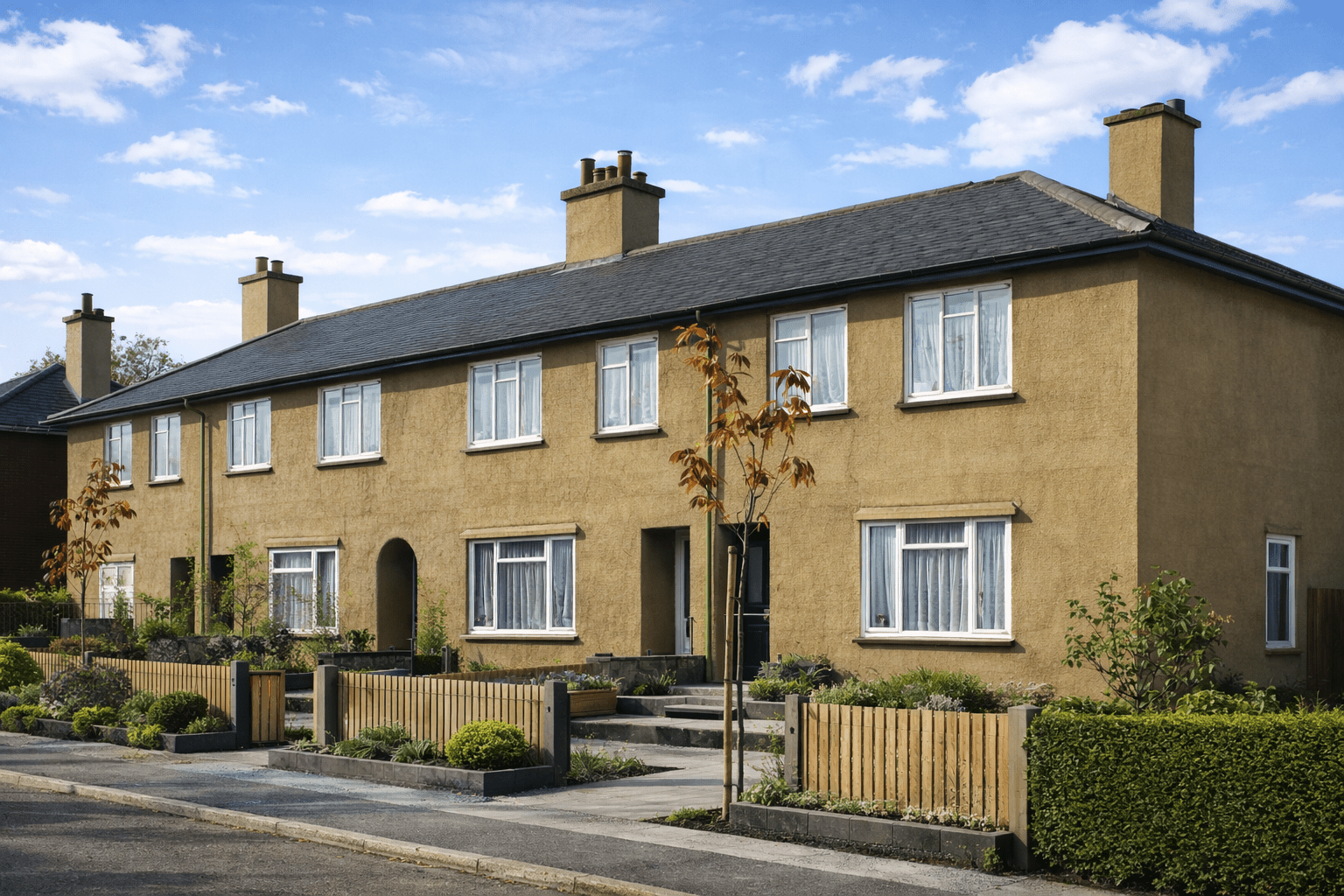
Forrester-Marsh houses are two-storey terraced dwellings with rendered reinforced concrete external walls and a distinctive re-entrant front door porch. They were built using a combination of dense aggregate reinforced concrete and clinker aggregate concrete.
Typical characteristics & construction
Forrester-Marsh houses are typically two-storey terraced properties with medium-pitch hipped roofs covered in tiles. External walls are rendered, either with a pebbledash or smooth finish, and the recessed entrance porch is a defining architectural feature.
Construction combines reinforced concrete and clinker aggregate concrete, reflecting building practices of the 1920s.
| Element | Typical construction | Inspection focus |
|---|---|---|
| Substructure | Reinforced concrete slab deepened below load-bearing walls to form downstand beams with damp-proof course | Cracking, settlement, signs of moisture ingress |
| External walls | 2½" dense aggregate reinforced concrete outer leaf, 2½" ventilated cavity, 3" clinker aggregate reinforced concrete inner leaf, tied together; rendered finish; brick header course at eaves; timber wall plate | Carbonation, reinforcement corrosion, horizontal and vertical cracking, render condition |
| Separating walls | Concrete construction between terraced units | Cracking, movement, soundness |
| Internal partitions | Clinker and dense aggregate concrete | Degradation, cracking, local weakness |
| Ground floor | Reinforced concrete slab | Cracking, damp-related defects |
| First floor | Timber joists with timber boarding | Deflection, decay, condition of joists and boards |
| Roof | Timber rafters and purlins with tiled covering | Condition of timber structure, tile security, signs of water ingress |
Potential hazards & inspection priorities
The principal technical concern in Forrester-Marsh houses is carbonation of the dense aggregate reinforced concrete external walls. Over time, carbonation can progress through the concrete cover, potentially leading to corrosion of embedded reinforcement.
The clinker aggregate concrete used to the inner leaf and internal partitions can also be unsound. Degradation of this material may give rise to localised weakness and cracking.
Horizontal and vertical cracking to the rendered external walls is another recognised issue. Such cracking can permit moisture ingress, accelerating deterioration of both concrete and reinforcement if left unaddressed.
Is this house right for you?
A Forrester-Marsh house will require an understanding of early reinforced concrete construction and its long-term behaviour.
- Commission a detailed building survey
- Assess the extent of cracking and any evidence of carbonation-related deterioration
- Consider the condition of clinker aggregate internal elements
A clear appraisal of structural condition is essential before commitment.
Mortgage & resale considerations
Forrester-Marsh houses are not classed as defective under the Defective Premises Act. However, the presence or absence of significant concrete deterioration, cracking or reinforcement corrosion is likely to influence lending and resale decisions.
Clear reporting on structural condition and any completed remedial works will be important factors in assessment.
What a survey can — and cannot — tell you
A building survey provides an informed assessment of the visible condition and construction of a Forrester-Marsh house. Inspections are non-intrusive and limited to areas that are accessible at the time of inspection.
- Identify visible cracking to reinforced concrete external walls and associated render
- Assess signs of carbonation-related deterioration where evident
- Comment on roof coverings, drainage details, and external envelope condition
- Review the general condition of accessible floors, ceilings, and structural elements
- Highlight defects that may require repair, monitoring, or further investigation
However, there are limitations to what a survey can determine without intrusive investigation.
- Confirm the condition of concealed reinforcement within reinforced concrete walls
- Assess hidden structural elements behind finishes or linings
- Determine the full extent of carbonation within concrete sections
- Inspect areas that are inaccessible or covered at the time of inspection
Where higher-risk indicators are identified, further specialist or intrusive investigation may be recommended.
For a thorough building survey in Greater London, an instant quotation can be obtained through the online survey calculator.
Considering a Forrester-Marsh house?
A detailed building survey can help clarify construction-specific risks before committing to a purchase.
Get your instant survey quoteDisclaimer: This article is provided for general educational purposes only and is based on industry research, professional knowledge, and experience. It does not relate to any specific property and should not be relied upon when making a purchasing decision. Prospective purchasers should always commission an independent RICS-qualified surveyor to conduct a full inspection and provide a report on the actual condition of any property of interest.
