


Overview
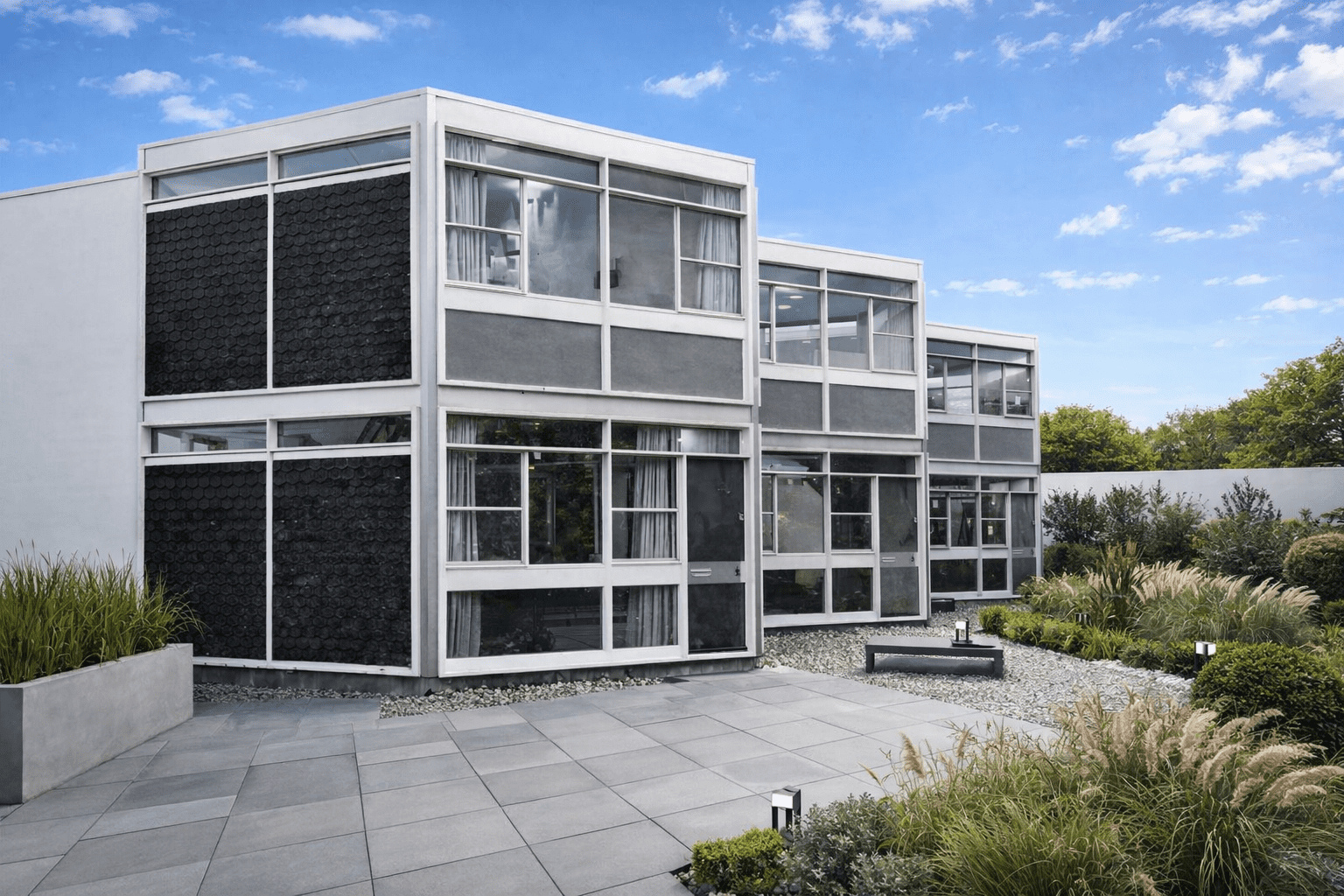
The Formula house is a distinctive system-built property developed during the mid-1960s, specifically between 1966 and 1967. It emerged during a period of significant innovation in the UK construction industry, driven by the need for rapid and cost-effective housing solutions following post-war shortages.
Designed by Thorne and Barton in collaboration with Morrison and Partners, and manufactured by Lewis and Watters Ltd, only 160 Formula houses were constructed. As a result, they remain a relatively rare form of non-traditional housing within today’s residential market.
Formula houses, also known as the Interbuild System Building 2, are typically found in suburban locations and are notable for their unusual hexagonal form and system-built structural frame.
Typical characteristics & construction
Formula houses are predominantly two-storey properties with a hexagonal plan form. They were constructed in detached, semi-detached, and terraced configurations, with the geometric layout intended to maximise internal space while providing structural efficiency.
The substructure comprises a concrete ring beam with a concrete slab. Above this, the main structural frame consists of six perimeter tubular steel stanchions and one central stanchion, supporting RSA perimeter beams and welded panel supports at first-floor level.
External walls are formed using storey-height timber frame infill panels. These are clad externally with tile hanging, coloured asbestos cement sheets, or timber boarding, with cover strips concealing panel junctions and floor-level transitions. Internally, walls are lined with foil-backed plasterboard with polystyrene insulation between the studs.
| Element | Typical construction | Inspection focus |
|---|---|---|
| Substructure | Concrete ring beam and slab | Cracking, movement, general stability |
| Structural frame | Tubular steel stanchions and RSA beams | Corrosion, fixings, overall integrity |
| External walls | Timber frame panels with tile hanging, asbestos cement or timber cladding | Decay, panel movement, asbestos condition |
| Roof | Flat roof with timber joists and bituminous felt | Water ingress, felt condition, drainage |
| Floors | Concrete ground floor, chipboard on timber joists at first floor | Deflection, moisture effects, soundness |
Potential hazards & inspection priorities
The most significant hazards associated with Formula houses relate to asbestos-containing materials, flat roof performance, and the long-term durability of the timber frame panels.
Asbestos cement sheets were commonly used to the external walls and present a health risk if disturbed. Their condition and any evidence of damage or inappropriate alteration should be treated as a priority during inspection.
Flat roofs finished with bituminous felt are vulnerable to water ingress where maintenance has been poor. Prolonged moisture penetration can affect roof timbers, internal finishes, and the overall performance of the structure.
Is this house right for you?
A Formula house will generally suit purchasers who understand non-traditional construction and are prepared to assess the property based on its specific condition rather than its age alone.
- Commission a full building survey by a surveyor experienced with system-built housing
- Review any records of roof replacement, asbestos management, or structural repairs
- Accept that original insulation and materials may not meet modern standards
Greater caution is required where there is evidence of water ingress, unaddressed asbestos, or a lack of maintenance history.
Mortgage & resale considerations
Mortgage acceptance for Formula houses can vary depending on lender criteria, property condition, and the quality of professional reporting. Construction type and the presence of asbestos are common considerations.
Clear survey findings, evidence of appropriate maintenance, and the absence of unresolved defects can influence both lending decisions and future resale prospects.
What a survey can — and cannot — tell you
A building survey provides an informed assessment of the visible condition and construction of a Formula house. Inspections are non-intrusive and limited to areas that are accessible at the time of inspection.
- Identify visible defects to external cladding, including asbestos cement sheets
- Assess signs of dampness, water ingress, and condensation risk
- Comment on flat roof coverings, drainage details, and weatherproofing
- Review the condition of accessible floors, ceilings, and structural elements
- Highlight defects requiring repair, monitoring, or further investigation
However, there are limitations to what a survey can determine without intrusive investigation.
- Confirm the condition of concealed steel connections or fixings
- Assess hidden timber elements behind linings or insulation
- Determine the full extent of deterioration within enclosed panels
- Inspect areas that are inaccessible or covered at the time of inspection
Where higher-risk indicators are identified, further specialist or intrusive investigation may be recommended.
For a thorough building survey in Greater London, an instant quotation can be obtained through the online survey calculator.
Considering a Formula house?
A detailed building survey can help clarify construction-specific risks before committing to a purchase.
Get your instant survey quoteDisclaimer: This article is provided for general educational purposes only and is based on industry research, professional knowledge, and experience. It does not relate to any specific property and should not be relied upon when making a purchasing decision. Prospective purchasers should always commission an independent RICS-qualified surveyor to conduct a full inspection and provide a report on the actual condition of any property of interest.