


Overview
The Falkiner-Nuttall house is a distinctive form of post-war system-built housing introduced in 1947, developed during a period of acute housing shortage following the Second World War. Sometimes referred to simply as the Nuttall house, it formed part of a wider programme of rapid construction intended to deliver durable, cost-effective family homes at scale.
Falkiner-Nuttall houses were constructed using prefabricated steel-framed components assembled on site, most commonly as semi-detached chalet bungalows within planned suburban housing estates.
Typical characteristics & construction
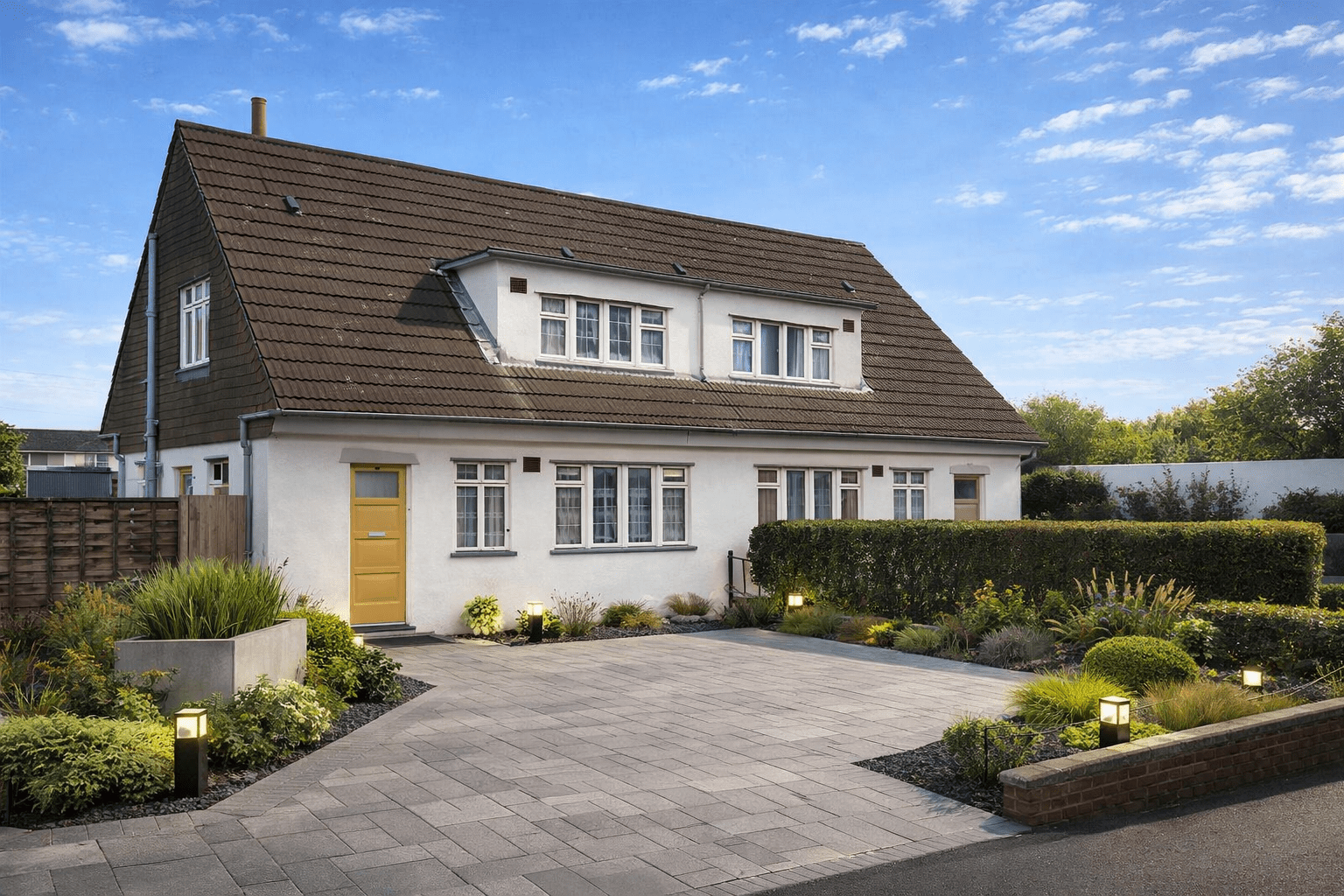
Falkiner-Nuttall houses are typically semi-detached chalet bungalows with steeply pitched gable roofs and front and rear dormer windows. External walls are rendered throughout, with tile hanging commonly used to the gable apex. Dormers are also rendered to match the main elevations.
These properties were most often constructed as part of larger suburban housing estates, particularly in areas that experienced extensive post-war reconstruction. Interlocking concrete tiles are used to the main roof slopes, providing a robust external covering.
| Element | Typical construction | Inspection focus |
|---|---|---|
| Substructure | Concrete raft foundation, thickened at perimeter, with damp-proof course | Cracking, movement, effectiveness of moisture protection |
| Frame | Bolted rolled steel channel (RSC) frames with steel bracing and RSJ floor beams | Corrosion, condition of protective coatings |
| External walls | Expanded metal lathing rendered both sides, cavity with vapour barrier and woodwool slabs | Render cracking, detachment, moisture ingress |
| Floors | Concrete ground floor; first floor screed and mastic asphalt on galvanised corrugated steel | Cracking, deflection, surface condition |
| Roof | Steel rafters and purlins with felt, battens, and interlocking concrete tiles | Tile condition, felt integrity, dormer flat roof performance |
Potential hazards & inspection priorities
The principal concern with Falkiner-Nuttall houses is corrosion of the steel frame and associated steel components. Although frames were originally protected with red oxide and bituminous coatings, deterioration of these finishes over time can result in superficial corrosion, particularly to the underside of corrugated steel sheets and expanded metal lathing.
Minor horizontal cracking to external render is commonly encountered. While often non-structural, such cracking can allow moisture penetration if not maintained, increasing the risk of concealed corrosion behind the render finish.
These properties are not generally classified as defective under the Defective Premises Act. Nevertheless, their non-traditional construction warrants careful inspection to confirm overall condition and ongoing serviceability.
Is this house right for you?
Falkiner-Nuttall houses can perform satisfactorily where they have been properly maintained and monitored. Purchasers should be prepared for the realities of steel-framed construction concealed behind traditional finishes.
- Commission a full building survey prior to purchase
- Pay particular attention to signs of corrosion and render cracking
- Budget for ongoing external maintenance
Mortgage & resale considerations
Lender acceptance of system-built housing can vary and is often influenced by condition, maintenance history, and the clarity of professional reporting. Detailed survey findings and evidence of appropriate upkeep are important considerations.
What a survey can — and cannot — tell you
A building survey provides an informed assessment of the visible condition and construction of a Falkiner-Nuttall house. Inspections are non-intrusive and limited to areas that are accessible at the time of inspection.
- Identify visible corrosion or deterioration to accessible steel elements
- Assess render condition, cracking patterns, and moisture risk
- Comment on roof coverings, dormer construction, and rainwater disposal
- Review the general condition of accessible floors, ceilings, and partitions
- Highlight defects requiring repair, monitoring, or further investigation
However, there are limitations to what a survey can determine without intrusive investigation.
- Confirm the condition of concealed steelwork behind render or linings
- Assess hidden bracing, connections, or protective coatings
- Inspect areas that are inaccessible or covered at the time of inspection
Where higher-risk indicators are identified, further specialist or intrusive investigation may be recommended.
For a thorough building survey in Greater London, an instant quotation can be obtained through the online survey calculator.
Considering a Falkiner-Nuttall house?
A detailed building survey can help clarify construction-specific risks before committing to a purchase.
Get your instant survey quoteDisclaimer: This article is provided for general educational purposes only and is based on industry research, professional knowledge, and experience. It does not relate to any specific property and should not be relied upon when making a purchasing decision. Prospective purchasers should always commission an independent RICS-qualified surveyor to conduct a full inspection and provide a report on the actual condition of any property of interest.
