


Overview
Cranwell houses are a form of post-war system-built housing developed in the immediate aftermath of the Second World War. Constructed between 1945 and 1948, they were intended to provide rapid, cost-effective accommodation during a period of acute housing shortage.
Although relatively limited in number, Cranwell houses have a distinct construction form and a set of recurring defects that warrant careful inspection prior to purchase.
Cranwell houses were constructed by Cranwell Construction Co., Cranwell Syndicate Ltd, and Mid-Kent Builders Ltd. Approximately 600 units were built, typically as two-storey semi-detached or terraced houses in suburban locations.
Typical characteristics & construction
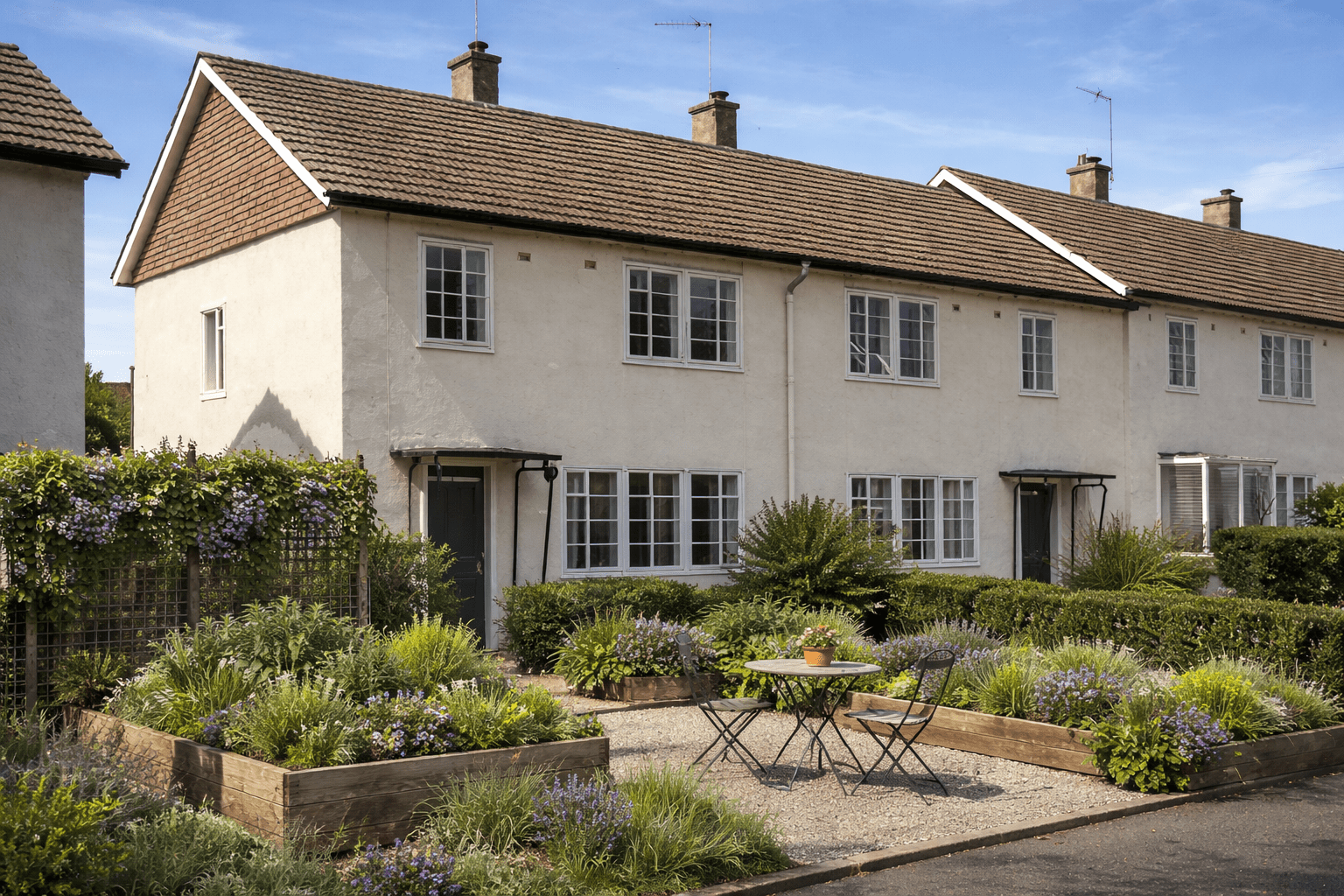
Cranwell houses are typically arranged as two-storey semi-detached or terraced properties. Roofs are medium pitch, hipped or gable in form, and finished with interlocking concrete tiles or, in some cases, profiled asbestos cement sheets.
External walls are rendered hollow clay blockwork with a cavity incorporating wood wool slab insulation. The gable apex is commonly finished with tile hanging or profiled asbestos cement sheeting.
A steel frame forms the primary structural support, with RSJ and RSA members coated in red oxide, red lead, or black bituminous paint.
| Element | Typical construction | Inspection focus |
|---|---|---|
| Substructure | Concrete trench fill with ground floor slab and DPC | Settlement, moisture transfer, slab condition |
| Frame | Steel stanchions, perimeter ties, and roof trusses | Corrosion, particularly at stanchion bases |
| External walls | Rendered hollow clay blocks with cavity insulation | Cracking, render condition, moisture ingress |
| Floors | Concrete ground floor, timber joisted first floor | Cracking, bulging, joist shrinkage |
| Roof | Timber rafters with felt and concrete tiles | Tile condition, felt integrity, asbestos presence |
Potential hazards & inspection priorities
Corrosion of steel stanchions is a common issue in Cranwell houses, particularly at the bases where moisture exposure is greatest. Moderate corrosion to the setting out jig is also frequently observed.
Fine vertical cracking to render and internal plaster linings often aligns with stanchion positions. Carbonation of PRC door and window surrounds can lead to reinforcement corrosion if left unmanaged.
Where magnesite floor screeds are present, cracking and lifting can result in uneven floors. Shrinkage of first-floor joists may cause localised bulging over RSJ floor support beams.
Some properties incorporate asbestos cement sheets to roofs or gable cladding, which require careful management if disturbed.
Is this house right for you?
Cranwell houses can be suitable where purchasers understand system-built construction and are prepared to manage age-related defects associated with steel frames and PRC elements.
- Commission a full building survey
- Pay particular attention to corrosion and carbonation
- Consider long-term maintenance requirements
Mortgage & resale considerations
Lender acceptance for Cranwell houses varies and is influenced by condition, extent of corrosion, and the clarity of professional reporting. Evidence of adequate maintenance and clear survey findings is often critical.
What a survey can — and cannot — tell you
A building survey provides an informed assessment of the visible condition and construction of a Cranwell house. Inspections are non-intrusive and limited to areas that are accessible at the time of inspection.
- Identify visible corrosion to steel stanchions and associated cracking
- Assess signs of dampness, moisture ingress, and condensation risk
- Comment on roof coverings, gable cladding, and external envelope condition
- Review the general condition of accessible floors, ceilings, and structural elements
- Highlight defects that may require repair, monitoring, or further investigation
However, there are limitations to what a survey can determine without intrusive investigation.
- Confirm the condition of concealed steelwork behind finishes
- Assess hidden structural elements within walls or floors
- Determine the full extent of corrosion or carbonation to PRC elements
- Inspect areas that are inaccessible or covered at the time of inspection
Where higher-risk indicators are identified, further specialist or intrusive investigation may be recommended.
For a thorough building survey in Greater London, an instant quotation can be obtained through the online survey calculator.
Considering a Cranwell House?
A detailed building survey can help clarify construction-specific risks before committing to a purchase.
Get your instant survey quoteDisclaimer: This article is provided for general educational purposes only and is based on industry research, professional knowledge, and experience. It does not relate to any specific property and should not be relied upon when making a purchasing decision. Prospective purchasers should always commission an independent RICS-qualified surveyor to conduct a full inspection and provide a report on the actual condition of any property of interest.
