


Overview
The Cornish Unit Type 1 house is a form of non-traditional post-war housing developed in response to acute shortages following the Second World War. These properties were constructed between 1946 and the 1960s using prefabricated reinforced concrete systems, with approximately 30,000 units built across Type I and Type II variants.
The design is attributed to A E Beresford and R Tonkin, with manufacture by Central Cornwall Concrete & Artificial Stone Co. and Selleck Nicholls & Co. Examples are most commonly found in Cornwall but also appear in other parts of the UK, particularly in suburban and rural settings.
Cornish Unit Type 1 houses are non-traditional PRC properties constructed using storey-height reinforced concrete columns and precast concrete wall panels. They are designated as defective under the Defective Premises Act.
Typical characteristics & construction
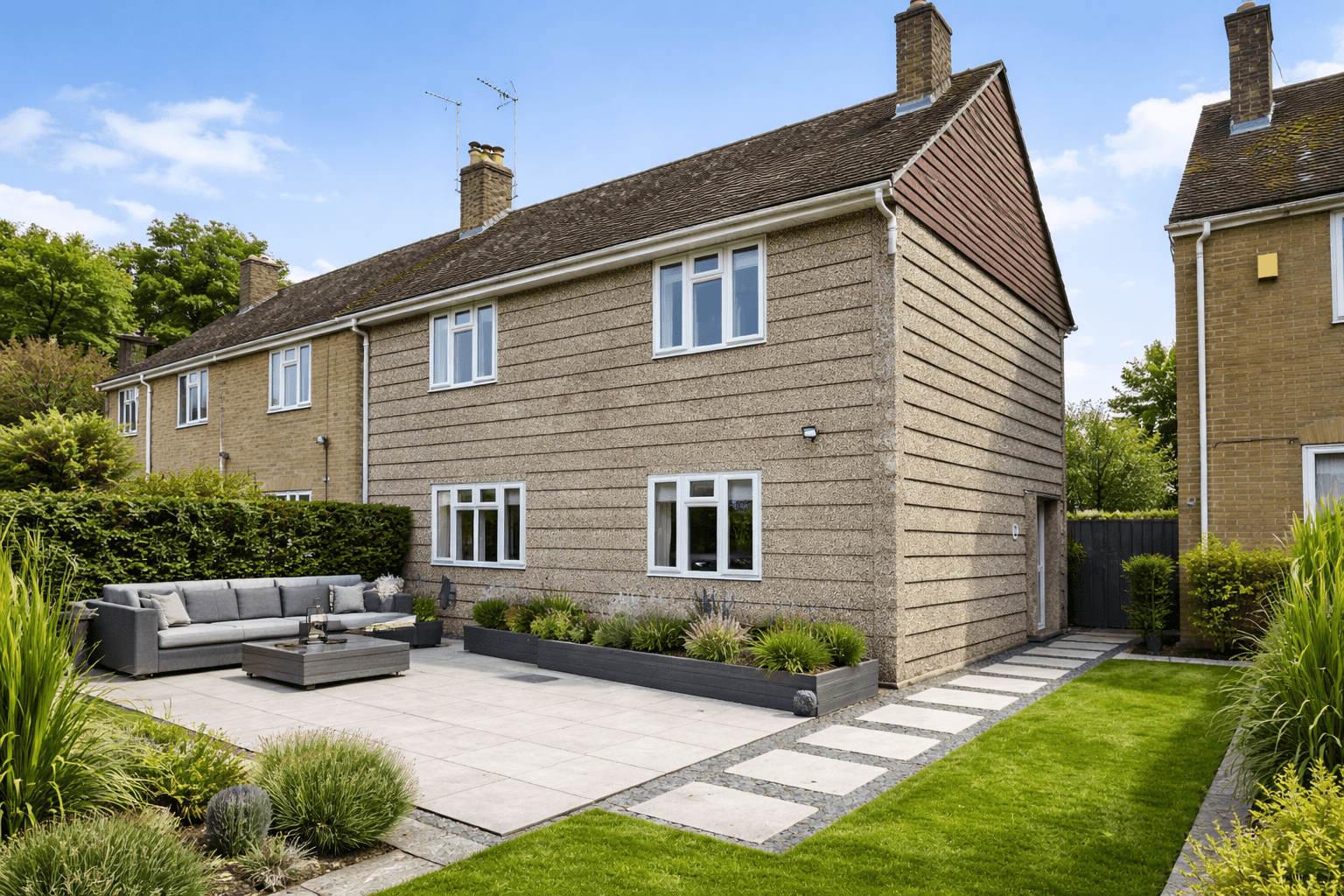
Cornish Unit Type 1 houses are commonly bungalows or two-storey semi-detached and terraced houses. A defining feature is the mansard medium-pitch hipped roof, finished with concrete tiles, asbestos cement slates, or occasionally cedar shingles.
The structural system is based on reinforced concrete columns combined with horizontal precast concrete panels forming the external walls. Rounded precast concrete corner units are a distinctive identifying feature of this construction type.
| Element | Typical construction | Inspection focus |
|---|---|---|
| Substructure | Concrete strip footings, concrete block underbuilding, concrete slab with DPC | Movement, cracking, damp-proof course continuity |
| External walls | PRC columns with precast concrete panels forming cavity walls | Cracking, carbonation, corrosion staining |
| Internal walls | Dense PC blocks or brick; some timber stud partitions | Cracking, movement, loadbearing performance |
| Floors | Concrete ground floor; timber first floor on joists | Sagging, deflection, timber condition |
| Roof | Timber mansard roof with felt and tiled or slate covering | Covering condition, leaks, asbestos presence |
Potential hazards & inspection priorities
The most significant risks relate to the condition of the reinforced concrete elements. PRC columns are known to suffer from horizontal and vertical cracking, often associated with carbonation and, in some cases, chloride contamination.
Cracking to first-floor ring beams is also frequently encountered and can indicate progressive deterioration of the structural frame. These issues warrant careful inspection and, where necessary, further specialist assessment.
Asbestos cement slates are commonly present to roof coverings. While generally stable if undisturbed, they present a health risk if damaged or removed without appropriate controls.
Thermal performance is poor by modern standards. Original cavity construction offers limited insulation, and upgrading can be constrained by the PRC system.
Is this house right for you?
Purchasers considering a Cornish Unit Type 1 house should be aware of its non-traditional construction and the implications this has for maintenance, repair, and long-term durability.
- Commission a full building survey by an experienced surveyor
- Understand the condition of PRC columns and ring beams
- Factor in ongoing maintenance and potential remedial works
Mortgage & resale considerations
Cornish Unit Type 1 houses are designated as defective under the Defective Premises Act. Mortgage acceptance can therefore be more restrictive and is often dependent on condition, documented repairs, and the clarity of professional reporting.
Properties that have undergone recognised repair schemes or demonstrate stable condition are generally viewed more favourably by lenders.
What a survey can — and cannot — tell you
A building survey provides an informed assessment of the visible condition and construction of a Cornish Unit Type 1 house. Inspections are non-intrusive and limited to areas that are accessible at the time of inspection.
- Identify visible cracking to PRC columns, panels, and ring beams
- Assess signs of dampness, moisture ingress, and condensation risk
- Comment on roof coverings, drainage details, and external envelope condition
- Review the general condition of accessible floors, ceilings, and structural elements
- Highlight defects that may require repair, monitoring, or further investigation
However, there are limitations to what a survey can determine without intrusive investigation.
- Confirm the condition of concealed steel reinforcement within PRC elements
- Assess hidden structural components behind finishes
- Determine the full extent of carbonation or internal concrete deterioration
- Inspect areas that are inaccessible or covered at the time of inspection
Where higher-risk indicators are identified, further specialist or intrusive investigation may be recommended.
For a thorough building survey in Greater London, an instant quotation can be obtained through the online survey calculator.
Considering a Cornish Unit Type 1 house?
A detailed building survey can help clarify construction-specific risks before committing to a purchase.
Get your instant survey quoteDisclaimer: This article is provided for general educational purposes only and is based on industry research, professional knowledge, and experience. It does not relate to any specific property and should not be relied upon when making a purchasing decision. Prospective purchasers should always commission an independent RICS-qualified surveyor to conduct a full inspection and provide a report on the actual condition of any property of interest.
