


Overview
The British Iron and Steel Federation (BISF) Type A house is a well-known form of post-war non-traditional housing developed to address severe housing shortages following the Second World War. Constructed primarily during the mid-20th century, these properties rely on steel framing and profiled metal components, giving them distinct characteristics when compared with traditionally built houses.
BISF Type A houses were promoted by the British Iron and Steel Federation and manufactured by British Steel Homes Ltd. Approximately 36,000 units were constructed across the UK, most commonly as two-storey semi-detached houses in urban areas.
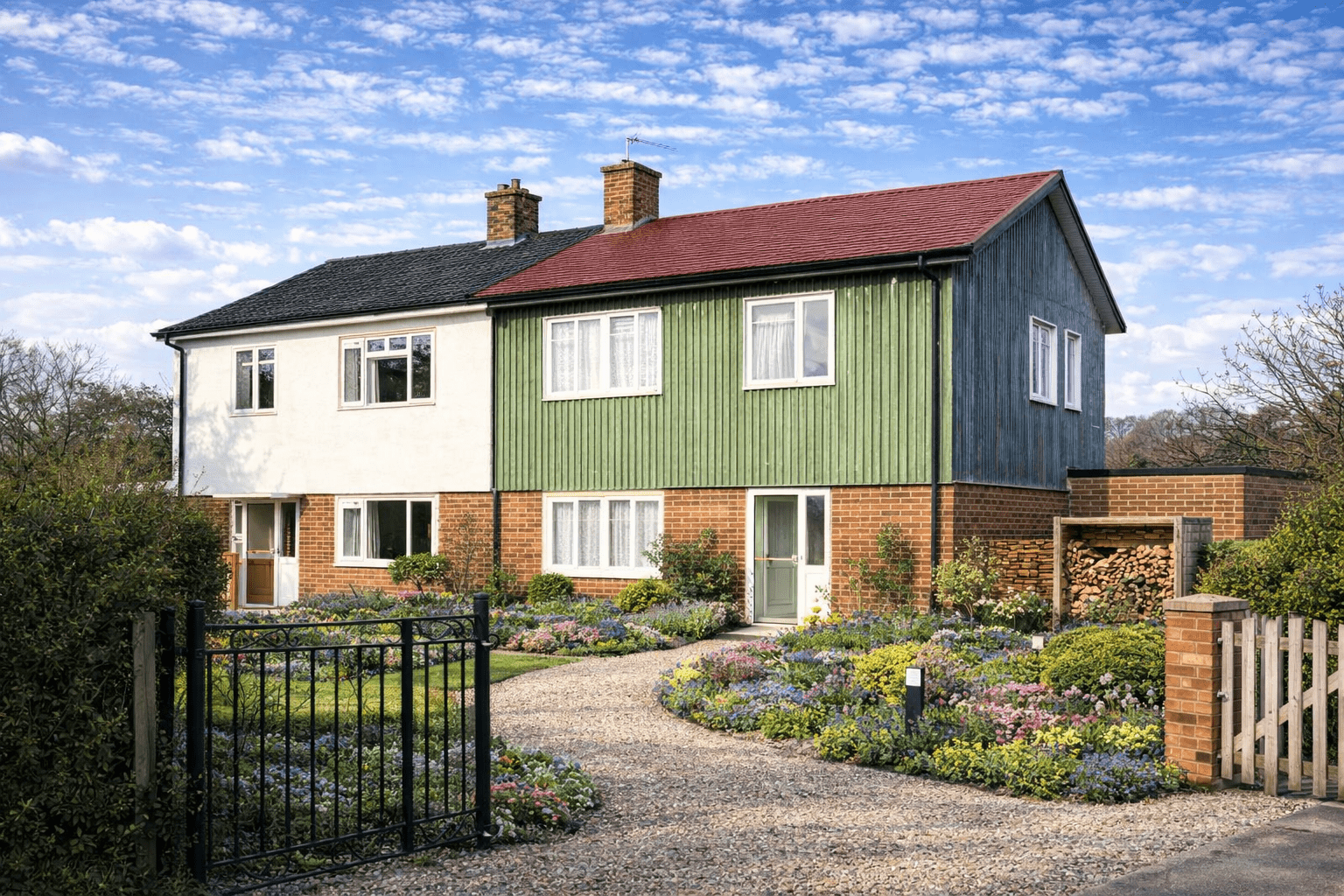
Typical characteristics & construction
BISF Type A houses are two-storey semi-detached properties built on concrete strip footings with brick under-building. A concrete slab floor is thickened around the perimeter and incorporates a damp-proof course intended to limit ground moisture.
The primary structure consists of a rolled steel frame formed from rolled steel channels, angles, and joists. External walls are brick and block cavity construction up to first-floor level, with vertically profiled steel sheeting backed by fibreboard above. Roofs are shallow pitched and clad with profiled steel sheets.
Internally, partitions are generally blockwork. Ground floors are concrete slabs, while first floors are formed using concrete laid on expanded metal lathing, creating a solid but relatively heavy floor construction.
| Element | Typical construction | Inspection focus |
|---|---|---|
| Substructure | Concrete strip footings and slab | Settlement, cracking, damp-proof course continuity |
| Frame | Rolled steel channels, angles, and joists | Corrosion, protective coating condition |
| External walls | Brick and block below, steel cladding above | Moisture ingress, corrosion, fixings |
| Floors | Concrete slab and concrete on metal lathing | Dampness, cracking, deflection |
| Roof | Profiled steel sheets with fibreboard backing | Leaks, corrosion, fixings and laps |
Potential hazards & inspection priorities
The most significant risk in BISF Type A houses relates to corrosion of the steel frame. Although originally protected with red lead and bituminous coatings, long-term exposure to moisture can lead to deterioration if maintenance has been inconsistent.
Thermal performance is another common concern. Original insulation provision is limited, and cold bridging through the steel frame can contribute to condensation and heat loss. Asbestos-containing materials may also be present within roofing, linings, or insulation and require careful management.
Is this house right for you?
BISF Type A houses require purchasers to understand non-traditional construction and to place weight on condition rather than age alone. Ongoing maintenance of steel components is a critical factor in long-term performance.
- Commission a full building survey by an experienced surveyor
- Review evidence of corrosion treatment and maintenance history
- Be prepared for insulation upgrades and ongoing monitoring
Mortgage & resale considerations
Lender attitudes to BISF Type A houses vary and are influenced by condition, evidence of maintenance, and the clarity of professional reporting. Properties with unmanaged corrosion or uncertainty around structural condition can face lending restrictions.
Clear survey findings and documented remedial works are often key to mortgage acceptance and future resale.
What a survey can — and cannot — tell you
A building survey provides an informed assessment of the visible condition and construction of a BISF Type A house. Inspections are non-intrusive and limited to areas that are accessible at the time of inspection.
- Identify visible corrosion to steel frame members and cladding
- Assess signs of dampness, moisture ingress, and condensation risk
- Comment on roof coverings, drainage details, and external envelope condition
- Review the general condition of accessible floors, ceilings, and structural elements
- Highlight defects that may require repair, monitoring, or further investigation
However, there are limitations to what a survey can determine without intrusive investigation.
- Confirm the condition of concealed steelwork behind linings
- Assess hidden fixings and connections within the frame
- Determine the full extent of corrosion where finishes remain intact
- Inspect areas that are inaccessible or covered at the time of inspection
Where higher-risk indicators are identified, further specialist or intrusive investigation may be recommended.
For a thorough building survey in Greater London, an instant quotation can be obtained through the online survey calculator.
Considering a BISF Type A house?
A detailed building survey can help clarify construction-specific risks before committing to a purchase.
Get your instant survey quoteDisclaimer: This article is provided for general educational purposes only and is based on industry research, professional knowledge, and experience. It does not relate to any specific property and should not be relied upon when making a purchasing decision. Prospective purchasers should always commission an independent RICS-qualified surveyor to conduct a full inspection and provide a report on the actual condition of any property of interest.
