


Overview
The BRS Type 4 house is a rare form of post-war non-traditional housing designed by the Building Research Station (BRS). Constructed between 1953 and 1956, only 60 examples were built. These properties are typically found in suburban locations developed to address significant housing shortages following the Second World War.
The scheme formed part of a wider government initiative focused on delivering quickly constructed, affordable homes using innovative materials and structural systems. Although limited in number, the BRS Type 4 represents an important stage in the evolution of reinforced concrete housing.
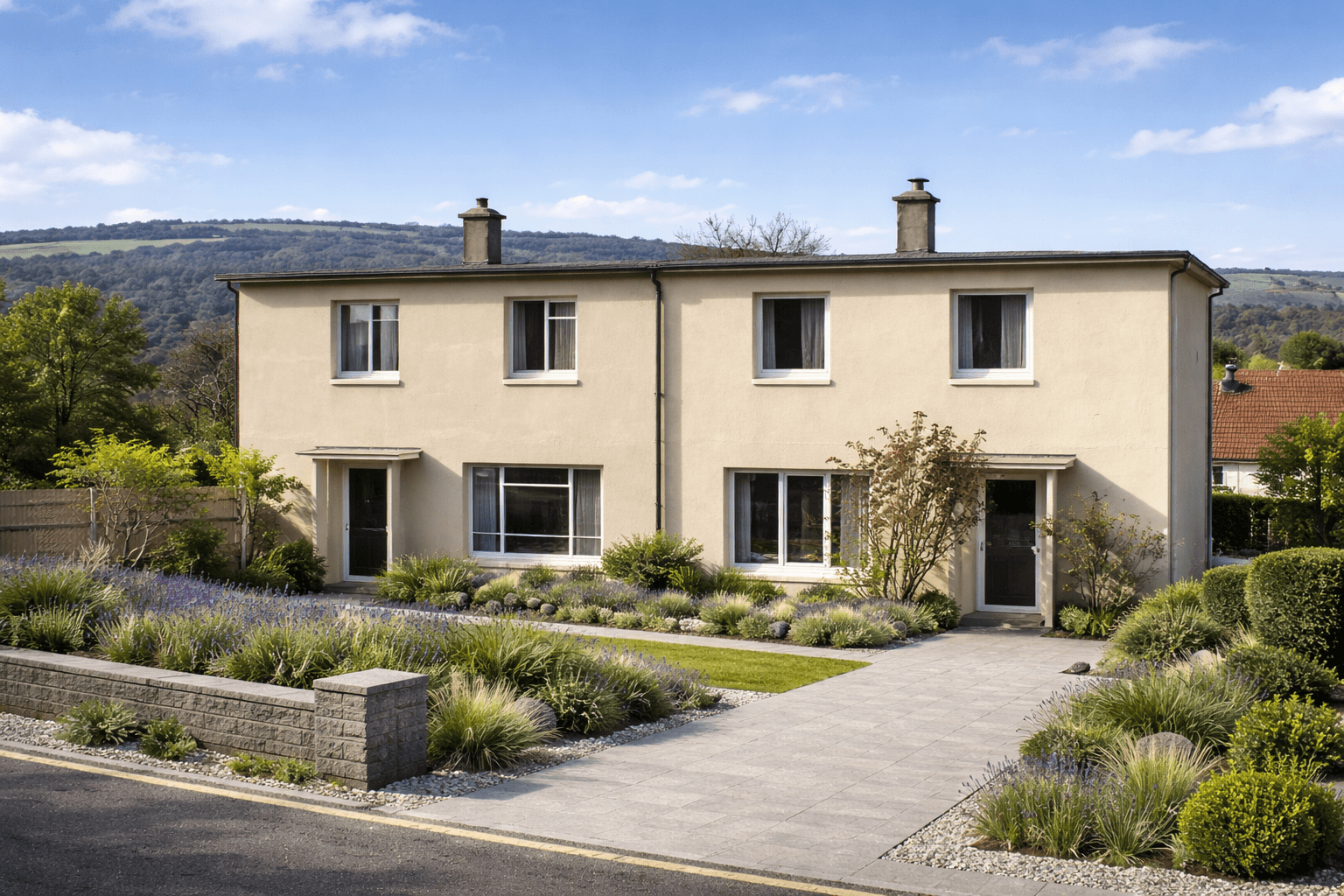
Built between 1953 and 1956, only 60 BRS Type 4 houses were constructed. They are two-storey detached or semi-detached dwellings with flat reinforced concrete roofs and rendered no-fines concrete external walls.
Typical characteristics & construction
BRS Type 4 houses are two-storey properties built in both detached and semi-detached forms. The design is functional, reflecting the post-war emphasis on efficiency and rapid delivery.
The substructure comprises concrete underbuilding with a concrete slab. External walls are formed using 8-inch no-fines concrete, combined with timber frame panels lined with waffle plaster acting as permanent shuttering. Lightly reinforced dense reinforced concrete ring beams are provided at first-floor and eaves level.
Separating walls between adjoining properties are constructed from 6-inch no-fines concrete with timber frame panels lined in waffle plaster. Internal partitions use cellular cardboard cored panels lined with plasterboard.
Ground floors are concrete. First floors consist of a 7-inch reinforced concrete slab. Ceilings are formed using ribbed plaster on timber frame panels. The flat roof is a reinforced concrete slab overlaid with woodwool slabs and finished with bituminous felt.
| Element | Typical construction | Inspection focus |
|---|---|---|
| Substructure | Concrete underbuilding with concrete slab | Cracking, settlement, moisture ingress |
| External walls | 8″ no-fines concrete with timber frame panels and waffle plaster lining | Render condition, cracking, water penetration |
| Ring & spine beams | Lightly reinforced dense reinforced concrete | Carbonation, corrosion, concrete cover, compaction defects |
| Floors | Concrete ground floor; 7″ reinforced concrete first floor slab | Cracking, levelness, structural performance |
| Roof | Reinforced concrete slab with woodwool overlay and bituminous felt | Felt deterioration, ponding, spalling, reinforcement corrosion |
| Partitions | Cellular cardboard cored panels with plasterboard lining | Damage, distortion, moisture sensitivity |
Potential hazards & inspection priorities
Deterioration of external render is common and can permit water penetration into the no-fines concrete structure. Spalling to reinforced concrete roof slab oversails may occur due to reinforcement corrosion.
Carbonation within dense reinforced concrete beams, inadequate cover to reinforcement, poor compaction and the presence of cast-in chlorides all increase the risk of corrosion. Low cement content in some concrete elements can further reduce durability.
Flat roof construction presents ongoing maintenance demands. Bituminous felt coverings are vulnerable to weathering and ponding, increasing the risk of leaks. Internally, condensation and moisture ingress can affect finishes and lightweight partitions.
Is this house right for you?
The BRS Type 4 house is a rare post-war construction type that requires an informed approach. Its reinforced concrete structure and no-fines walling demand careful assessment of condition rather than reliance on age alone.
- Review evidence of roof maintenance and felt renewal
- Assess the condition of reinforced concrete beams and roof slab
- Consider the performance of lightweight internal partitions
- Ensure moisture management and ventilation are adequate
Condition varies significantly between examples, and maintenance history is particularly important with this form of construction.
Mortgage & resale considerations
The BRS Type 4 house is not classed as defective under the Defective Premises Act. However, as a non-traditional reinforced concrete construction built in limited numbers, lending decisions may depend on condition, structural performance and clarity of professional reporting.
Evidence of ongoing maintenance to the roof and reinforced concrete elements will often be relevant in lender and purchaser decision-making.
What a survey can — and cannot — tell you
A building survey provides an informed assessment of the visible condition and construction of a BRS Type 4 house. Inspections are non-intrusive and limited to areas that are accessible at the time of inspection.
- Identify visible cracking to render and no-fines concrete walls
- Assess signs of dampness, moisture ingress, and condensation risk
- Comment on flat roof coverings, drainage falls, and evidence of ponding
- Review the condition of reinforced concrete beams and roof slab where visible
- Highlight defects requiring repair, monitoring, or further investigation
However, there are limitations to what a survey can determine without intrusive investigation.
- Confirm the internal condition of concealed reinforcement within concrete elements
- Assess hidden structural components behind finishes or linings
- Determine the full extent of carbonation or chloride contamination
- Inspect areas that are inaccessible or covered at the time of inspection
Where higher-risk indicators are identified, further specialist or intrusive investigation may be recommended.
For a thorough building survey in Greater London, an instant quotation can be obtained through the online survey calculator.
Considering a BRS Type 4 House?
A detailed building survey can help clarify construction-specific risks before committing to a purchase.
Get your instant survey quoteDisclaimer: This article is provided for general educational purposes only and is based on industry research, professional knowledge, and experience. It does not relate to any specific property and should not be relied upon when making a purchasing decision. Prospective purchasers should always commission an independent RICS-qualified surveyor to conduct a full inspection and provide a report on the actual condition of any property of interest.
