


Overview
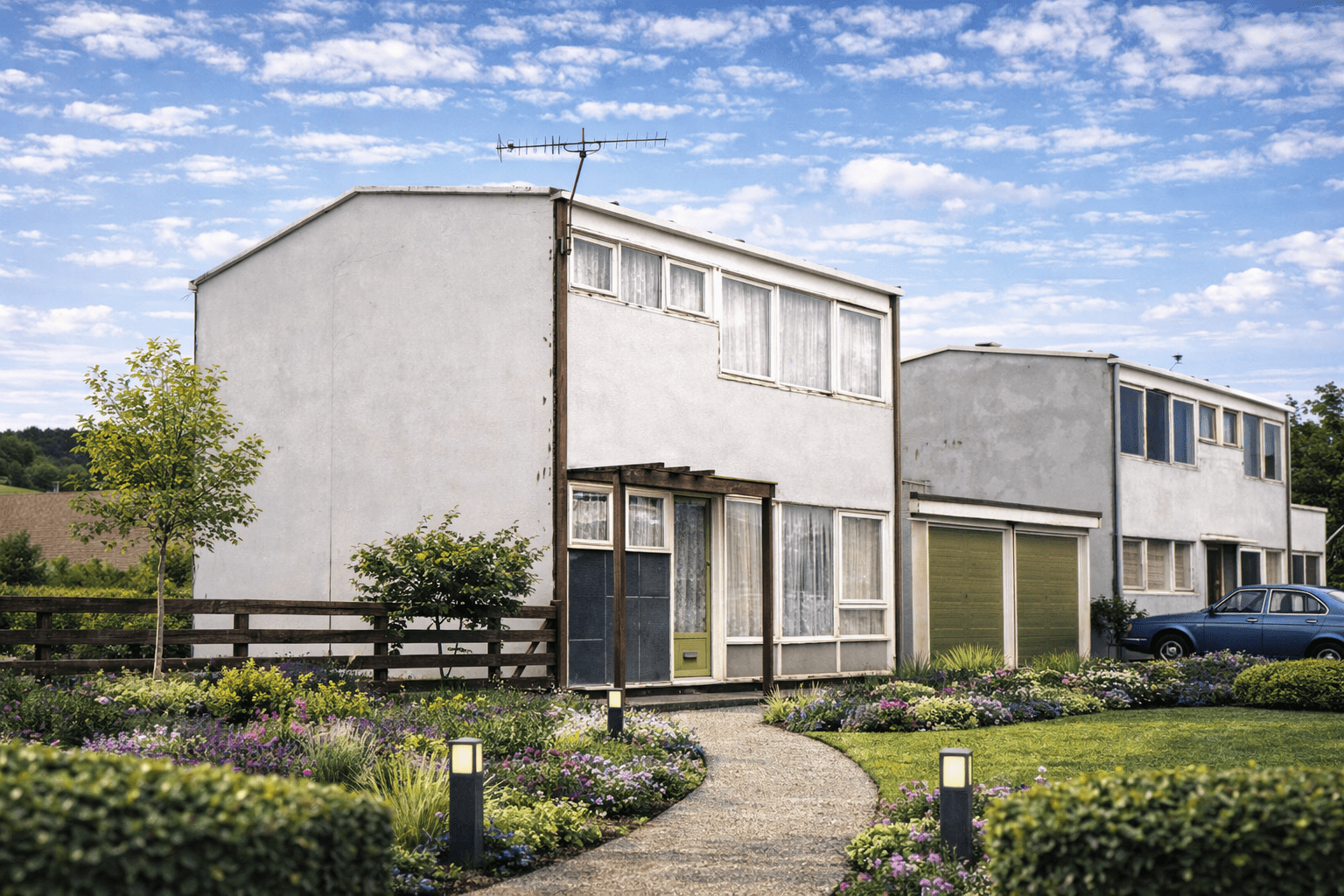
The British Housing house, also known as the Doxford or Lynn, is a form of non-traditional housing developed during the mid-1960s. These properties were manufactured by John Lynn & Co. Ltd. between 1965 and 1967 and were constructed in limited numbers, primarily as bungalows and two-storey detached, semi-detached, and terraced houses.
British Housing houses were designed during a period of rapid urban expansion and housing demand. Approximately 100 units were constructed using innovative materials and prefabricated components that differ markedly from traditional masonry housing.
Typical characteristics & construction
British Housing houses are constructed around a steel frame comprising boxed RSA and RSC stanchions with perimeter and floor support beams. The structure is supported on concrete pads below the stanchions, with a concrete ground-bearing slab incorporating a damp-proof course.
External walls are formed using timber frame panels. Front and rear elevations are commonly clad with polyester glass laminate, slate, tile hanging, timber shiplap boarding, or stone panels. Gable walls are typically clad with woodwool slabs, mesh reinforcement, and render finished with a synthetic resin-based aggregate.
Roofs are shallow pitch gable in form and finished with coloured polyester glass laminate sheets supported on timber trusses.
| Element | Typical construction | Inspection focus |
|---|---|---|
| Substructure | Concrete pads and concrete slab with DPC | Cracking, movement, damp protection |
| Frame | Boxed RSA and RSC steel stanchions and beams | Corrosion, particularly at bases and cleats |
| External walls | Timber frame panels with laminate, slate, render, or timber cladding | Render failure, panel junction cracking, moisture ingress |
| Roof | Timber trusses with polyester glass laminate covering | Water staining, leaks, condition at eaves |
| Ceilings | Asbestolux panels | Damage, disturbance, asbestos management |
Potential hazards & inspection priorities
The principal risks associated with British Housing houses relate to durability of the steel frame, performance of external cladding systems, and the presence of asbestos-containing materials.
- Corrosion to boxed steel stanchions and cleats, particularly at ground level
- Failure of render to gable walls and deterioration of resin-based coatings
- Asbestolux ceiling panels and potential sprayed limpet asbestos within wall panels
- Water staining to roof timbers at eaves indicating defects to roof coverings
- Vertical cracking at panel junctions internally and externally
Is this house right for you?
British Housing houses require purchasers to take a condition-led view rather than relying on appearance alone. Construction complexity and material ageing mean that a detailed inspection is essential.
- Commission a full building survey with experience of non-traditional housing
- Review evidence of past repairs, corrosion treatment, and cladding renewal
- Be prepared for targeted remedial works where defects are identified
Mortgage & resale considerations
Lender acceptance for British Housing houses varies and is closely linked to condition, clarity of survey reporting, and the absence of significant unresolved defects. Non-traditional construction and asbestos-related issues are common areas of scrutiny.
Clear documentation of repairs and professional assessment of structural condition are often influential factors.
What a survey can — and cannot — tell you
A building survey provides an informed assessment of the visible condition and construction of a British Housing house. Inspections are non-intrusive and limited to areas that are accessible at the time of inspection.
- Identify visible corrosion to steel stanchions and associated fixings
- Assess cracking, render condition, and signs of moisture ingress
- Comment on roof coverings, drainage details, and external envelope condition
- Review the general condition of accessible floors, ceilings, and structural elements
- Highlight defects that may require repair, monitoring, or further investigation
However, there are limitations to what a survey can determine without intrusive investigation.
- Confirm the internal condition of boxed steel sections
- Assess concealed structural elements behind finishes or linings
- Determine the full extent of corrosion within enclosed steelwork
- Inspect areas that are inaccessible or covered at the time of inspection
Where higher-risk indicators are identified, further specialist or intrusive investigation may be recommended.
For a thorough building survey in Greater London, an instant quotation can be obtained through the online survey calculator.
Considering a British Housing house?
A detailed building survey can help clarify construction-specific risks before committing to a purchase.
Get your instant survey quoteDisclaimer: This article is provided for general educational purposes only and is based on industry research, professional knowledge, and experience. It does not relate to any specific property and should not be relied upon when making a purchasing decision. Prospective purchasers should always commission an independent RICS-qualified surveyor to conduct a full inspection and provide a report on the actual condition of any property of interest.
