


Overview
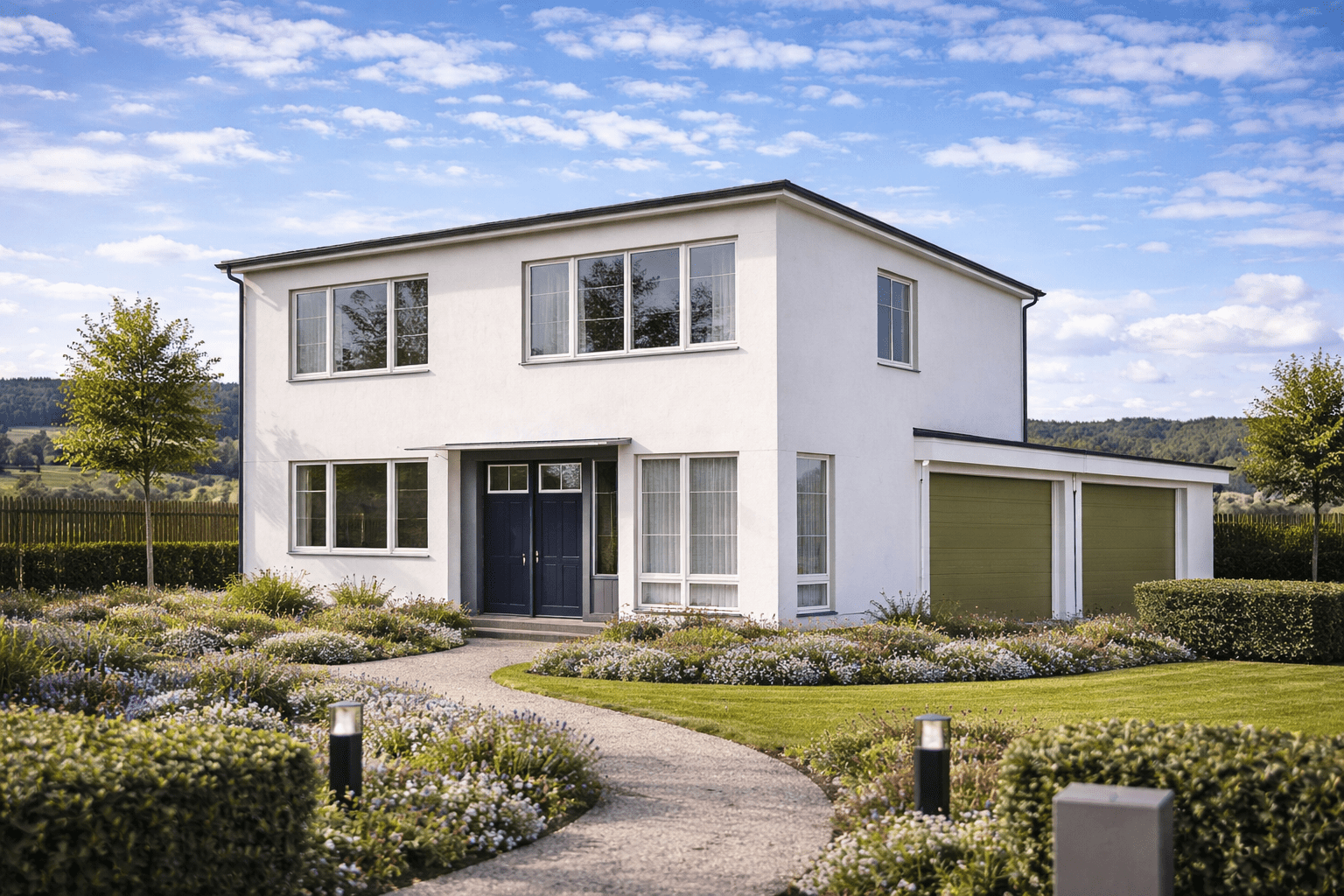
The Braithwaite House, also known as the Unit Frame House, is a rare form of post-war non-traditional housing designed by F R S Yorke and manufactured by Braithwaite & Co. Ltd. Constructed in 1945, only two examples were built, making this one of the least common system-built house types encountered in the UK.
Braithwaite Houses were constructed as two-storey semi-detached or terraced dwellings with flat roofs and a pre-stressed concrete and steel structural frame. Their rarity and unconventional materials place them firmly outside mainstream traditional construction.
Typical characteristics & construction
Braithwaite Houses are two-storey dwellings arranged in semi-detached or terraced form. The structure is based around a ladder-like pre-stressed concrete and steel frame bolted together on site and coated with graphite paint.
External walls are predominantly clad with storey-height fluted asbestos cement sheets. Where present, flank walls are finished in brickwork up to first-floor level with asbestos cement sheets above. Internally, walls are lined with wallboard and insulated with mineral fibre.
Roofs are flat and constructed using aerated concrete slabs finished with a bituminous felt covering. Floors are formed using blockboard panels, with the ground floor supported on concrete and the first floor on timber bearers.
| Element | Typical construction | Inspection focus |
|---|---|---|
| Substructure | Concrete trench fill foundation with slab and DPC | Movement, cracking, damp ingress |
| Frame | Pre-stressed concrete and steel unit frame | Corrosion, joint condition, protective coating |
| External walls | Fluted asbestos cement sheets and brickwork | Asbestos condition, fixings, weathering |
| Roof | Aerated concrete slabs with bituminous felt | Felt deterioration, leaks, surface wear |
| Floors | Blockboard panels on concrete and timber bearers | Deflection, moisture damage, timber decay |
Potential hazards & inspection priorities
The most significant risk associated with Braithwaite Houses is asbestos within the external cladding. While asbestos cement is generally stable when undisturbed, deterioration or damage presents a clear health and management issue.
The steel elements of the structural frame require careful assessment. Where the original graphite paint coating has failed, corrosion can develop, particularly at joints and brackets.
Flat roof coverings are another priority area. Bituminous felt has a finite service life and failure can lead to concealed moisture ingress affecting both the roof deck and internal finishes.
Is this house right for you?
A Braithwaite House is suited to purchasers who understand non-traditional construction and are prepared for specialist inspection and ongoing maintenance.
- Commission a full building survey
- Factor in asbestos management responsibilities
- Review evidence of structural maintenance
These properties require informed ownership rather than casual upkeep.
Mortgage & resale considerations
Lender acceptance for Braithwaite Houses varies due to their rarity and non-traditional construction. Decisions are typically influenced by condition, clarity of professional reporting, and evidence of maintenance.
Clear survey findings and appropriate documentation are particularly important for future resale and lending discussions.
What a survey can — and cannot — tell you
A building survey provides an informed assessment of the visible condition and construction of a Braithwaite House. Inspections are non-intrusive and limited to areas that are accessible at the time of inspection.
- Identify visible deterioration to asbestos cement cladding
- Assess signs of dampness, moisture ingress, and condensation risk
- Comment on flat roof coverings and drainage details
- Review the general condition of accessible floors, ceilings, and frame elements
- Highlight defects requiring repair, monitoring, or further investigation
However, there are limitations to what a survey can determine without intrusive investigation.
- Confirm the internal condition of concealed steel or concrete frame elements
- Assess hidden structural components behind linings
- Determine the full extent of corrosion beneath protective coatings
- Inspect areas that are inaccessible or covered at the time of inspection
Where higher-risk indicators are identified, further specialist or intrusive investigation may be recommended.
For a thorough building survey in Greater London, an instant quotation can be obtained through the online survey calculator.
Considering a Braithwaite House?
A detailed building survey can help clarify construction-specific risks before committing to a purchase.
Get your instant survey quoteDisclaimer: This article is provided for general educational purposes only and is based on industry research, professional knowledge, and experience. It does not relate to any specific property and should not be relied upon when making a purchasing decision. Prospective purchasers should always commission an independent RICS-qualified surveyor to conduct a full inspection and provide a report on the actual condition of any property of interest.
