


Overview
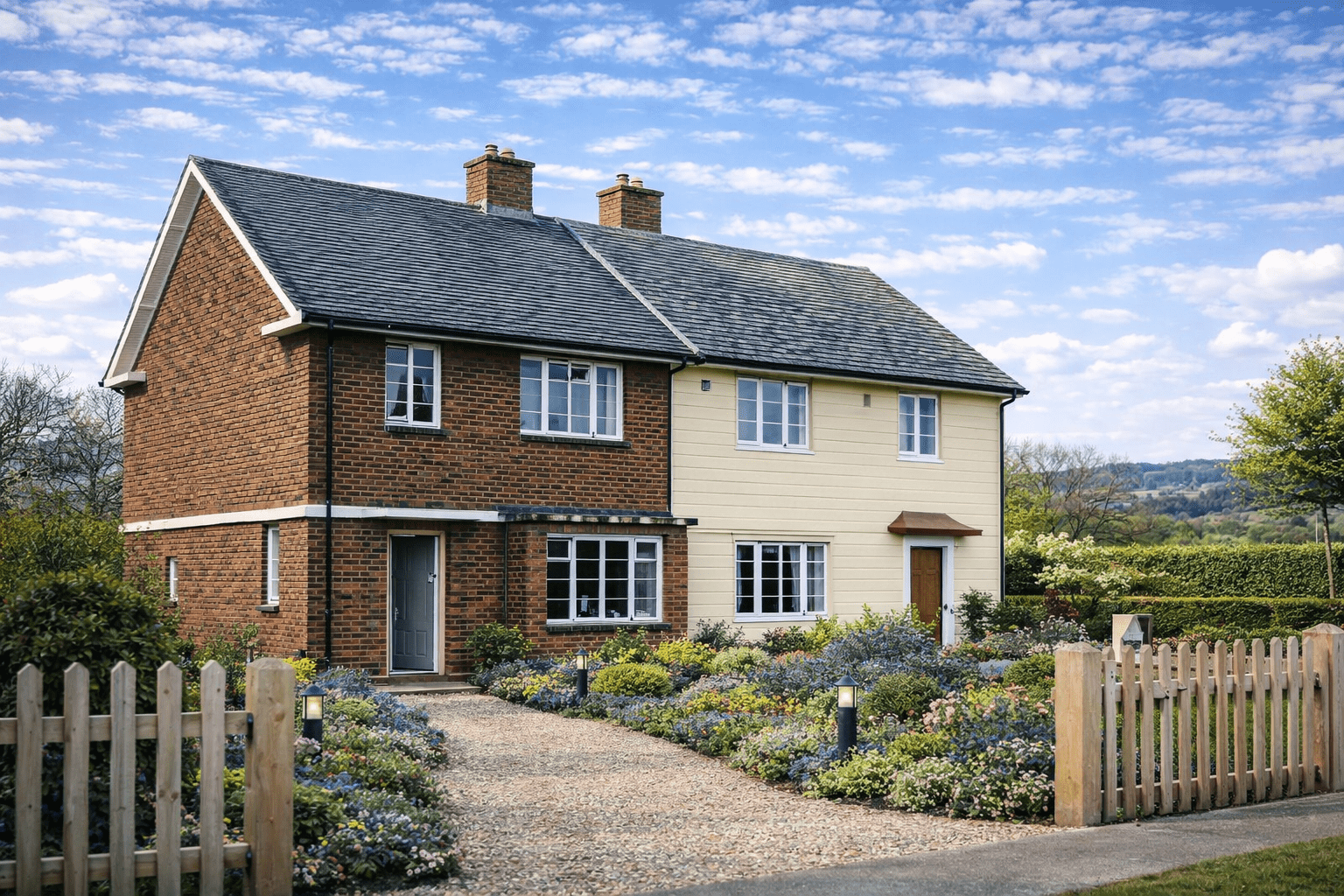
The Birmingham Corporation house is a rare post-war non-traditional property type designed by the Birmingham Corporation and manufactured by Hills Patent Glazing Ltd. Constructed in 1945, only two examples were built. Their limited number and distinctive steel-framed construction make them an unusual but historically significant form of housing.
Birmingham Corporation houses were manufactured by Hills Patent Glazing Ltd in 1945. Only two properties were constructed, both as two-storey semi-detached houses using a steel frame with masonry infill and prefabricated elements.
Typical characteristics & construction
Birmingham Corporation houses are two-storey semi-detached dwellings with a steeply pitched gable roof. Roof coverings are commonly interlocking concrete tiles, although some variants were constructed with profiled asbestos cement sheets.
External walls are either full brick cavity construction or incorporate a precast reinforced concrete band course at first-floor level. This band course extends externally to form a canopy above the front door and bay window.
Generous overhanging eaves and verges are typical, with galvanised steel door and window surrounds forming a distinctive identifying feature.
| Element | Typical construction | Inspection focus |
|---|---|---|
| Substructure | Concrete strip footings with brick under-building and DPC | Movement, moisture bridging, general stability |
| Frame | Steel lattice stanchions, RSAs, lattice beams and trusses | Corrosion, condition of protective coatings |
| External walls | Brick and block cavity walls with PRC band course | Deterioration, cracking, moisture penetration |
| Floors | Concrete ground floor; timber joists with T&G boarding at first floor | Dampness, deflection, insulation performance |
| Roof | Timber purlins, PRC slabs, interlocking concrete tiles or asbestos cement sheets | Covering condition, flashings, water ingress |
Potential hazards & inspection priorities
The primary inspection concern is corrosion of the steel frame, particularly at stanchion bases where moisture exposure is more likely. Although the steelwork was coated with hot bitumen, deterioration of this protection can occur over time.
The PRC band course, especially above bay windows, is another higher-risk area. Deterioration here can lead to localised structural and weathering issues if not addressed.
Defective flashings around chimneys and junctions are also commonly identified and can allow water ingress. Galvanised steel window frames may show minor corrosion, generally requiring maintenance rather than wholesale replacement.
Is this house right for you?
Birmingham Corporation houses require purchasers to understand non-traditional steel-framed construction and the importance of targeted inspection and maintenance.
- Rarity means limited comparable sales and repair history
- Condition of steel frame protection is critical
- PRC elements require close inspection and monitoring
Assessment should always be based on the individual property rather than assumptions drawn from age alone.
Mortgage & resale considerations
Mortgage acceptance for Birmingham Corporation houses depends on construction clarity, condition, and professional reporting. Lender attitudes can vary, particularly due to the steel frame and PRC components.
Clear survey reporting, evidence of maintenance, and absence of advanced corrosion or deterioration are typically influential in mortgage and resale decisions.
What a survey can — and cannot — tell you
A building survey provides an informed assessment of the visible condition and construction of a Birmingham Corporation house. Inspections are non-intrusive and limited to areas that are accessible at the time of inspection.
- Identify visible corrosion to steel frame elements where accessible
- Assess deterioration of PRC band courses and external wall construction
- Comment on roof coverings, flashings, and rainwater detailing
- Review the general condition of accessible floors, ceilings, and partitions
- Highlight defects requiring repair, monitoring, or further investigation
However, there are limitations to what a survey can determine without intrusive investigation.
- Confirm the internal condition of concealed steelwork
- Assess hidden structural elements behind finishes
- Determine the full extent of corrosion beneath protective coatings
- Inspect areas that are inaccessible at the time of inspection
Where higher-risk indicators are identified, further specialist or intrusive investigation may be recommended.
For a thorough building survey in Greater London, an instant quotation can be obtained through the online survey calculator.
Considering a Birmingham Corporation house?
A detailed building survey can help clarify construction-specific risks before committing to a purchase.
Get your instant survey quoteDisclaimer: This article is provided for general educational purposes only and is based on industry research, professional knowledge, and experience. It does not relate to any specific property and should not be relied upon when making a purchasing decision. Prospective purchasers should always commission an independent RICS-qualified surveyor to conduct a full inspection and provide a report on the actual condition of any property of interest.
