


Overview
The Bates 4L house, often referred to simply as the 4L, is a system-built property type developed in the UK during the 1960s and 1970s. Designed by T Bates & Sons and manufactured by Four L (UK) Ltd, it formed part of a wider post-war drive towards prefabricated housing intended to address acute housing shortages.
With approximately 830 units constructed, the Bates 4L remains a relatively uncommon example of mid-20th-century non-traditional housing, typically found in suburban locations where local authorities required rapid, repeatable construction solutions.
Bates 4L houses were constructed using prefabricated reinforced concrete (PRC) components, assembled on site to create two-storey terraced dwellings. The system was intended to balance speed of construction with durability using the materials and standards of the period.
Typical characteristics & construction
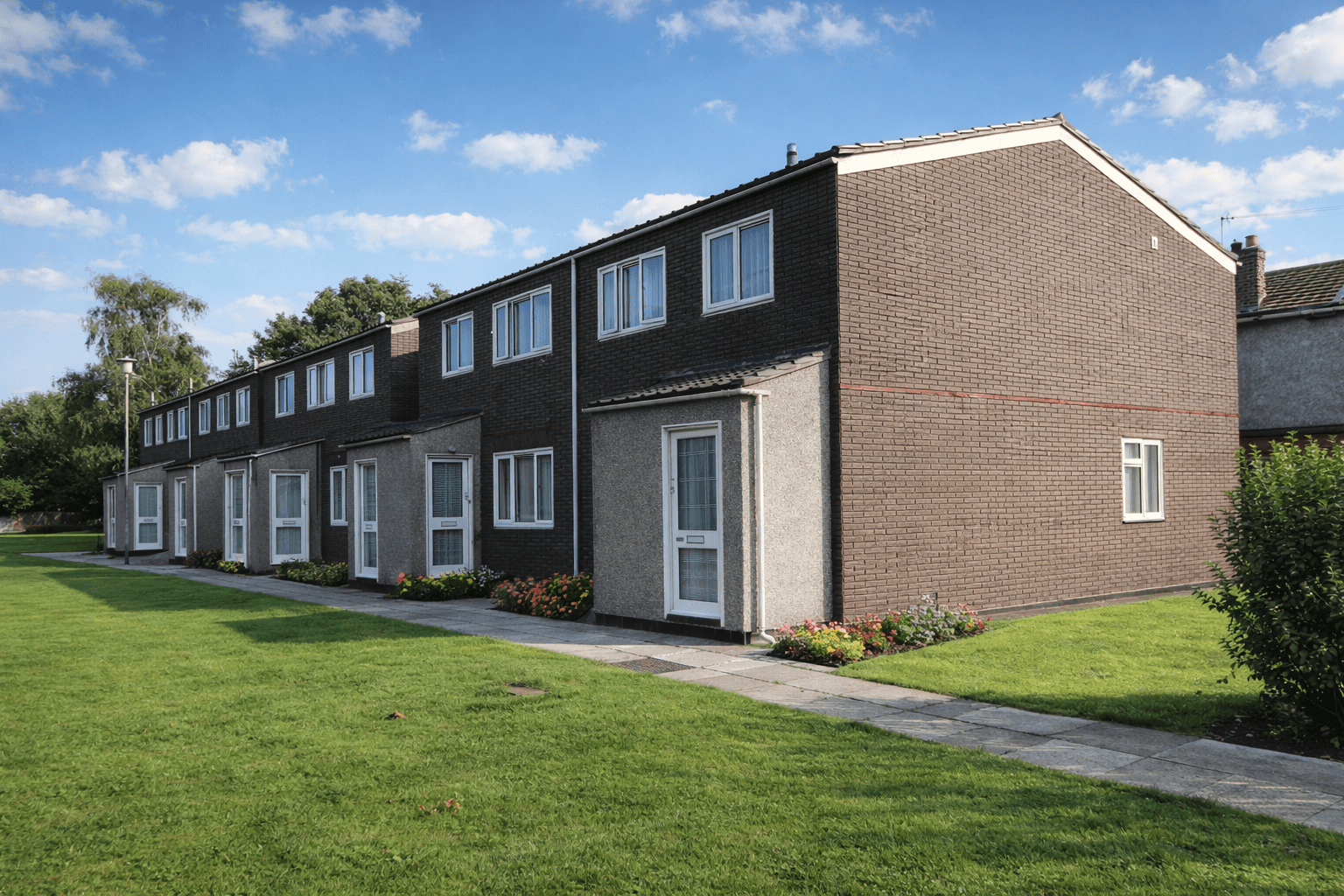
Bates 4L houses are two-storey terraced dwellings constructed using a system-built reinforced concrete frame. Identification is usually based on the shallow pitch gable roof and the variety of concrete-based external wall finishes.
External walls may be finished with Coloroc PC or pressed concrete cladding panels. Some examples are rendered, either fully or to first-floor level, with horizontal timber boarding or horizontal shiplap plastic weatherboarding above. Asbestos cement slates are also found to upper elevations on certain variants.
| Element | Typical construction | Inspection focus |
|---|---|---|
| Substructure | Concrete pads and concrete underbuilding with DPC | Settlement, cracking, condition of ground beams |
| External walls | PRC panels with PC cladding, render, or asbestos cement slates | Reinforcement cover, cracking, panel condition |
| Separating walls | Storey-height PRC panel cavity walls | Movement, soundness, junction detailing |
| Floors | Precast concrete slabs bolted or welded to PRC panels | Cracking, movement, adequacy of fixings |
| Roof | Timber trusses and purlins with concrete tiles | Condition of trusses, connections, tile covering |
Potential hazards & inspection priorities
The most significant risks associated with Bates 4L houses relate to the durability of the reinforced concrete elements. Inadequate cover to reinforcement within PRC panels and ground beams can allow corrosion to develop, which may lead to cracking, spalling, and loss of structural capacity.
Poor detailing at truss-to-wall and floor beam-to-wall connections is a known issue. Over time, this can contribute to localised movement or instability if not properly addressed or monitored.
Asbestos-containing materials are commonly present, particularly in external wall finishes such as asbestos cement slates. These materials do not present a risk if left undisturbed but require careful management and professional assessment.
Is this house right for you?
A Bates 4L house may be suitable for purchasers who understand non-traditional construction and are prepared to base decisions on the specific condition of the individual property.
- Commission a detailed building survey
- Pay close attention to reinforced concrete condition
- Factor in potential management of asbestos-containing materials
Condition, maintenance history, and evidence of previous repairs are particularly important considerations with this form of construction.
Mortgage & resale considerations
Mortgage and resale acceptance for Bates 4L houses can vary depending on lender criteria, the property’s condition, and the quality of professional reporting. Non-traditional construction is often assessed on a case-by-case basis.
Clear evidence of condition, appropriate repairs, and the absence of unresolved structural concerns are commonly influential factors.
What a survey can — and cannot — tell you
A building survey provides an informed assessment of the visible condition and construction of a Bates 4L house. Inspections are non-intrusive and limited to areas that are accessible at the time of inspection.
- Identify visible cracking to PRC panels, ground beams, and associated finishes
- Assess signs of dampness, moisture ingress, and condensation risk
- Comment on roof coverings, drainage details, and external envelope condition
- Review the general condition of accessible floors, ceilings, and structural elements
- Highlight defects that may require repair, monitoring, or further investigation
However, there are limitations to what a survey can determine without intrusive investigation.
- Confirm the condition of concealed reinforcement within PRC elements
- Assess hidden structural elements behind finishes or linings
- Determine the full extent of internal concrete deterioration
- Inspect areas that are inaccessible or covered at the time of inspection
Where higher-risk indicators are identified, further specialist or intrusive investigation may be recommended.
For a thorough building survey in Greater London, an instant quotation can be obtained through the online survey calculator.
Considering a Bates 4L house?
A detailed building survey can help clarify construction-specific risks before committing to a purchase.
Get your instant survey quoteDisclaimer: This article is provided for general educational purposes only and is based on industry research, professional knowledge, and experience. It does not relate to any specific property and should not be relied upon when making a purchasing decision. Prospective purchasers should always commission an independent RICS-qualified surveyor to conduct a full inspection and provide a report on the actual condition of any property of interest.
