


Overview
The Arrowhead house, also known as Prowting, RFC, or Rigid Frame Construction, is a non-traditional residential property type developed in the UK during the mid-1960s. Manufactured by Rigid Frame Construction Ltd, these system-built homes were constructed between 1963 and 1970, with approximately 1,000 units completed.
Arrowhead houses were produced in response to post-war housing demand and were designed for rapid, cost-effective construction. They are most commonly found in suburban settings and were built in a range of formats including bungalows, two-storey semi-detached houses, and terraced properties.
Arrowhead houses were constructed using a steel rigid frame system with prefabricated wall panels. Their design and materials reflect mid-20th century system-building methods, which require informed inspection and ongoing management.
Typical characteristics & construction
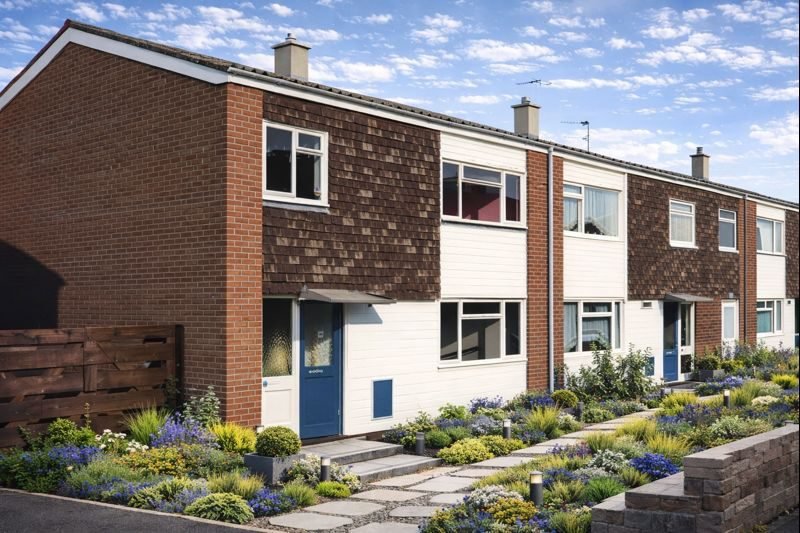
Arrowhead houses are identifiable by their shallow pitch gable or monopitch roofs and flat canopy over the front entrance. External wall finishes vary and can include brickwork, exposed aggregate panels, Tyrolean finish panels, or mathematical tiling, with asbestos cement sheets frequently present at upper levels or gable apexes.
Internally, the ground floor is generally concrete, with first floors formed using tongue-and-groove boarding on timber joists. Internal and separating walls are commonly formed from composite panels incorporating compressed fibre and flat asbestos cement sheets.
| Element | Typical construction | Inspection focus |
|---|---|---|
| Substructure | Concrete pads and slab with perimeter thickening | Settlement, cracking, damp proof course integrity |
| Frame | Steel rigid frame with metal web stanchions | Corrosion, protective coating condition |
| External walls | Panel infill with brick, tile hanging, or asbestos cement sheets | Panel condition, fixings, moisture ingress |
| Floors | Concrete ground floor; timber first floor | Notching to joists, deflection, dampness |
| Roof | Timber rafters with felt and concrete tiles or flat felt roof | Tile condition, felt deterioration, verge details |
Potential hazards & inspection priorities
The primary inspection concerns in Arrowhead houses relate to the steel frame, asbestos-containing materials, and roof and wall detailing. Superficial corrosion to metal web stanchions is commonly encountered and requires monitoring and, where necessary, remedial treatment.
Asbestos cement sheets are frequently present within external walls, roof elements, and internal partitions. These materials do not present an immediate hazard if undisturbed, but their presence has implications for maintenance and alteration.
Defects such as broken or missing tile hanging, poorly constructed blockwork at gable verges, and excessive notching to floor joists can lead to water ingress and structural weakening if left unmanaged.
Is this house right for you?
An Arrowhead house can be suitable for occupation, provided its condition is clearly understood. These properties benefit from informed ownership and proactive maintenance rather than assumption that construction mirrors traditional masonry housing.
- Confirm the condition of the steel frame and protective coatings
- Understand the extent and location of asbestos-containing materials
- Assess roof coverings, verges, and panel junctions carefully
Mortgage & resale considerations
Mortgage acceptance for Arrowhead houses can vary depending on lender criteria, clarity of construction identification, and the results of professional inspection. Clear reporting on frame condition, corrosion management, and asbestos presence is often influential.
Documented maintenance and evidence of appropriate repairs can assist in addressing lender and purchaser concerns.
What a survey can — and cannot — tell you
A building survey provides an informed assessment of the visible condition and construction of an Arrowhead house. Inspections are non-intrusive and limited to areas that are accessible at the time of inspection.
- Identify visible corrosion to steel stanchions and frame elements
- Assess roof coverings, wall panels, and moisture-related defects
- Comment on floor structures, internal partitions, and ceilings
- Highlight the presence and condition of asbestos-containing materials
- Advise on defects requiring repair, monitoring, or further investigation
However, there are limitations to what a survey can determine without intrusive investigation.
- Confirm the condition of concealed steelwork within wall panels
- Assess hidden corrosion behind finishes or linings
- Determine the full condition of inaccessible roof or floor voids
- Inspect areas covered or not visible at the time of inspection
Where higher-risk indicators are identified, further specialist or intrusive investigation may be recommended.
For a thorough building survey in Greater London, an instant quotation can be obtained through the online survey calculator.
Considering a Arrowhead house?
A detailed building survey can help clarify construction-specific risks before committing to a purchase.
Get your instant survey quoteDisclaimer: This article is provided for general educational purposes only and is based on industry research, professional knowledge, and experience. It does not relate to any specific property and should not be relied upon when making a purchasing decision. Prospective purchasers should always commission an independent RICS-qualified surveyor to conduct a full inspection and provide a report on the actual condition of any property of interest.
