


Overview
The Arcon Temporary Bungalow, often referred to as the Arcon Mk V or simply a prefab, is a form of post-World War II prefabricated housing developed as an emergency response to acute housing shortages. Manufactured by Taylor Woodrow (Arcon) Ltd and designed by Arcon, these properties were erected from 1945 onwards and were intended as short-term accommodation.
Around 40,000 Arcon bungalows were constructed, predominantly in urban and suburban areas where bomb damage and population displacement were most severe. Despite their original temporary designation, many remain in residential use today.
Arcon Temporary Bungalows were steel-framed, single-storey dwellings designed for rapid assembly using factory-produced components. Their continued survival is largely attributable to the robustness of the primary frame and ongoing maintenance over time.
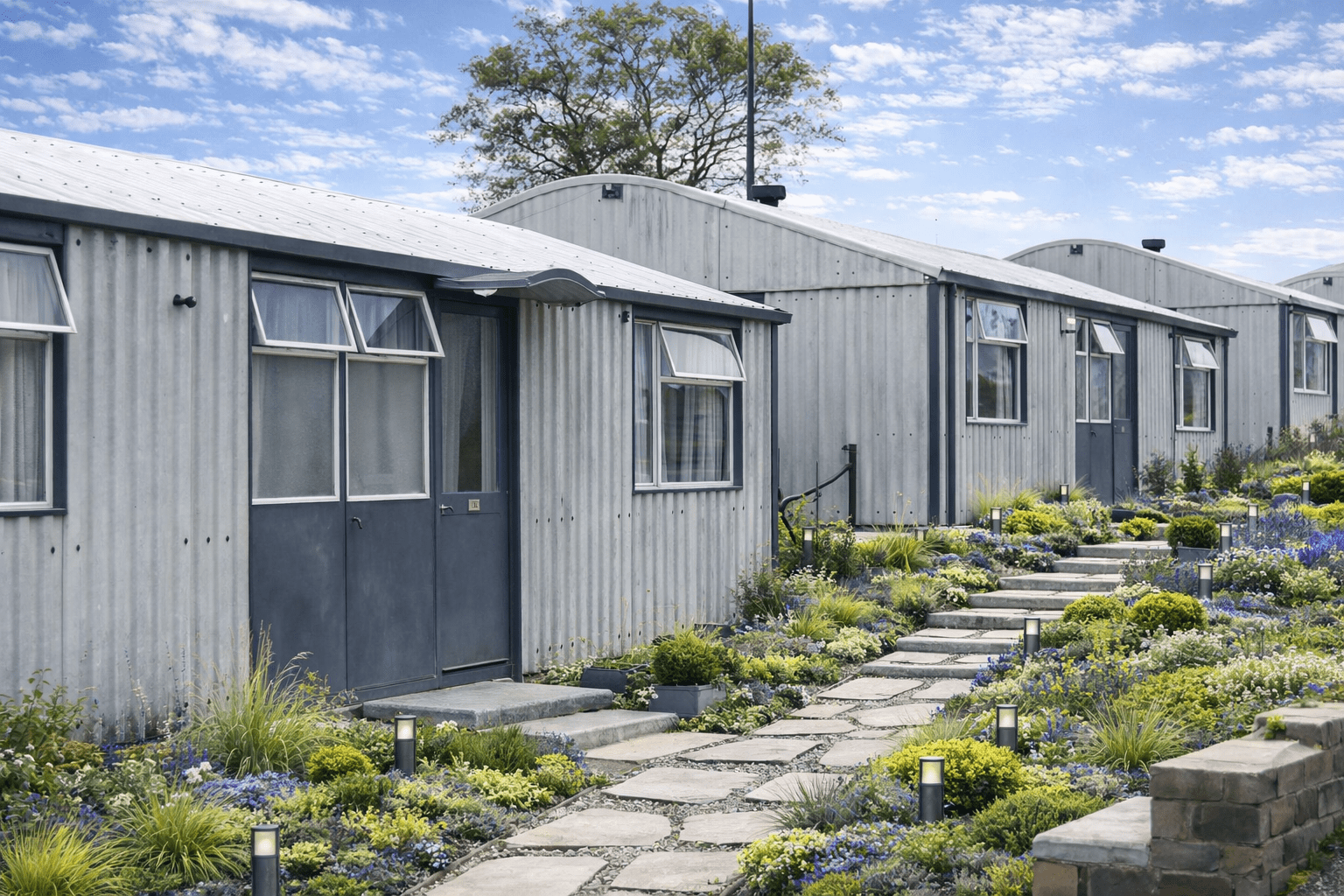
Typical characteristics & construction
Arcon Temporary Bungalows are detached, single-storey dwellings constructed around a steel frame. The design uses a concrete slab foundation with a thickened perimeter kerb and incorporates a damp-proof course intended to limit rising moisture.
Externally, walls are formed from double-skin vertically profiled asbestos cement sheets with a cavity infilled using woodwool insulation and lined internally with plasterboard fixed to a timber framework. Roofs are shallow pitched with corrugated asbestos cement sheeting and a distinctive curved ridge detail.
| Element | Typical construction | Inspection focus |
|---|---|---|
| Substructure | Concrete slab with thickened perimeter kerb and DPC | Cracking, moisture ingress, perimeter movement |
| Frame | Steel stanchions, beams, and tubular roof trusses | Corrosion, section loss, previous repairs |
| External walls | Double-skin profiled asbestos cement with woodwool infill | Asbestos condition, fixings, moisture penetration |
| Roof | Corrugated asbestos cement on steel purlins | Sheet condition, fixings, leaks, moss growth |
| Floors | T&G boarding on timber battens over concrete | Dampness, timber decay, unevenness |
Potential hazards & inspection priorities
The most significant risk associated with Arcon Temporary Bungalows is the extensive use of asbestos cement in both wall and roof construction. While asbestos cement is relatively stable when intact, deterioration, cracking, or inappropriate alteration materially increases health risk.
Steel frame corrosion is a secondary but important consideration. Localised corrosion can occur where moisture has been trapped within wall build-ups or at floor junctions, particularly where maintenance has been limited.
Is this house right for you?
An Arcon Temporary Bungalow may be suitable where purchasers understand non-traditional construction and are prepared to assess condition on its merits rather than relying on age or appearance.
- Commission a full building survey by a surveyor familiar with prefab construction
- Ensure asbestos materials are identified and managed appropriately
- Budget for ongoing maintenance and potential upgrading of insulation
Mortgage & resale considerations
Mortgage availability for Arcon Temporary Bungalows varies and is influenced by condition, professional reporting, and lender policy. Clear evidence of maintenance, controlled asbestos risk, and absence of significant corrosion are commonly influential factors.
What a survey can — and cannot — tell you
A building survey provides an informed assessment of the visible condition and construction of an Arcon Temporary Bungalow. Inspections are non-intrusive and limited to areas that are accessible at the time of inspection.
- Identify visible deterioration to asbestos cement walls and roof sheets
- Assess signs of dampness, moisture ingress, and condensation risk
- Comment on the condition of the steel frame where accessible
- Review floors, ceilings, and internal linings for defect or movement
- Highlight defects requiring repair, monitoring, or further investigation
However, there are limitations to what a survey can determine without intrusive investigation.
- Confirm the internal condition of concealed steel elements
- Inspect asbestos materials hidden behind linings or finishes
- Assess areas that are inaccessible at the time of inspection
Where higher-risk indicators are identified, further specialist or intrusive investigation may be recommended.
For a thorough building survey in Greater London, an instant quotation can be obtained through the online survey calculator.
Considering an Arcon Temporary Bungalow?
A detailed building survey can help clarify construction-specific risks before committing to a purchase.
Get your instant survey quoteDisclaimer: This article is provided for general educational purposes only and is based on industry research, professional knowledge, and experience. It does not relate to any specific property and should not be relied upon when making a purchasing decision. Prospective purchasers should always commission an independent RICS-qualified surveyor to conduct a full inspection and provide a report on the actual condition of any property of interest.
