


Overview
The Arbor House is a distinctive non-traditional property type found across parts of the UK. Recognised for its timber frame construction and varied external finishes, it reflects mid-20th century efforts to combine efficient building methods with conventional domestic appearance.
Understanding how these houses were built, and where their weaknesses tend to arise, is essential for anyone considering purchase or further investigation.
Arbor Houses were manufactured by E Appleyard Ltd and were built predominantly between 1965 and 1975. Around 1,000 units were constructed, often appearing under alternative names including Appleyard, Lexington, Lexington Super, and New England.
Typical characteristics & construction
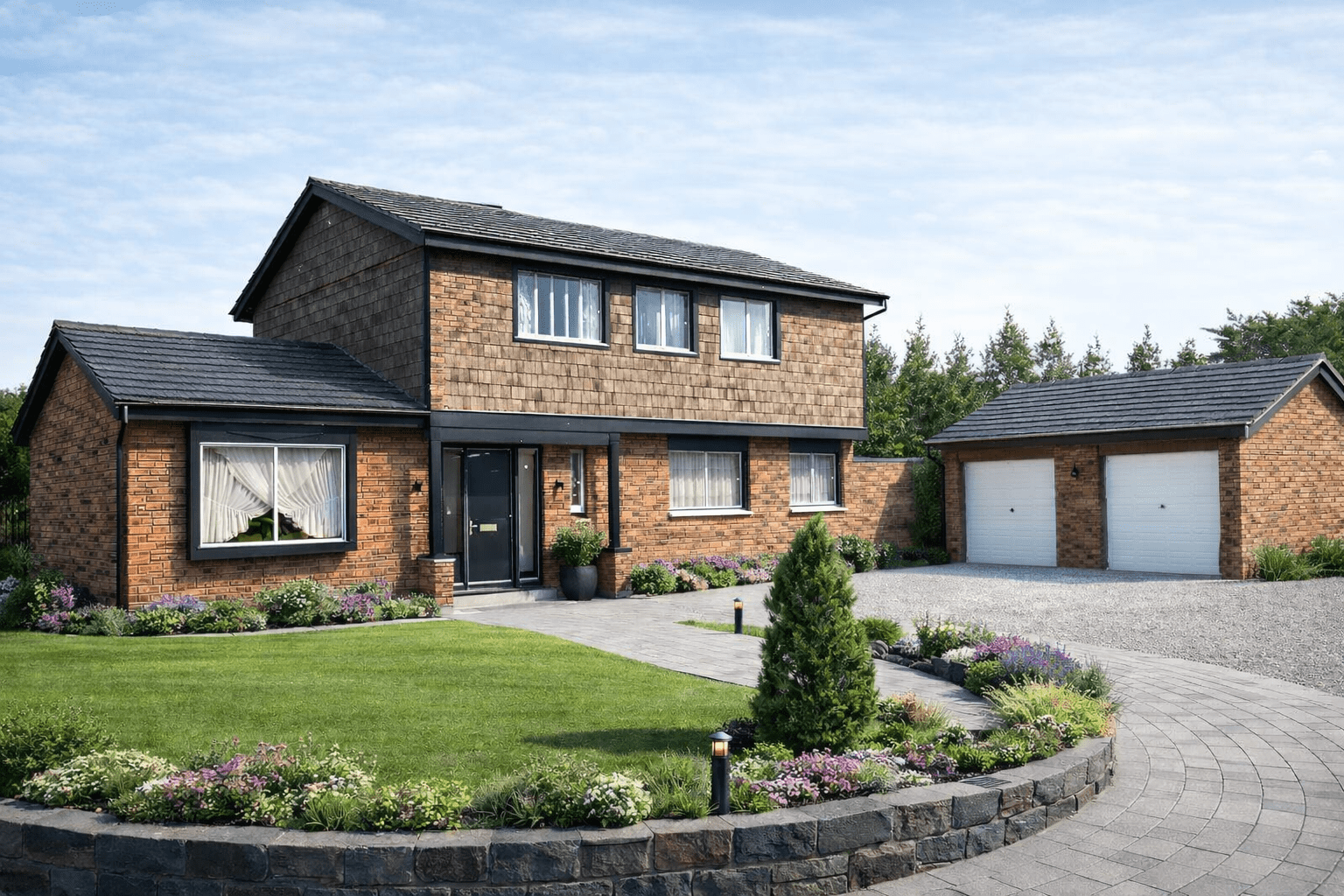
Arbor Houses are typically constructed as bungalows or two-storey detached dwellings. The design commonly incorporates a medium-pitched gable roof finished with interlocking concrete tiles.
External wall finishes vary and may include rendered masonry, facing brickwork, horizontal plastic weatherboarding, tile hanging, or shingles, sometimes used in combination. Some examples incorporate single-storey pitched roof extensions projecting from the gable wall.
Internally, layouts are conventional for their era, with timber stud partitions lined with plasterboard and ceilings similarly finished.
| Element | Typical construction | Inspection focus |
|---|---|---|
| Substructure | RC perimeter beams and concrete slab with DPC | Cracking, movement, damp proof course integrity |
| External walls | Platform timber frame with plywood sheathing and applied cladding | Moisture ingress, timber decay, cladding condition |
| Floors | Chipboard on polystyrene on concrete (ground floor); timber boarding on joists (first floor) | Moisture damage, deflection, localised decay |
| Roof | Timber trusses with bituminous felt and concrete tiles | Tile condition, felt failure, ventilation |
Potential hazards & inspection priorities
The primary inspection concern with Arbor Houses is moisture management. Timber frame elements are vulnerable where detailing has failed or where rainwater goods, cladding junctions, or roof coverings allow prolonged water penetration.
Another recognised risk relates to asbestos-containing materials, which were widely used during the period of construction. These may be present in certain boards, linings, or ancillary components and require careful management.
Is this house right for you?
Arbor Houses can provide practical family accommodation, but they demand an informed approach. Condition varies widely depending on maintenance history, alterations, and exposure.
- Accept that timber frame condition is critical
- Budget for ongoing maintenance of external finishes
- Ensure construction is clearly understood before committing
Mortgage & resale considerations
Mortgage acceptance for Arbor Houses depends on condition, clarity of survey reporting, and lender-specific policy on non-traditional construction. Outcomes can vary.
Clear evidence of maintenance, absence of active timber decay, and well-documented construction details are often influential in lending and resale decisions.
What a survey can — and cannot — tell you
A building survey provides an informed assessment of the visible condition and construction of an Arbor House. Inspections are non-intrusive and limited to areas that are accessible at the time of inspection.
- Identify visible signs of timber decay or moisture damage
- Assess external cladding, roof coverings, and rainwater goods
- Comment on internal finishes, floors, and ceilings
- Highlight defects requiring repair, monitoring, or further investigation
However, there are limitations to what a survey can determine without intrusive investigation.
- Confirm the concealed condition of timber framing
- Inspect hidden areas behind finishes or linings
- Determine the full extent of concealed moisture ingress
- Assess areas that are inaccessible at the time of inspection
Where higher-risk indicators are identified, further specialist or intrusive investigation may be recommended.
For a thorough building survey in Greater London, an instant quotation can be obtained through the online survey calculator.
Considering a Arbor House?
A detailed building survey can help clarify construction-specific risks before committing to a purchase.
Get your instant survey quoteDisclaimer: This article is provided for general educational purposes only and is based on industry research, professional knowledge, and experience. It does not relate to any specific property and should not be relied upon when making a purchasing decision. Prospective purchasers should always commission an independent RICS-qualified surveyor to conduct a full inspection and provide a report on the actual condition of any property of interest.
