


Overview
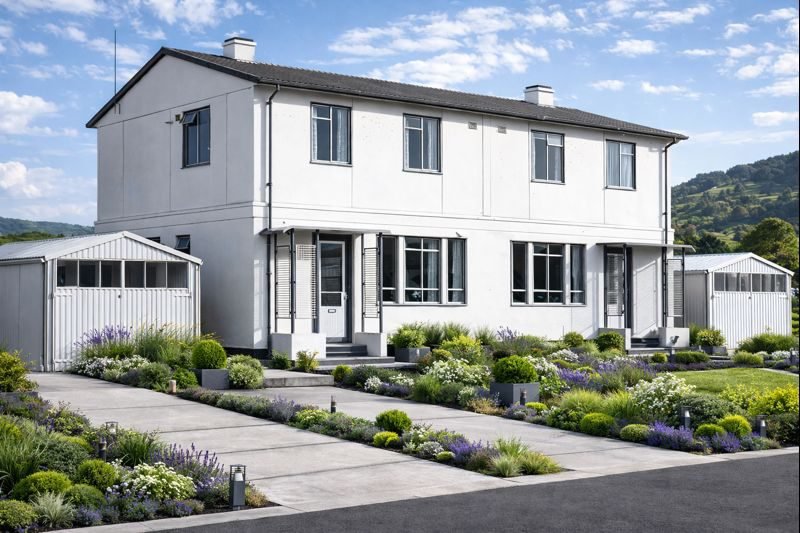
The Aluminium House is a rare form of non-traditional housing developed in the early post-war period. Constructed in 1950, it reflects a short-lived but highly innovative response to the severe housing shortages faced in the UK following the Second World War.
Aluminium Houses were manufactured by A W Hawksley Ltd, with the design credited to the Bristol Aeroplane Company. Only two examples are known to have been built, making this one of the rarest post-war housing types.
Typical characteristics & construction
Aluminium Houses are two-storey semi-detached dwellings constructed using a metal frame system set over a brick underbuilding. The design reflects aeronautical manufacturing principles adapted for rapid housebuilding.
External walls are formed from storey-height metal sheets, joined with vertical cover moulds. A projecting string course is present at first-floor level, creating a distinctive horizontal feature.
Roofs are shallow pitched and finished with profiled metal sheeting. Internal construction details are less well documented, although layouts were designed to be functional and efficient rather than flexible.
| Element | Typical construction | Inspection focus |
|---|---|---|
| Substructure | Brick underbuilding | Cracking, settlement, general stability |
| Frame | Metal structural frame | Corrosion, distortion, connection integrity |
| External walls | Storey-height metal sheets with cover moulds | Corrosion, joint condition, weather tightness |
| Roof | Shallow pitch with profiled metal sheeting | Fixings, corrosion, water ingress |
Potential hazards & inspection priorities
The primary risk associated with Aluminium Houses is corrosion of the metal frame and external wall panels. Prolonged exposure to moisture can lead to deterioration that is not always immediately visible.
Thermal performance is another concern. Metal construction, combined with limited original insulation, increases the likelihood of heat loss, condensation, and associated internal moisture issues.
Is this house right for you?
An Aluminium House will appeal to purchasers who understand non-traditional construction and are prepared to manage ongoing maintenance of metal components.
- Commission a full building survey
- Review evidence of corrosion protection or repairs
- Accept that energy performance may fall below modern standards
Particular caution is advised where there is limited access to inspect concealed sections of the frame.
Mortgage & resale considerations
Mortgage and resale acceptance for Aluminium Houses can be limited due to their rarity and non-traditional construction. Decisions are usually influenced by condition, clarity of survey reporting, and evidence of maintenance.
Clear documentation and the absence of active corrosion issues are commonly important factors.
What a survey can — and cannot — tell you
A building survey provides an informed assessment of the visible condition and construction of an Aluminium House. Inspections are non-intrusive and limited to areas that are accessible at the time of inspection.
- Identify visible corrosion to metal frames and wall panels
- Assess signs of dampness, moisture ingress, and condensation risk
- Comment on roof coverings, fixings, and external envelope condition
- Review the general condition of accessible floors, ceilings, and structural elements
- Highlight defects that may require repair, monitoring, or further investigation
However, there are limitations to what a survey can determine without intrusive investigation.
- Confirm the condition of concealed metal frame components
- Assess hidden fixings or joints behind linings
- Determine the full extent of internal corrosion within closed sections
- Inspect areas that are inaccessible or covered at the time of inspection
Where higher-risk indicators are identified, further specialist or intrusive investigation may be recommended.
For a thorough building survey in Greater London, an instant quotation can be obtained through the online survey calculator.
Considering an Aluminium House?
A detailed building survey can help clarify construction-specific risks before committing to a purchase.
Get your instant survey quoteDisclaimer: This article is provided for general educational purposes only and is based on industry research, professional knowledge, and experience. It does not relate to any specific property and should not be relied upon when making a purchasing decision. Prospective purchasers should always commission an independent RICS-qualified surveyor to conduct a full inspection and provide a report on the actual condition of any property of interest.
