


Overview
The Cameron House is a distinctive non-traditional property type developed in the early 1970s as part of the UK’s post-war housing programme. Manufactured by Donald Cameron Ltd, these houses were constructed between 1970 and 1973, with approximately 200 units built.
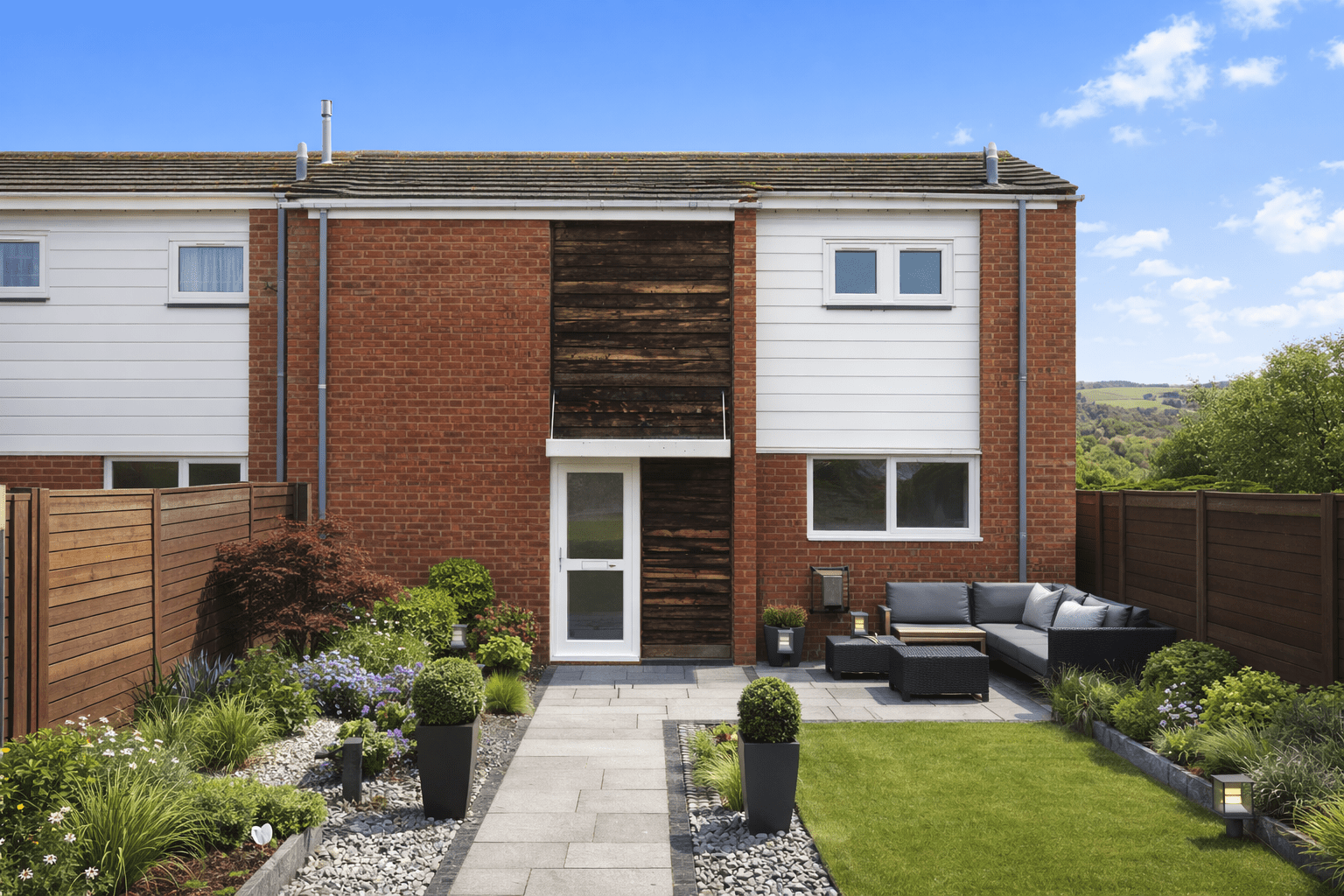
They are also referred to as CDC or Donald Cameron houses and are most commonly found in urban and suburban locations. The form is typically two or three storeys arranged in terraces, with shallow pitch gable roofs and a mix of brickwork and lightweight upper storey cladding.
Cameron Houses were designed to provide cost-effective family accommodation using platform timber frame construction and prefabricated wall panels, allowing for rapid assembly during a period of housing shortage.
Typical characteristics & construction
Cameron Houses are generally arranged as two- or three-storey terraced dwellings. The defining feature is the use of platform timber frame construction formed from storey-height panels.
Externally, the ground floor is normally finished in brickwork, with the upper storeys clad in horizontal timber boarding or coated fibreboard. Shallow pitch gable roofs are covered with concrete tiles, and a flat roof canopy is commonly present above the entrance door.
| Element | Typical construction | Inspection focus |
|---|---|---|
| Substructure | Concrete slab footings with brick under-building and DPC | Settlement, damp-proof course continuity, moisture ingress |
| External walls | Platform timber frame with bituminous fibreboard and building paper; brick to lower storey, lightweight cladding above | Decay, moisture penetration, condition of cladding and membranes |
| Separating walls | 4½ inch blockwork | Fire separation, cracking, sound insulation performance |
| Floors | Concrete ground floor; plywood on timber joists to upper floors | Sagging, deflection, vibration |
| Roof | Timber trusses with bituminous felt and concrete tiles | Felt condition, tile integrity, insulation at ceiling level |
Potential hazards & inspection priorities
The most frequently encountered concern in Cameron Houses is sagging or deflection of the upper floors. This was evident in a number of examples inspected historically and reflects the limitations of the original timber joist design when compared with modern standards.
Localised decay to building paper and horizontal timber cladding is also common, particularly where maintenance has been deferred or moisture exposure has been prolonged. Corrosion of foil-backed plasterboard linings has been reported and should not be overlooked.
A significant fire safety issue associated with this house type is the absence of fire stopping within the external wall cavity at separating walls. This increases the risk of fire spread and warrants careful inspection and, where necessary, remedial works.
Is this house right for you?
Cameron Houses can provide practical family accommodation, but purchasers need to be comfortable with non-traditional construction and the ongoing management it can require.
- Upper floor performance should be carefully assessed
- External cladding condition and detailing require close scrutiny
- Fire safety provisions should be clearly understood
Mortgage & resale considerations
Lender attitudes to Cameron Houses can vary depending on condition, detailing, and the quality of professional reporting. Clear identification of construction type and known risks is essential.
Properties with documented maintenance, resolved defects, and no unresolved fire or structural concerns are generally viewed more favourably.
What a survey can — and cannot — tell you
A building survey provides an informed assessment of the visible condition and construction of a Cameron House. Inspections are non-intrusive and limited to areas that are accessible at the time of inspection.
- Identify visible floor deflection, cracking, and distortion
- Assess signs of dampness, moisture ingress, and condensation risk
- Comment on external cladding, roof coverings, and drainage details
- Review the general condition of accessible structural elements
- Highlight defects requiring repair, monitoring, or further investigation
However, there are limitations to what a survey can determine without intrusive investigation.
- Confirm the condition of concealed timber frame elements
- Assess hidden wall cavities and fire stopping provisions
- Determine the full extent of concealed decay or corrosion
- Inspect areas that are inaccessible or covered at the time of inspection
Where higher-risk indicators are identified, further specialist or intrusive investigation may be recommended.
For a thorough building survey in Greater London, an instant quotation can be obtained through the online survey calculator.
Considering a Cameron House?
A detailed building survey can help clarify construction-specific risks before committing to a purchase.
Get your instant survey quoteDisclaimer: This article is provided for general educational purposes only and is based on industry research, professional knowledge, and experience. It does not relate to any specific property and should not be relied upon when making a purchasing decision. Prospective purchasers should always commission an independent RICS-qualified surveyor to conduct a full inspection and provide a report on the actual condition of any property of interest.
