


Overview
The Calverley Type II house is a system-built form of non-traditional housing constructed in the late 1960s as part of wider post-war efforts to address housing shortages. Built between 1966 and 1970, only around 200 examples were produced, making this a relatively uncommon property type.
These dwellings are most often found in suburban estates developed during periods of rapid expansion, where speed of construction and standardisation were key drivers.
Calverley Type II houses were manufactured by Calverley Ltd and designed by J L Heap. Variants may also be referred to as Calverley Modular, Calverley Modular Type I, CM, CM Yuill, CMX, or Yuill.
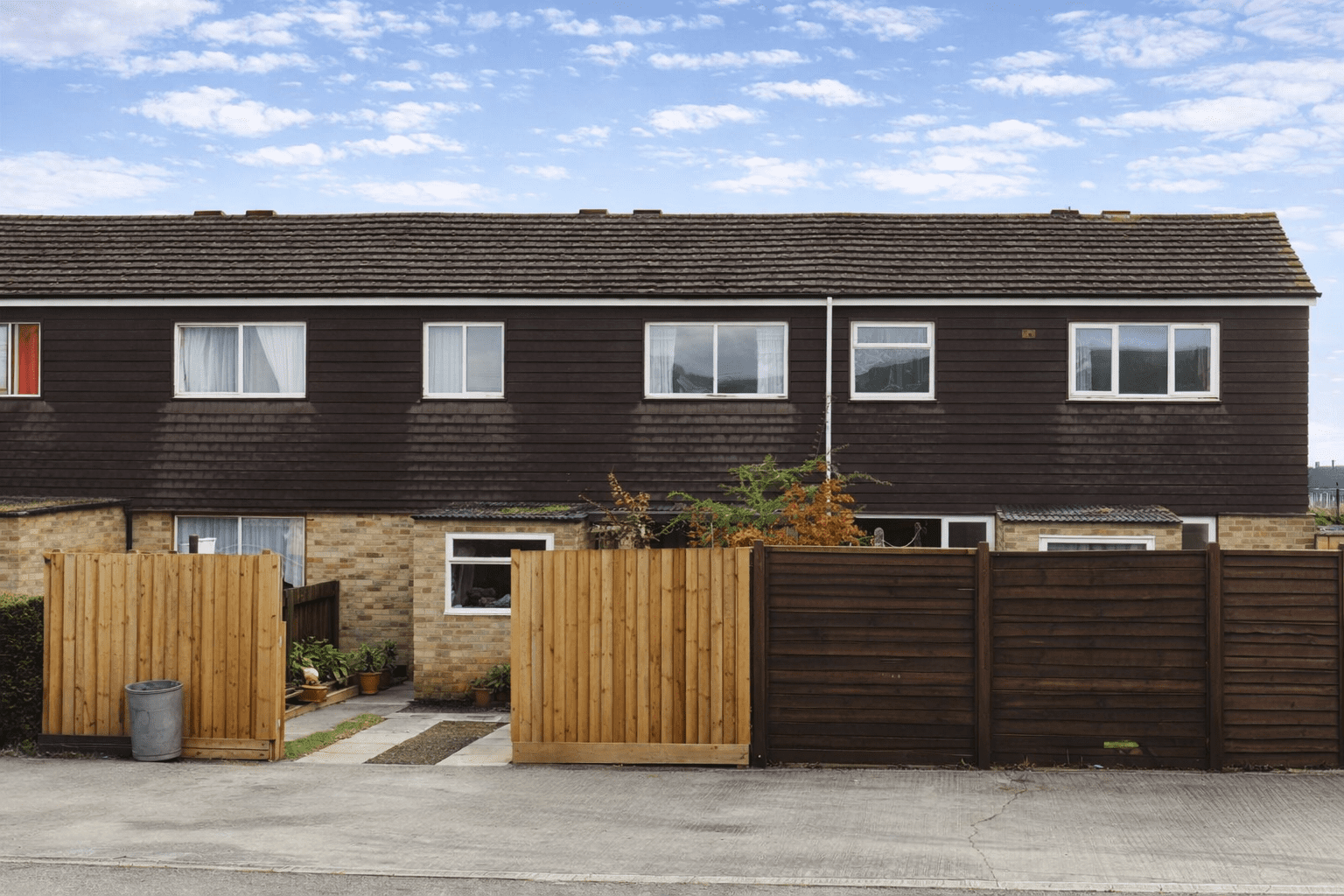
Typical characteristics & construction
Calverley Type II houses were constructed as bungalows and two-storey semi-detached or terraced dwellings. Roofs are generally medium-pitch gable forms finished with tiles.
Externally, walls are typically faced with brickwork up to first floor level, with tile hanging or vertical timber boarding above. Some properties incorporate single-storey brick extensions to the rear.
The structural system is based on platform timber frame construction using storey-height panels. These panels are sheathed externally with plywood, overlaid with bituminous felt, and then clad separately.
| Element | Typical construction | Inspection focus |
|---|---|---|
| Substructure | Concrete slab foundation with damp-proof course | Movement, cracking, DPC continuity |
| External walls | Timber frame panels with brick and tile hanging | Fixings, moisture damage, decay |
| Floors | Concrete ground floor, plywood on timber joists above | Deflection, dampness, deterioration |
| Roof | Timber trusses with felt and tiled covering | Leaks, felt condition, detailing |
Potential hazards & inspection priorities
The most significant issues associated with Calverley Type II houses relate to the interface between the timber frame and external cladding. Inadequate fixings between brickwork and timber frame panels have been identified as a recurring concern.
Localised decay to sole plates and plywood sheathing is also common, particularly where moisture has been present for prolonged periods. This was evident during inspection of comparable properties of this type.
Additional risks include rain penetration at window flashings, gaps in separating walls within roof spaces, and interstitial condensation within wall build-ups.
Is this house right for you?
A Calverley Type II house may be suitable where purchasers are prepared to assess condition carefully and understand the implications of system-built timber frame construction.
- Commission a full building survey
- Check for evidence of moisture management and past repairs
- Review any alterations affecting the external envelope
Mortgage & resale considerations
Lender attitudes to non-traditional housing vary and are often influenced by construction clarity and documented condition. Calverley Type II houses are not designated defective under the Defective Premises Act, but acceptance remains case-specific.
Clear survey reporting and evidence of maintained structural integrity are key considerations.
What a survey can — and cannot — tell you
A building survey provides an informed assessment of the visible condition and construction of a Calverley Type II house. Inspections are non-intrusive and limited to areas that are accessible at the time of inspection.
- Identify visible decay to timber frame elements and plywood sheathing
- Assess signs of dampness, moisture ingress, and condensation risk
- Comment on roof coverings, flashings, and external envelope condition
- Review the general condition of accessible floors, ceilings, and partitions
- Highlight defects requiring repair, monitoring, or further investigation
However, there are limitations to what a survey can determine without intrusive investigation.
- Confirm the condition of concealed timber elements
- Assess hidden fixings behind brickwork or cladding
- Determine the full extent of interstitial condensation risk
- Inspect areas that are inaccessible or covered at the time of inspection
Where higher-risk indicators are identified, further specialist or intrusive investigation may be recommended.
For a thorough building survey in Greater London, an instant quotation can be obtained through the online survey calculator.
Considering a Calverley Type II house?
A detailed building survey can help clarify construction-specific risks before committing to a purchase.
Get your instant survey quoteDisclaimer: This article is provided for general educational purposes only and is based on industry research, professional knowledge, and experience. It does not relate to any specific property and should not be relied upon when making a purchasing decision. Prospective purchasers should always commission an independent RICS-qualified surveyor to conduct a full inspection and provide a report on the actual condition of any property of interest.
