


Overview
The Birmingham Corporation Type ST house is a post-war experimental housing form developed in 1945 in response to severe housing shortages following the Second World War. Constructed in limited numbers, with approximately 68 properties completed, these houses are predominantly found in Birmingham, an area heavily affected by wartime bombing.
The design was produced by Birmingham Corporation in collaboration with Hills Patent Glazing Co. Ltd and is sometimes referred to as the Birmingham Corporation Postwar or Experimental house, reflecting its non-traditional construction approach.
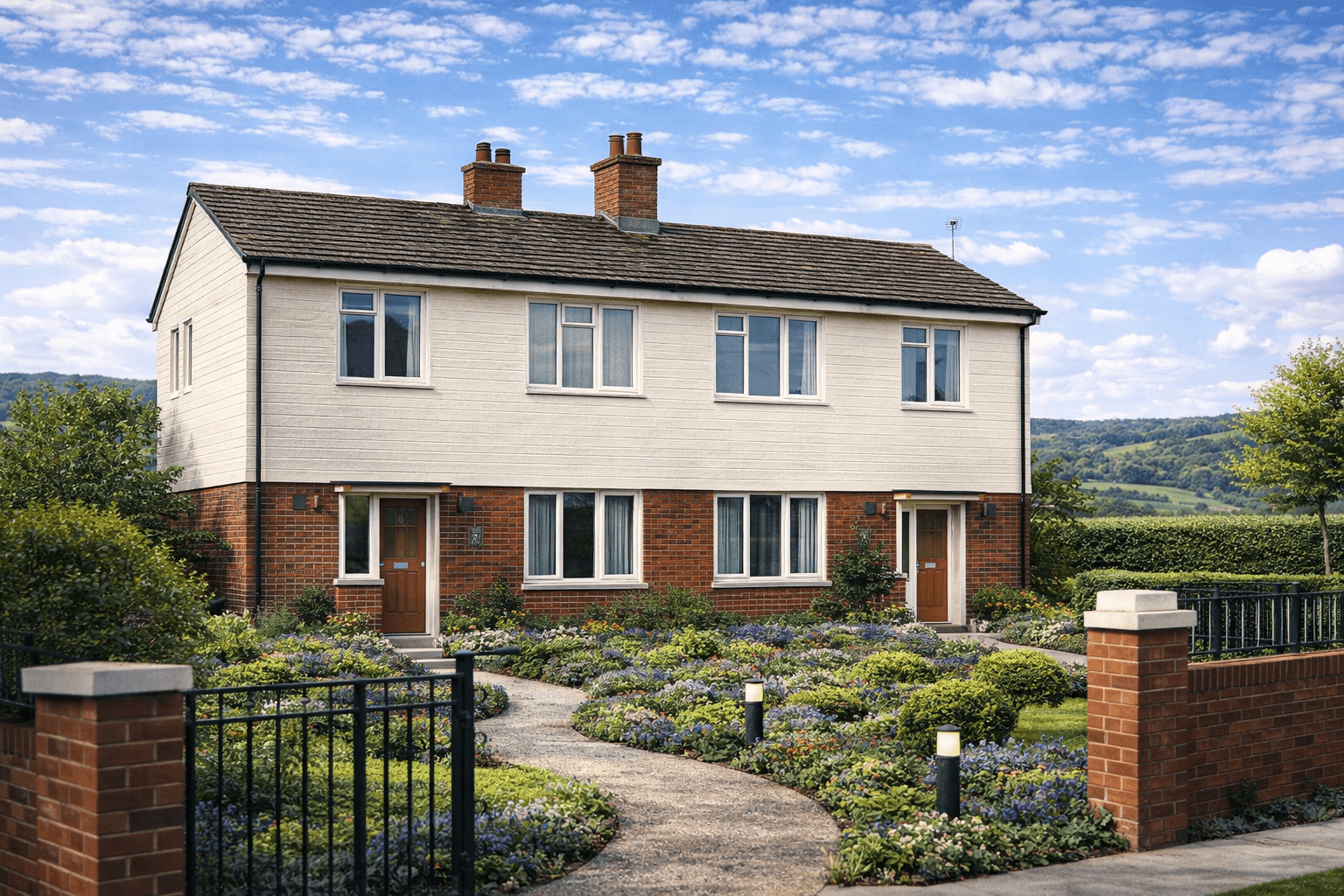
Birmingham Corporation Type ST houses are two-storey semi-detached or terraced dwellings of steel-framed construction with extensive use of asbestos cement cladding, making them readily identifiable but technically complex to assess.
Typical characteristics & construction
Birmingham Corporation Type ST houses are generally arranged as two-storey semi-detached or terraced properties beneath a medium-pitched gable roof finished with interlocking concrete tiles. Pressed steel door and window surrounds are a consistent external feature.
Externally, walls are clad with vertically profiled asbestos cement sheets up to first-floor window head level, with flat asbestos cement sheets above. A projecting brick plinth capped with an asbestos cement sill runs around the base of the building, and an asbestos cement canopy supported on tubular steel is commonly present over the front entrance.
| Element | Typical construction | Inspection focus |
|---|---|---|
| Substructure | Concrete strip footings with brick-faced concrete underbuilding | Damp-proof course condition, signs of settlement or moisture ingress |
| Frame | Steel lattice stanchions, floor joists, and roof trusses | Corrosion, protective coating condition |
| External walls | Asbestos cement sheets with timber infill and plasterboard lining | Panel condition, fixings, asbestos integrity |
| Floors | Timber boarding or quarry tiles on breeze concrete (ground floor); timber boarding on bearers (first floor) | Deflection, moisture, localised decay |
| Roof | Timber battens with concrete tiles | Tile condition, weather tightness |
Potential hazards & inspection priorities
The most significant hazard associated with this house type is the extensive use of asbestos cement products. These materials are present in wall cladding, flashings, plinth cappings, and entrance canopies. While asbestos cement is generally lower risk when intact, deterioration or disturbance during works presents a clear health concern.
Steel frame corrosion is another primary inspection priority. The original protective coating applied to the steel frame is not documented, and corrosion can develop where moisture is able to reach structural members, particularly around fixings and junctions.
Damp and moisture ingress may arise where the damp-proof course has failed or where detailing around cladding and openings has deteriorated. Original insulation levels are limited, and thermal performance does not align with modern expectations.
Is this house right for you?
Birmingham Corporation Type ST houses require purchasers to understand the implications of non-traditional construction and asbestos-containing materials. Condition varies significantly between properties depending on maintenance history and past alterations.
- Commission a full building survey by a surveyor experienced in non-traditional housing
- Review any asbestos surveys or remediation records
- Consider ongoing maintenance and monitoring requirements
Mortgage & resale considerations
Mortgage acceptance for Birmingham Corporation Type ST houses can vary between lenders and may depend on condition, documented repairs, and the clarity of professional reporting. Asbestos presence and steel frame condition are often central considerations.
Clear survey advice and evidence of appropriate management of known risks are commonly influential in mortgage and resale decisions.
What a survey can — and cannot — tell you
A building survey provides an informed assessment of the visible condition and construction of a Birmingham Corporation Type ST house. Inspections are non-intrusive and limited to areas that are accessible at the time of inspection.
- Identify visible deterioration to asbestos cement cladding and associated details
- Assess signs of dampness, moisture ingress, and condensation risk
- Comment on roof coverings, drainage, and external envelope condition
- Review the general condition of accessible floors, walls, and structural elements
- Highlight defects requiring repair, monitoring, or further investigation
However, there are limitations to what a survey can determine without intrusive investigation.
- Confirm the condition of concealed steel frame members
- Assess hidden structural elements behind finishes or linings
- Determine the internal condition of asbestos cement panels
- Inspect areas that are inaccessible or covered at the time of inspection
Where higher-risk indicators are identified, further specialist or intrusive investigation may be recommended.
For a thorough building survey in Greater London, an instant quotation can be obtained through the online survey calculator.
Considering a Birmingham Corporation Type ST house?
A detailed building survey can help clarify construction-specific risks before committing to a purchase.
Get your instant survey quoteDisclaimer: This article is provided for general educational purposes only and is based on industry research, professional knowledge, and experience. It does not relate to any specific property and should not be relied upon when making a purchasing decision. Prospective purchasers should always commission an independent RICS-qualified surveyor to conduct a full inspection and provide a report on the actual condition of any property of interest.
